


Persian Oud: History, Sound, and Cultural Significance in Iranian Music

- maryam jafary
- 8 December 2025
- Traditional Persian Music
- 4 minutes
The oud is one of the most ancient and renowned instruments in Persian music, as well as in the broader Middle Eastern region. Known for its rich, resonant sound, it has been a cornerstone of classical music in both Persian and the surrounding areas, from the Middle Ages to the present day. This article explores the historical origins, components, and famous figures associated with this iconic instrument, offering a deeper understanding of its cultural significance.
Historical Roots and Earliest Evidence of the Oud
The Ancient Origins of the Oud
The oud, one of the oldest string instruments in the world, has origins that stretch back to ancient civilizations. The earliest evidence of the oud comes from a seal found in ancient Mesopotamia, which depicts a figure playing a stringed instrument. This artifact, now preserved in the British Museum, is one of the first historical references to the oud. However, some scholars believe this depiction may not necessarily represent the oud, as the image only shows the neck of the instrument, with other features not clearly visible.
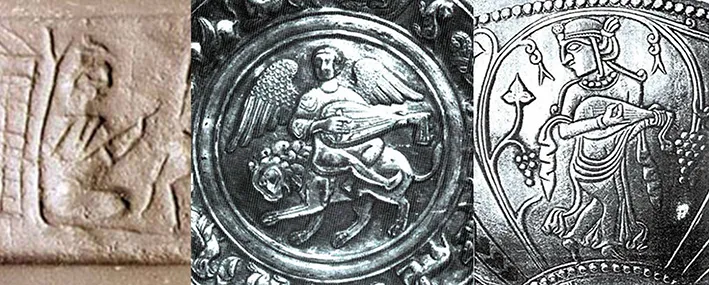
An image on the left of something or other from Mesopotamia, 3500–3200 BCE.
While the British Museum, which holds the artifact, would like to claim this is the
earliest depiction of an oud, this vague outline of a figure could just as well be
holding a fishing rod or a clothes hanger. Middle and right are two very clear
oud players on a metal cup in the Sassanid era of Persian, CE 224–651.
The Sassanid Era and the Oud
A more detailed understanding of the oud’s history comes from the Sassanid era in Persian, where the instrument appears frequently in art and literature. The Sassanids depicted musicians playing the oud in bas-reliefs and metalwork, suggesting its importance at the royal court. These ancient representations provide a clearer picture of the oud’s form compared to earlier Mesopotamian depictions. It is clear that the oud played a significant role in the music of the time, serving as an essential instrument in Persian court music.
Components of the Oud and Its Differences from Similar Instruments
The Structure and Sound Characteristics of the Oud
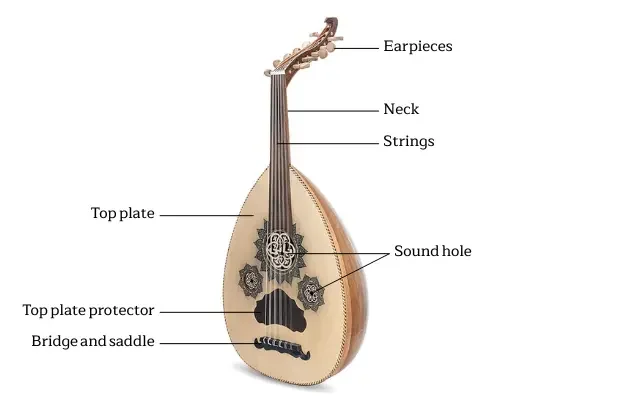
The oud’s structure makes it distinct from other stringed instruments. It features a large, bowl-shaped body, often crafted from high-quality woods like walnut or sycamore. This large body gives the oud its deep, resonant sound, which is further enhanced by a sound hole located in the center of the instrument. Unlike other stringed instruments, the oud’s larger size produces a richer tone and deeper resonance. This contributes to its distinctive sound, making it unique in classical music.
The Neck and Strings of the Oud
The oud’s neck typically uses sturdy wood, while its strings consist of either metal or nylon. The number of strings varies, but the instrument usually has between 10 and 11 strings, arranged in pairs and connected to pegs. Musicians tighten the strings along the neck, using a bridge to adjust the instrument’s pitch. The oud’s setup, including the bridge and string arrangement, allows for precise tuning and sound production, making it a versatile instrument for both solo performances and ensemble settings.
What Makes the Oud Different from Other String Instruments
One of the key differences between the oud and other stringed instruments like the guitar or lute is its shape and size. The oud’s larger body produces a deeper sound compared to the smaller-bodied guitar. Additionally, the oud typically has fewer strings, which contributes to its distinctive resonance and tonal quality. While the lute shares similarities with the oud, it has a more flattened body and a longer neck, and the oud’s sound is generally richer and more resonant due to its larger size and curved body.
Contemporary Persian Oud Masters
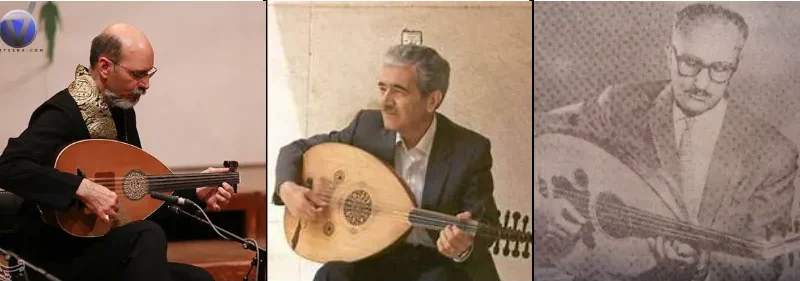
Today, musicians like Mansour Nariman, Mahmoud Rahmanipour, and Akbar Mohseni are known for their ability to merge the oud with modern Persian styles. Pirbudi, for instance, is celebrated for his innovative approach to oud playing, blending traditional techniques with contemporary Persian music. This fusion has brought new life to the oud, allowing it to resonate with younger generations while maintaining its rich cultural heritage.
The Origin of the Name “Barbat” and Its Connection to the Oud
The Persian Barbat and Its Evolution into the Oud
The Persian term “barbat,” used historically for the oud, has fascinating roots. According to the medieval Persian scholar Khwarazmi, the name “barbat” was a metaphor for the breast of a duck, referencing the curved shape of the oud’s body. This vivid imagery highlights the unique form of the instrument, which made it stand out among other stringed instruments of the time.
However, the Arabic term “oud,” meaning “wood,” also refers to the material from which the instrument is crafted. It’s likely that the term “oud” became more widely adopted in Arabic-speaking regions due to the instrument’s prominent role in Arab classical music.
The Role of Barbad in Persian Music
The connection between the oud and the legendary musician Barbad is central to understanding the instrument’s significance in Persian culture. Barbad, who lived during the reign of King Khosrow Parviz, is considered one of the greatest oud players in Persian history. He not only perfected the art of oud playing but also played a key role in the development of music in the Sassanid court. Some scholars even suggest that the name “barbat” may have been derived from his name, honouring his contribution to Persian music. Barbad’s legacy continues to influence oud players and musicians in Persian and beyond.
Conclusion
The Persian oud is more than just a musical instrument; it is a cultural symbol with a rich history that spans millennia. From its ancient roots in Mesopotamia and the Sassanid era to its role in modern Persian music, the oud has left an indelible mark on the musical landscape of the Middle East. Whether you’re a seasoned musician or a newcomer eager to explore its enchanting sound, the oud offers a unique and soulful experience.
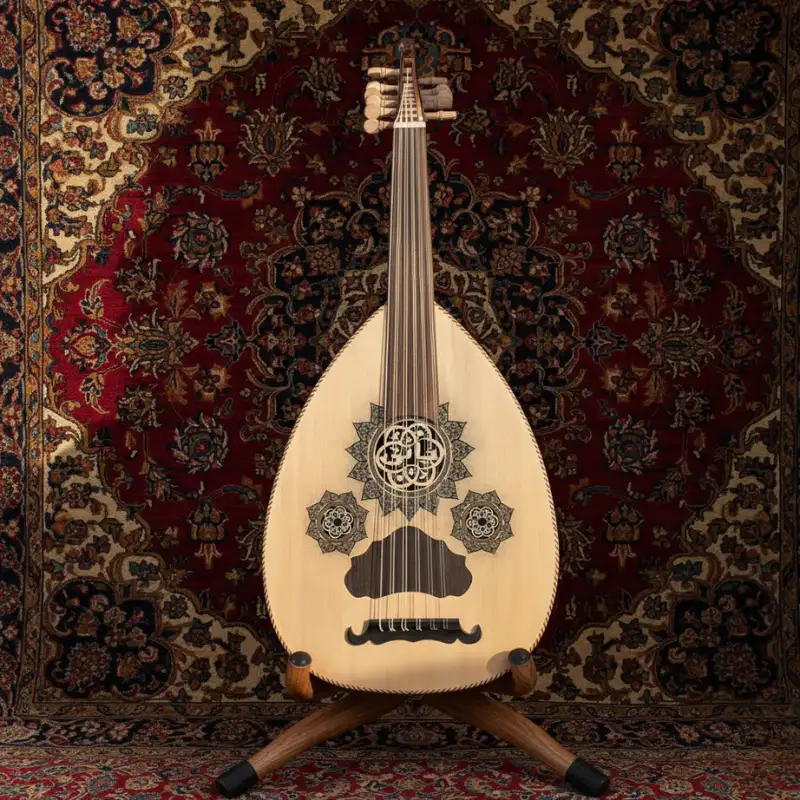
At Persis Collection, we take pride in offering the finest selection of authentic Persian ouds, crafted with precision and care. With our guaranteed worldwide delivery, you can bring the timeless sound of the oud into your home or studio, no matter where you are. Browse our collection today and join the legacy of oud players who continue to keep this beautiful instrument alive in music and culture.


Comments