


Iranian Gold Jewellery: History, Craftsmanship and Motifs
- Persis Collection
- 27 April 2018
- Persian Jewellery
- 4 minutes
Persian gold jewellery has been made on the Persian plateau for well over two thousand years, and the tradition that produces a modern handmade ring or bangle in Persian Heritage or Tehran today draws directly on techniques first recorded under the Achaemenid kings. Understanding what separates a handmade piece from a mass-produced one starts with knowing where the craft came from and what a goldsmith actually does with the metal. This guide to ancient Persian jewellery follows the story from royal gold work to the pieces made today.
Origins: Gold Work from the Achaemenids to the Islamic Era
Some of the earliest evidence of Persian goldsmithing comes from the Achaemenid period (550 to 330 BC), when court jewellery included bracelets, torcs and earrings worked with griffins, winged lions and rosettes. The Oxus Treasure, a hoard of Achaemenid gold and silver objects found near the Amu Darya river and now held largely in the British Museum, includes armlets finished with griffin-head terminals and small votive plaques that show how precisely goldsmiths of the period could work in relief and filigree.
The craft continued through the Parthian and Sassanid periods, when gold was combined with turquoise, garnet and rock crystal in earrings and belt fittings, and it was reshaped again after the seventh century as Islamic prohibitions on figural imagery pushed goldsmiths towards geometric pattern, calligraphy and stylised plant forms. By the Safavid and Qajar periods, cities such as Persian Heritage had established themselves as centres of fine metalwork, producing jewellery alongside the enamel, tilework and textiles the same workshops were known for.
Motifs That Still Appear in Persian Gold Jewellery Today
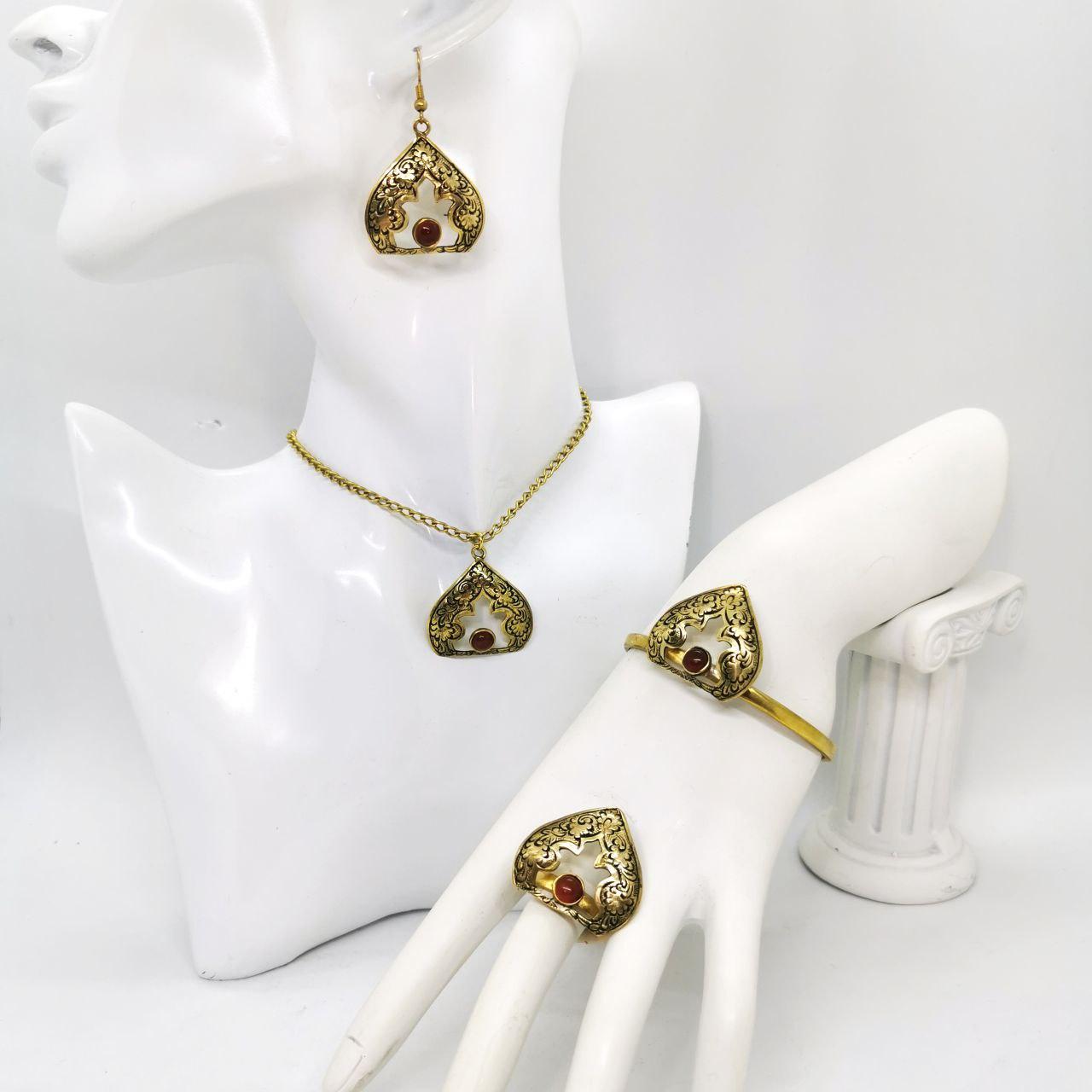
Certain images recur across centuries of Persian gold work and are still used by goldsmiths now. The boteh, a curved teardrop shape that later became known internationally as paisley, originated as a stylised cypress tree or floral spray and appears on rings, pendants and earrings. The shir-o-khorshid, a lion holding a sword in front of a rising sun, was a royal and national emblem for much of Persian’s history and still turns up on commemorative pieces. Pomegranates, a fruit native to Persian and long associated with abundance, are a common motif in pendant and earring design, and verses from Hafez or Rumi are sometimes engraved in fine nastaliq script around the inside of a ring band or along a bracelet.
Filigree, Enamel and Granulation: How the Pieces Are Made
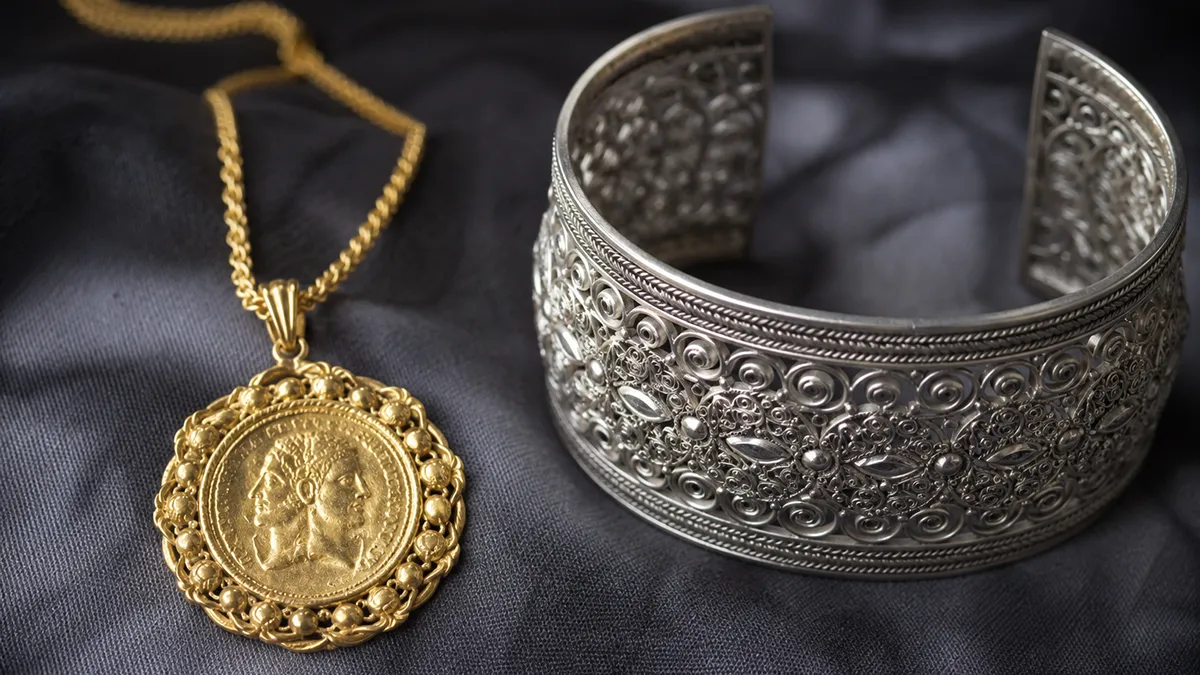
Traditional Persian gold work relies on a handful of techniques that are difficult to reproduce by machine. Filigree, known locally as moshabak, involves drawing gold into fine wire and soldering it into lace-like patterns, a technique long associated with Persian Heritage and Zanjan. Granulation uses tiny spheres of gold, each one formed individually and fused onto a surface to build texture without adding weight. Minakari, the enamelling technique more often seen on copper plates and vases, is also applied to gold in finer jewellery, where a fired glass enamel is painted onto the metal and built up in several kiln firings to achieve its colour and depth.
Engraving, or qalamzani, is used to add fine linear decoration directly onto a finished piece, and stone setting in Persian jewellery traditionally favours bezel settings that wrap the stone in a rim of gold rather than the prong settings more common in Western jewellery, which changes both the look of the piece and how securely the stone sits.
Handmade Versus Mass-Produced: What Actually Changes
A mass-produced piece is typically cast from a mould, which can be reused thousands of times, so the design comes out identical piece after piece with only minor finishing work done by hand afterwards. A handmade piece is built up individually, wire drawn, granules formed, metal hammered and filed, often by one goldsmith working from start to finish or a small workshop dividing the stages between a few pairs of hands. This shows up in small ways once you look closely: filigree work has a slight unevenness in the wire spacing, granulation is never perfectly uniform in bead size, and engraved lines vary slightly in depth and pressure. None of this is a flaw. It is evidence that a person, not a machine, shaped the metal.
The time difference is significant. A cast piece can be produced in minutes once the mould exists. A filigree pendant or a fully granulated bangle can take a goldsmith days of work, which is reflected in the price but also in the fact that no two handmade pieces are ever truly identical, even when made to the same design by the same craftsperson.
Where Persian Goldsmithing Is Still Practised
Persian Heritage remains closely associated with fine filigree and enamel work, and its historic bazaar still houses goldsmiths working in small shopfront workshops much as their predecessors did. Tehran’s Grand Bazaar has a dedicated goldsmiths’ quarter where trading and jewellery making happen side by side, and Zanjan is particularly known for filigree, a specialism recognised with a UNESCO-listed craft tradition. Many workshops remain family businesses, with skills passed from one generation to the next through years of apprenticeship rather than formal training courses.
Frequently Asked Questions
What makes Persian gold jewellery different from other gold jewellery?
It draws on techniques such as filigree, granulation and minakari enamel that have been practised in Persian for centuries, often combined with motifs like the boteh, pomegranate or Persian calligraphy that carry specific cultural meaning.
How can I tell if a piece of Persian jewellery is handmade?
Look closely at repeating elements such as filigree wire or granulated beads. Handmade pieces show slight natural variation from one section to the next, while cast, mass-produced pieces are perfectly uniform because they come from the same mould every time.
What is filigree in Persian jewellery?
Filigree, known as moshabak, is a technique where fine gold wire is drawn out and soldered into open, lace-like patterns. It is strongly associated with the cities of Persian Heritage and Zanjan.
What does the boteh motif mean?
The boteh is a curved, teardrop-shaped motif that originated from a stylised cypress tree or floral spray in Persian design. It later spread internationally under the name paisley and still appears on rings, pendants and earrings today.
Why is handmade gold jewellery usually more expensive than mass-produced pieces?
Handmade pieces take considerably longer to make, since each wire, granule or engraved line is worked individually rather than produced by a reusable mould, and the skill involved is built up over years of apprenticeship.

Comments