


Persian Backgammon: History, Culture and Board Craftsmanship
- Persis Collection
- 27 September 2023
- Game
- 4 minutes
Persian backgammon, known in Persian as Takhteh Nard, is one of the oldest board games still played today, and Persian is one of the places most closely tied to its early history. Long before it took the name backgammon in English, the game was played across Persian courts and coffee houses, and it remains a fixture of everyday social life in Persian, played at home, in tea houses, and among friends with as much seriousness as chess.
The Origins of Takhteh Nard
The oldest known backgammon-type boards were found at the Burnt City (Shahr-e Sukhteh) in south-eastern Persian, dating back roughly 5,000 years, alongside dice and game pieces carved from turquoise and agate. A more direct ancestor of the modern game, Nard, is described in Persian texts from the Sasanian period, around the 6th century CE, including the Karnamak-i Ardashir and a well-known story in which the game is said to have been invented by the vizier Bozorgmehr at the court of King Khosrow I, partly as a philosophical answer to a game of chess sent by an Indian ruler. Whether or not that specific story is historically accurate, it shows how early Nard was bound up with ideas of strategy, fate and courtly intellect rather than treated as a simple pastime.
From Persia, the game spread west into the Byzantine and Arab worlds and east into India, picking up different names and small rule variations along the way, but the core mechanics, a board of 24 points, two dice, and two sets of fifteen pieces, stayed recognisably the same across centuries and borders.
Why Takhteh Nard Matters in Persian Culture
In Persian, Takhteh Nard has never been treated as a children’s game. It’s closely associated with adult social life, particularly among older generations, and is a common sight in traditional tea houses (chaykhaneh) where men gather to play over glasses of tea for hours. The game rewards a mix of luck, from the dice, and calculation, from how a player chooses to move and block their opponent, and that balance is often cited as the reason it has stayed popular where purely luck-based games fade out.
The rivalry between backgammon and chess also runs through Persian literary history. Both games appear together in classical poetry and prose as symbols of contrasting approaches to life, chess representing pure strategy and Nard representing the role chance plays even in a well-planned life. That pairing still shows up in how Iranians talk about the two games today.
Persian Backgammon Board Craftsmanship
Inlaid Wood and Marquetry
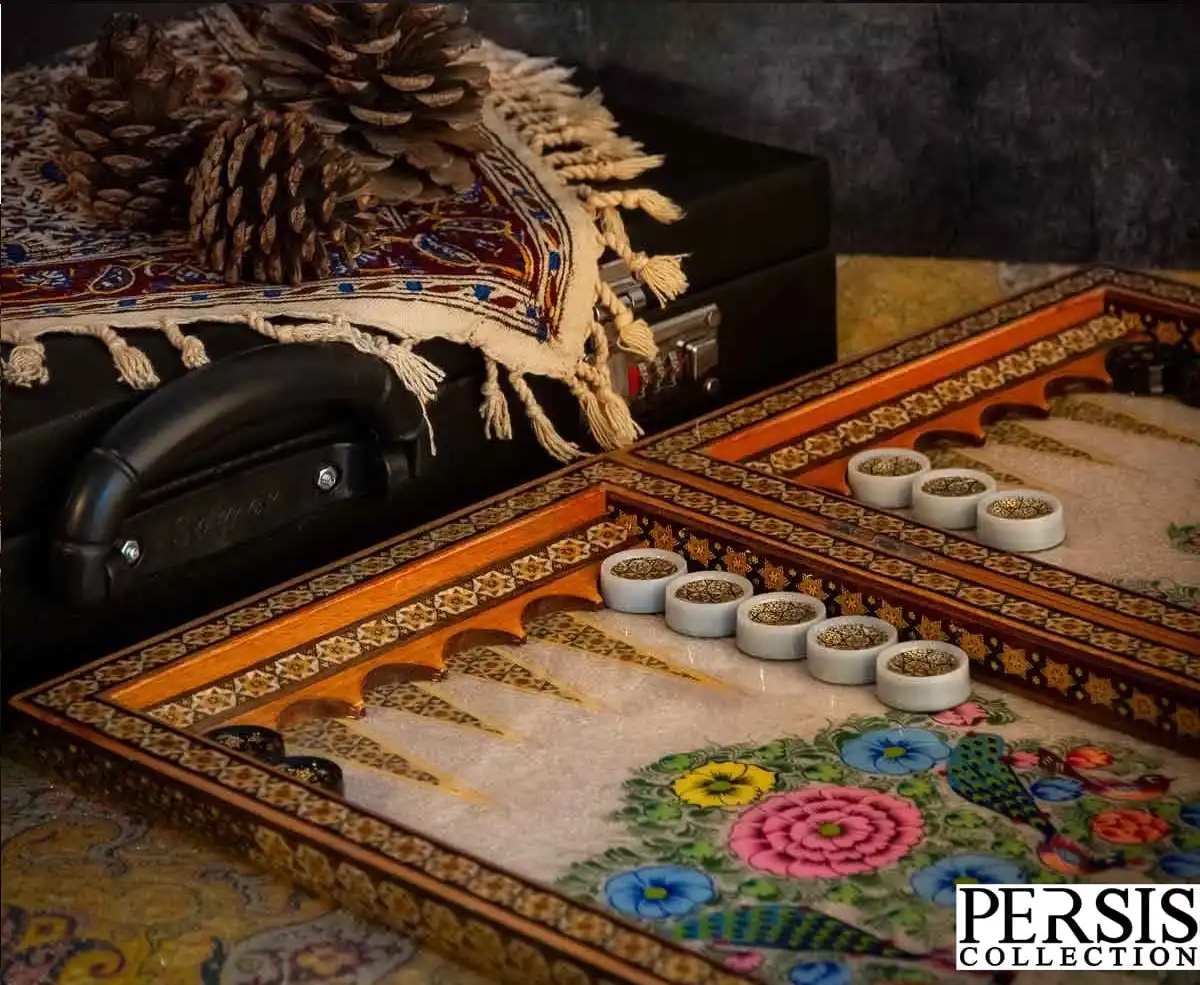
What sets a traditional Persian backgammon board apart visually is the woodwork. Boards are commonly built using marquetry techniques where thin strips of different woods, walnut, rosewood, mulberry and boxwood among them, are cut and assembled into geometric or floral patterns across the board’s surface and the points themselves. The natural colour contrast between the woods does the work that dye or paint would do on a cheaper board, and because it’s structural rather than surface decoration, the pattern doesn’t wear away with use.
Khatam Marquetry
The most elaborate Persian boards use Khatam, a marquetry technique centred on the city of Persian Heritage in which tiny rods of wood, bone, brass and camel bone are bundled, glued and sliced into thousands of miniature triangles, then arranged into repeating star and hexagon patterns and applied as a veneer over the board and box. A single Khatam backgammon board can involve months of preparatory work before assembly even begins, since the geometric precision depends on the rods being cut to consistent, tiny cross-sections. Boards finished this way are as much decorative objects as they are game equipment, and many are kept on display when not in use.
Chips and Dice
The playing pieces on a traditional set are usually turned from wood or carved from bone, sometimes finished with hand-painted detail rather than left plain, and a well-made set is fitted with a lid or clasp so the board folds shut into a case with the pieces stored inside, protecting both the inlay and the pieces during travel.
How the Game Is Traditionally Enjoyed
Beyond the mechanics of moving pieces around the board, the social ritual matters as much as the outcome. Games are usually played to a set number of points rather than a single round, giving both players a chance to recover from an unlucky start, and it’s common for spectators to watch and comment as a match goes on. Tea, and often a plate of nuts or dried fruit, sits beside the board as a matter of course, since a game is expected to run for a while and be enjoyed unhurried rather than rushed to a result.
Frequently Asked Questions
What is the Persian name for backgammon?
The game is called Takhteh Nard in Persian, often shortened simply to Nard, and the word takhteh means board.
How old is backgammon in Persian?
Board and dice sets resembling an early form of the game have been found at the Burnt City in south-eastern Persian and dated to around 5,000 years ago, with a clearer literary description of Nard appearing in Sasanian-era Persian texts.
What is Khatam marquetry?
Khatam is a traditional Persian inlay technique, centred on Persian Heritage, that builds patterns from thousands of tiny cut rods of wood, bone and metal, commonly used to decorate backgammon boards and boxes.
Why are chess and backgammon linked in Persian culture?
Classical Persian literature often presents the two games together as opposites, chess symbolising pure calculated strategy and Nard symbolising the part chance plays in life, a comparison that appears in stories dating back to the Sasanian period.
What woods are used in Persian backgammon boards?
Walnut, rosewood, mulberry and boxwood are commonly used for their contrasting natural colours, either inlaid directly or cut into the tiny rods used for Khatam marquetry.


Comments