


Persian Store Guide: Authentic Iranian Products
- Persis Collection
- 11 June 2025
- Iranian Art
- 4 minutes
Finding a genuinely authentic Persian product online means looking past generic listings and understanding what actually separates handcrafted Persian work from mass-produced imitations. Persis Collection sources handpicked pieces across jewellery, rugs, ceramics and textiles, and this guide covers what to look for in each category so a purchase reflects real craftsmanship rather than a vague description of “Persian style”. This guide to Persian products is written by Persis Collection, a Persian online store based in London.
What Actually Makes a Persian Product Authentic
Authenticity comes down to technique and origin rather than appearance alone. A printed pattern that resembles a Persian motif is not the same as a piece made using the actual technique associated with that motif, whether that’s hand-knotting a rug, hand-painting a glaze, or hammering silver by hand. A genuinely authentic piece will usually show small, natural irregularities. No two hand-knotted rugs are identical, and no two pieces of hand-painted pottery come out of the kiln looking exactly alike. If every item in a range looks perfectly uniform, it was almost certainly produced by machine rather than by hand.
Jewellery: Turquoise, Silver and Poetic Motifs
Persian jewellery draws on several recognisable traditions. Turquoise, historically mined near Neyshabur in north-eastern Persian, has been used in Persian jewellery for centuries and remains one of the most identifiable materials in the category. Silversmithing techniques passed down through workshops in cities such as Persian Heritage produce engraved rings, bangles and pendants, sometimes carrying calligraphic inscriptions, often lines of poetry from Hafez or Rumi rendered in Nastaliq script. When buying jewellery, it’s worth checking whether the stone is genuine turquoise rather than a dyed imitation, and whether any engraving is hand done, since laser-etched text tends to look noticeably more uniform than a hand-carved line.
Rugs and Kilims: Reading Origin, Knot and Pattern
Persian rugs vary enormously depending on where they’re woven. Qashqai kilims, made by nomadic and semi-nomadic weavers in Fars province, tend to use bold geometric patterns and are typically flat-woven rather than knotted. Rugs from Tabriz and Nain, by contrast, are prized for high knot density and finely detailed medallion or floral designs, often taking months to complete on a single loom. Knowing the region a rug comes from helps explain both its pattern and its price, since a densely knotted city rug from Nain will usually cost more than a comparably sized nomadic kilim, reflecting the number of hours involved rather than one being more “authentic” than the other.
Ceramics and Hand-Painted Pottery
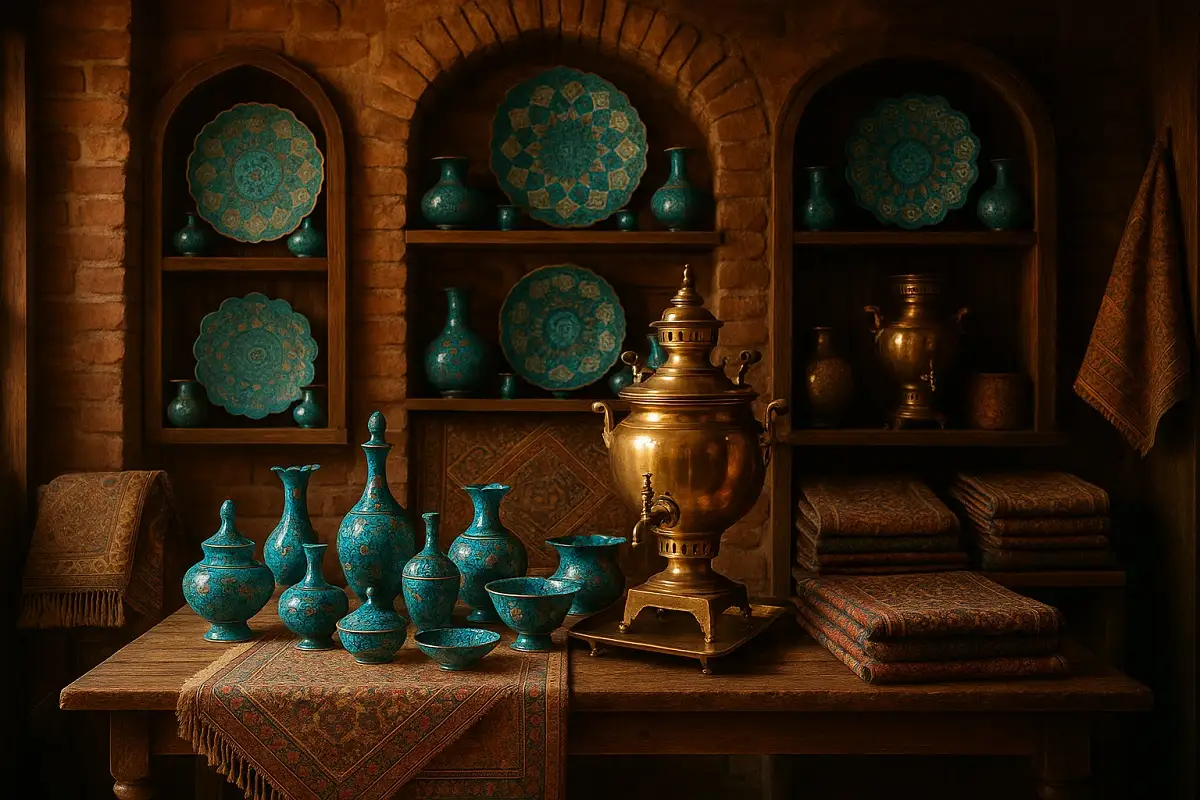
Persian ceramics range from turquoise-glazed tilework to hand-painted bowls and plates decorated with floral or geometric patterns applied by brush before glazing and firing. Workshops in towns such as Lalejin, near Hamadan, have specialised in pottery for generations, and much of what’s sold as decorative Persian ceramics today still follows techniques developed there. Genuine hand-painted pieces show visible brushwork under close inspection, with slight variation in line thickness and colour saturation from piece to piece, unlike transfer-printed designs, which look identical across an entire batch.
Textiles: Termeh, Embroidery and Traditional Dress
Termeh is a hand-loomed brocade fabric historically associated with Yazd, recognisable by its paisley motifs (boteh) usually woven in deep reds, golds and greens. It’s used for table runners, cushion covers and formal clothing, and because it’s genuinely woven rather than printed, it has a distinct texture and weight compared with imitation fabrics carrying the same pattern printed flat onto cotton. Hand-embroidered garments, kaftans and tunics inspired by regional Persian dress are another textile category worth checking closely, since embroidery done by hand will show tiny inconsistencies in stitch spacing that machine embroidery does not.
Questions to Ask Before You Buy
Before buying a Persian product online, it helps to ask a few direct questions: where specifically was this made, what material or technique is actually used, and does the seller know enough about the piece to answer both without generic marketing language. A seller working directly with artisans should be able to name the region, describe the technique, and explain roughly how long a piece like it takes to make. If a listing can’t answer any of that, it’s worth treating the “authentic” label with some scepticism.
Frequently Asked Questions
How can I tell if turquoise jewellery is genuine?
Genuine turquoise has natural variation in colour and matrix (the darker veining running through the stone), while dyed imitations tend to look uniformly saturated. A reputable seller should be able to confirm the stone’s origin.
What’s the difference between a Persian rug and a Persian kilim?
A rug is typically knotted, giving it a pile and thickness, while a kilim is flat-woven with no pile, which is why kilims are usually lighter and less expensive than a comparably sized knotted rug.
Why do handmade ceramics look slightly different from piece to piece?
Because each item is individually painted and fired, small variations in colour and pattern are normal and expected. This is a sign of genuine handcraft rather than a flaw.
Is termeh the same as any patterned fabric with a paisley print?
No. Termeh is specifically hand-loomed in a technique historically centred on Yazd, which gives it a texture and structure that printed imitations of the same pattern don’t have.
What are the most popular categories for first-time buyers?
Jewellery and ceramics tend to be the easiest starting point, since they’re generally smaller purchases, followed by textiles such as termeh runners and, for those ready for a bigger investment, hand-knotted rugs.


Comments