


The Avesta in English: Which Translation Should You Read?
- mahyar
- 13 October 2026
- Persian Literature
- 8 minutes
If you are looking for the Avesta in English, the right translation depends on how much of the text you want to read and how closely you want to study it. For broad coverage, the three-volume Zend-Avesta translated by James Darmesteter and L. H. Mills remains the main English reference and is available free online. For a readable modern translation of the Gathas, M. L. West is a useful starting point. Stanley Insler and Helmut Humbach offer more specialised approaches for readers interested in close textual study.
Not every book labelled an Avesta translation contains the same material. Some translate the Gathas alone, while others provide selected passages or a wider collection of texts. This guide compares seven English editions by publication year, coverage and intended reader. It also introduces three Persian translations for those who would rather read the Avesta in Persian.
Best English Translations of the Avesta at a Glance
The best English translation of the Avesta depends on whether you need broad textual coverage, a modern reading of the Gathas or a scholarly edition. The following comparison shows which texts each edition contains and who is most likely to benefit from it.
| Translator or Editor | Year | Texts Covered | Best For |
|---|---|---|---|
| James Darmesteter and L. H. Mills, Sacred Books of the East | 1880, 1882, 1887 | Vendidad, Yashts, Yasna, Gathas, Visperad and other texts | Readers seeking broad coverage of the Avesta |
| M. L. West, The Hymns of Zoroaster | 2010 | Gathas | General readers wanting a modern, readable translation |
| Stanley Insler, The Gathas of Zarathustra | 1975 | Gathas | Students and readers studying the wording closely |
| Helmut Humbach, The Gathas of Zarathushtra and the Other Old Avestan Texts | 1991 | Gathas and other Old Avestan texts, including Yasna Haptanghaiti | Specialists and philological research |
| Prods Oktor Skjærvø, The Spirit of Zoroastrianism | 2011 | Selected Avesta passages and later Middle Persian texts | Readers seeking a broader anthology |
| Mary Boyce, Textual Sources for the Study of Zoroastrianism | 1984 | Short thematic extracts | Readers seeking an introduction through selected sources |
| Delphi Classics, Zend-Avesta ebook | Ebook edition | Darmesteter and Mills translations, plus Avestan text of Yasna, Vendidad and Visperad | Readers who prefer a digital collected edition |
The most important distinction is between a collection covering many parts of the Avesta and a book devoted to one section. If your purpose is to compare translations of the Gathas, start with West, Insler and Humbach. If you need to consult the Vendidad and Yashts as well, the Darmesteter and Mills collection is more suitable.
Is There a Complete Avesta in English?
Yes. The most widely read English collection covering the Avesta as a whole is the three-part Zend-Avesta published in the Sacred Books of the East series. Edited by Max Müller, it was translated by James Darmesteter and L. H. Mills and published between 1880 and 1887.
Its principal advantage is the range of material included across the three parts. Readers should still distinguish this historical translation from newer studies concentrating on particular texts.
The Zend-Avesta by Darmesteter and Mills
The three parts of the Sacred Books of the East edition divide the material as follows:
- Part I, 1880: James Darmesteter’s translation of the Vendidad.
- Part II, 1882: James Darmesteter’s translation of the Sirozahs, Yashts and Nyayesh.
- Part III, 1887: L. H. Mills’s translation of the Yasna, including the Gathas, alongside the Visperad, Afrinagan, Gahs and fragments.
This division matters when choosing which volume to read. Someone looking specifically for the Gathas should begin with Part III, not Part I. A reader interested in the Yashts should look at Part II. Those wanting the wider collection can use all three.
The publication dates also matter. These are historical English translations, not recently written interpretations. Their broad coverage makes them useful references, but readers concentrating on the Gathas may prefer to compare them with a later translation.
Where to Read the Avesta in English for Free
The Darmesteter and Mills translations are out of copyright and available online without payment. This makes the Sacred Books of the East edition a practical starting point for readers who want to examine the English text before choosing a printed book.
The online archive at avesta.org provides access to Avestan texts and translations. Readers can use it to locate the sections they need rather than buying an edition simply because it carries the title Zend-Avesta.
Delphi Classics also sells a low-cost digital edition based on Darmesteter and Mills. Its collection includes the original Avestan text of the Yasna, Vendidad and Visperad alongside the translated material. This may appeal to readers who prefer an ebook format and want the original-language texts available for reference.
Which English Translation of the Gathas Is Best?
For a readable modern translation of the Gathas, start with M. L. West. For closer engagement with the wording, consider Stanley Insler. For specialist linguistic study, Helmut Humbach’s two-volume work is the more appropriate choice.
These books do not attempt to replace the full three-part Zend-Avesta. They concentrate on the Gathas and, in Humbach’s case, other Old Avestan material. The choice therefore depends on the reader’s level of interest and the kind of detail required.
M. L. West for General Readers
The Hymns of Zoroaster, published by I.B. Tauris in 2010, offers a modern English translation of the Gathas with an introduction and notes.
It is a useful first choice for someone who wants to read the hymns in accessible English without beginning with a specialist philological edition. The accompanying material also helps readers approach the text with some context.
Choose West if your priority is reading the Gathas rather than studying every part of the wider Avesta.
Stanley Insler for Close Reading
Stanley Insler’s The Gathas of Zarathustra appeared in the Acta Iranica series in 1975. It is respected by scholars and follows the text closely.
This makes it valuable for students and careful readers who want to examine how the Gathas have been rendered into English. It is particularly relevant when comparing individual passages across different translations.
Choose Insler when textual precision matters more to you than a straightforward introductory reading experience.
Helmut Humbach for Specialist Study
The Gathas of Zarathushtra and the Other Old Avestan Texts was published in two volumes in 1991. Helmut Humbach worked with Josef Elfenbein and Prods Oktor Skjærvø on this philological edition.
Its coverage includes the Gathas and the Yasna Haptanghaiti. This makes it relevant to readers studying Old Avestan texts in greater depth rather than seeking a general introduction.
Choose Humbach for specialist academic work or detailed comparison with other editions.
Avesta Anthologies in English: Skjærvø and Boyce
An anthology is often a better choice if you want selected passages rather than a continuous translation of the Avesta. Two useful options are Prods Oktor Skjærvø’s The Spirit of Zoroastrianism and Mary Boyce’s Textual Sources for the Study of Zoroastrianism.
Skjærvø’s book, published by Yale University Press in 2011, brings together translated passages from the Avesta and later Middle Persian texts. Its appeal lies in showing readers a selection of different sources within one collection.
Boyce’s 1984 book, published by Manchester University Press, provides short thematic extracts. It is suitable for readers who prefer to approach the material through selected topics rather than begin with a long multi-volume translation.
Neither should be mistaken for an English translation of every section of the Avesta. If you need continuous coverage of the Yasna, Yashts, Visperad and Vendidad, consult the Sacred Books of the East edition instead.
Avesta in Persian: Pourdavoud, Doostkhah and Ahmad Nouri
Readers who understand Persian have a different set of choices. Ebrahim Pourdavoud, Jalil Doostkhah and Ahmad Nouri are three important names to consider when looking for the Avesta in Persian, although their editions differ in presentation and approach.
For a broader introduction to the text itself, including its principal divisions, read our guide to the Avesta and its sacred texts.
Ebrahim Pourdavoud
Ebrahim Pourdavoud was a pioneering figure in translating and commenting on the Avesta in Persian. His work was published in parts beginning in the 1920s.
His translations and commentaries are an important point of reference for readers interested in the development of Persian-language Avesta scholarship. They also provide background for understanding later Persian editions.
Jalil Doostkhah
Jalil Doostkhah prepared the two-volume Avesta, Kohantarin Sorudha va Matnha-ye Irani, building on the work of Pourdavoud.
This edition is worth considering for Persian readers who want a substantial collection in two volumes. Its connection with earlier Persian scholarship makes it particularly relevant to readers comparing the development of translations.
Ahmad Nouri (Aryachehr)
Ahmad Nouri, writing under the name Aryachehr, produced Avesta, Daneshnameh-ye Persian-e Bastan, published by Artamis. The single-volume Persian edition was launched in 2017 after four years of work and contains 776 pages.
It includes the Gathas, Yasna, Yashts, Visperad, Khordeh Avesta and Vendidad, presented in plain modern Persian. Its single-volume format is useful for readers who want these sections together rather than across separate books.
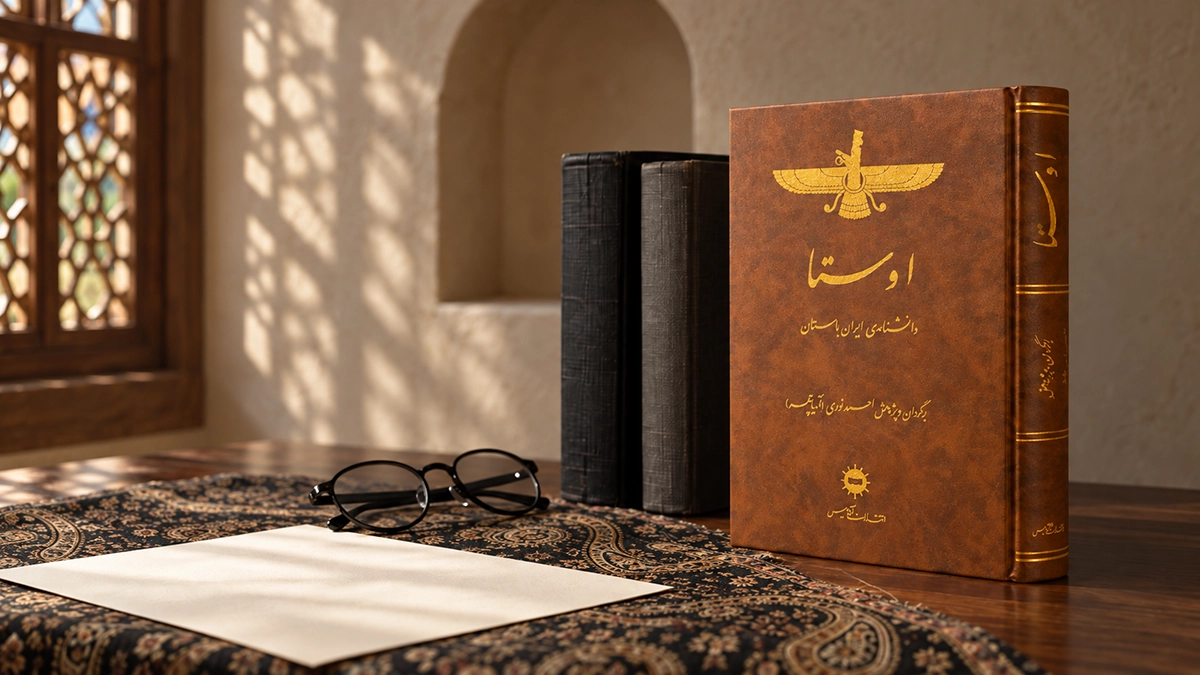
Persis Collection offers the Avesta Book in Persian by Ahmad Nouri, Leather Bound. This book is in Persian, not English. It is suitable for people who read Persian and can also be considered as a gift for Persian-speaking parents or grandparents.
Avestan Words That Survive in Persian
The Avesta also connects with words and names familiar in Persian cultural traditions. These connections can make the text particularly interesting for readers who know Persian, even when their first encounter with the Avesta is through an English translation.
- Mithra and Mehr: Mithra is associated with the Persian name Mehr, found in the month of Mehr and the festival of Mehregan.
- Ahura Mazda and Hormozd: The name Ahura Mazda has the Persian form Hormozd.
- Amesha Spentas and Amshaspandan: Amesha Spentas are known in Persian as Amshaspandan.
The connection between Mithra and Mehr is also relevant to Mehregan, the Persian autumn festival. It is one example of how names encountered in ancient texts continue to appear in later Persian cultural vocabulary.
Readers interested in related visual heritage can also explore the meaning of the Farvahar symbol and its place in Persian cultural design.
Our Experience at Persis Collection
At Persis Collection, we sell Ahmad Nouri’s leather-bound Persian edition of the Avesta. We selected it because it brings the main sections together in one volume and uses plain modern Persian. The book is dispatched from our London warehouse to customers worldwide.
Our Google Search Console data shows that many searches reaching our Avesta product page come from people looking for an English edition. Queries include “avesta book in english” and “zoroastrianism holy book in english”.
That is why we created this comparison. We would rather help a reader find a suitable English translation than encourage them to purchase a Persian book they cannot read.
We do not currently sell an English translation of the Avesta. If you read Persian, however, or want a gift for a Persian-speaking family member, our edition may be suitable.
The following table lists our relevant products and their current supplied prices. The Farvahar jewellery and accessory pieces are cultural gifts, not editions of the Avesta.
| Product | Description | Price |
|---|---|---|
| Avesta Book in Persian by Ahmad Nouri, Leather Bound | Single-volume Persian edition | £70 |
| 925 Silver Farvahar Necklace | Farvahar jewellery | £125 |
| 24K Gold Farvahar Persian Necklace | Farvahar-inspired jewellery | £70 |
| Heritage Faravahar Pin Brooch | Farvahar accessory | £25 |
Conclusion
The best Avesta in English is the edition that covers the texts you actually want to study. For wide coverage, choose the Darmesteter and Mills Zend-Avesta. For a modern, readable English translation of the Gathas, begin with M. L. West. Insler and Humbach serve readers who need closer textual study, while Skjærvø and Boyce provide selected passages.
For Persian readers, Pourdavoud and Doostkhah are valuable names to explore, while Ahmad Nouri offers a single-volume edition in modern Persian.
If you are buying for someone who reads Persian, explore our leather-bound Persian Avesta by Ahmad Nouri or browse our collection of Persian history books. If you need an English translation, use the comparison above to select an edition that matches your reading goals.
Frequently Asked Questions
What is the best English translation of the Avesta?
For broad coverage, the three-part Zend-Avesta by James Darmesteter and L. H. Mills is the main English reference. For a readable modern translation of the Gathas specifically, M. L. West’s The Hymns of Zoroaster is a useful choice. The best option depends on the sections you want to read.
Is the Zend Avesta available in English?
Yes. The Zend-Avesta was translated into English by James Darmesteter and L. H. Mills for the Sacred Books of the East series, published in three parts between 1880 and 1887. The translations are out of copyright and available free online.
Is there a Khordeh Avesta in English?
Yes. Much of the Khordeh Avesta, including the Yashts, the Nyayesh and the Sirozahs, appears in Part II of the Darmesteter translation in the Sacred Books of the East, with the Gahs and the Afrinagan in Part III by L. H. Mills. Zoroastrian communities also publish prayer books that print the Avestan prayers alongside an English translation for daily use.
What does Avesta mean in English?
Avesta is the name used in English for the collection of Zoroastrian sacred texts. It is generally retained as a proper name rather than translated into a different English title. In a book listing, “Avesta in English” usually refers to an English translation of those texts.
What is the Zoroastrian holy book called?
The sacred text collection of Zoroastrianism is called the Avesta. Its sections include the Gathas, Yasna, Yashts, Visperad and Vendidad. Different English publications translate different portions of this collection, so the book’s contents should be checked before purchase.
Is the Avesta book sold by Persis Collection in English?
No. The Avesta book sold by Persis Collection is Ahmad Nouri’s leather-bound Persian edition, not an English translation. It contains the Gathas, Yasna, Yashts, Visperad, Khordeh Avesta and Vendidad in modern Persian. We do not currently sell an English edition.


Comments