


Who Was Rumi? The Life of the Poet Behind the Masnavi
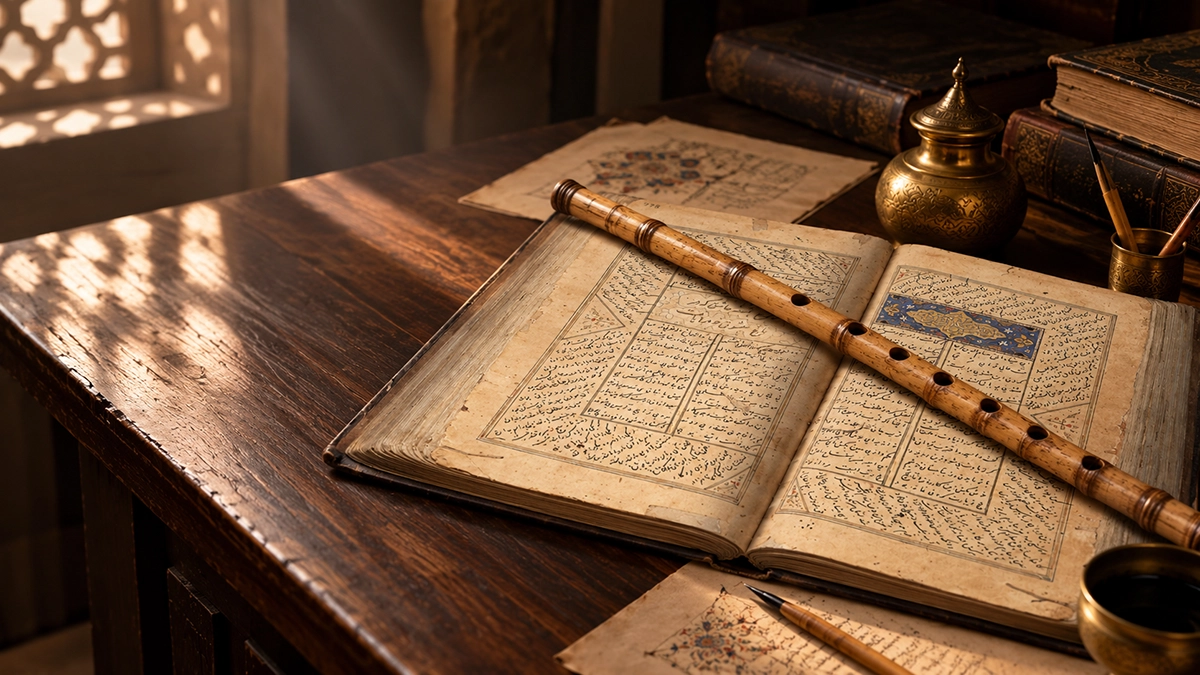
Who was Rumi? Rumi was a 13th-century Persian poet, teacher and mystic whose writings became some of the most enduring works of Persian literature. Born in the region of Balkh and later settled in Konya, he is known in Persian as Mowlana Jalal al-Din Muhammad Balkhi. His life was transformed by his encounter with Shams Tabrizi, and the years that followed produced the poetry of the Divan-e Shams and, later, his great Masnavi-ye Ma’navi.
To understand Rumi, however, it helps to see his life and the Masnavi as parts of the same story. His migrations, teachers, friendship with Shams, periods of loss and years of teaching all shaped the work for which he is remembered today.
Who Was Rumi?
Rumi was born in 1207 and died in Konya in 1273. He lived during a period of movement and upheaval across Central and Western Asia, and his own life crossed several regions before his family eventually settled in Konya.
His father, Baha al-Din Valad, was a scholar and teacher. Rumi therefore grew up in an intellectual and spiritual environment rather than beginning life primarily as a poet. His later fame can sometimes obscure this important part of his biography. Before the extraordinary poetry associated with Shams Tabrizi, Rumi had already established himself as a learned teacher.
Today he is known internationally simply as Rumi, while Persian speakers commonly call him Mowlana. His place within the wider history of Persian literature can also be understood alongside other major writers through our introduction to Persian history and cultural heritage.
Rumi’s Early Life, From Balkh to Konya
Rumi’s life did not unfold in a single city. He was born in the region of Balkh, and his family later travelled west before eventually making Konya their home. This movement placed him within a broad Persian literary and intellectual world while also making Konya the city most closely associated with his adult life.
There he became a respected teacher. This part of the Rumi life story matters because his meeting with Shams did not create his learning from nothing. It changed the direction in which an already educated and established man expressed it.
Rumi’s biography is therefore also a story of movement. Balkh belongs to his origins, while Konya became the setting for his teaching, his encounter with Shams, the composition of his mature works and eventually his burial.
Rumi and Shams Tabrizi: The Meeting That Changed His Life
Rumi met Shams Tabrizi in Konya in 1244. Their intense spiritual friendship became one of the defining relationships of Rumi’s life and changed the character of his poetry.
Shams was not simply a character who appeared in Rumi’s poems. His presence challenged Rumi intellectually and spiritually. Their long conversations drew Rumi away from the conventional rhythm of public teaching and towards a more inward form of experience.
The relationship also caused tension around them. Shams eventually disappeared from Rumi’s life. Accounts of what happened differ, and stories that he was murdered should be treated as one tradition surrounding his disappearance rather than as an established historical fact.
What is much clearer is the effect of his absence. Rumi’s response was not to leave Shams behind. Instead, Shams became increasingly present within his poetry.
Readers interested specifically in this relationship can also explore Shams and Rumi: A Bilingual Classic Biography, one of the bilingual books in the Persis Collection selection.
From Shams to the Divan-e Shams
The Divan-e Shams is the great lyrical collection associated with Rumi’s transformation after meeting Shams Tabrizi. Its very name shows how deeply Rumi connected his poetic voice with his absent companion.
This is one reason the story of Rumi and Shams should not be treated as a colourful episode separate from Rumi’s work. It helps explain the movement from the respected teacher of his earlier years towards the poet whose writing explores longing, separation, love, transformation and the search for meaning.
Rumi also formed important relationships with figures including Salah al-Din Zarkub and Hesam al-Din Chalabi. The latter would become especially important to the creation of the Masnavi.
How Rumi’s Masnavi Was Written
The Masnavi-ye Ma’navi, usually shortened in English to the Masnavi, grew out of Rumi’s later years of teaching and his relationship with Hesam al-Din Chalabi. Rather than being separate from Rumi’s biography, its creation is the culmination of much of the life that came before it.
Hesam al-Din Chalabi and the Beginning of the Masnavi
According to the traditional account of the work’s origin, Hesam al-Din encouraged Rumi to create a work that could guide his students through stories, teachings and reflections. Rumi responded with the opening verses that became the beginning of the Masnavi.
The work was then composed over many years, traditionally dated from around 1262 until near the end of Rumi’s life. Rumi recited and Hesam al-Din wrote down the verses. This relationship is essential to the story of the book because the Masnavi was not conceived simply as a private literary project. It emerged from teaching, conversation and companionship.
The Six Books and the Ney-nameh
The Masnavi is arranged in six books. It begins with the famous Ney-nameh, or The Song of the Reed, in which the voice of the reed introduces the theme of separation that runs through so much of Rumi’s thought.
From there, the work moves through stories within stories, moral questions, humour, parables and reflection. This structure is one reason a first-time reader may find the Masnavi different from a modern book designed to be read quickly from beginning to end.
The sixth book ends without the kind of formal conclusion a modern reader might expect. Rumi died in 1273, leaving the work as it has come down through the centuries.
Rumi’s Life in Dates: A Simple Timeline
| Date | Event |
|---|---|
| 1207 | Rumi is born in the region of Balkh. |
| Early life | His family travels west and eventually settles in Konya. |
| 1244 | Rumi meets Shams Tabrizi in Konya. |
| After Shams | Rumi’s poetry increasingly reflects the experience of companionship, separation and longing associated with Shams. |
| Around 1262 | The composition of the Masnavi begins with the encouragement of Hesam al-Din Chalabi. |
| 1273 | Rumi dies in Konya. |
| 30 September | Rumi’s birth is commemorated on this date, including in the Persian cultural calendar. |
| 17 December | The anniversary of his death is remembered as Shab-e Arus. |
Was Rumi Persian, Turkish or Afghan?
Modern national labels do not fit neatly onto a man who lived in the 13th century. Rumi was born in the region of Balkh, spent much of his adult life in Konya and wrote the overwhelming majority of his major literary work in Persian.
These facts explain why different modern cultures feel a strong connection to him. His birthplace is associated with a region whose modern political geography is very different from that of his lifetime, while Konya is in modern Turkey and remains central to his memory. In literary terms, however, Persian is fundamental to understanding Rumi because it is the principal language of the Masnavi and the great body of his poetry.
This does not require turning Rumi into a modern nationalist figure. His life crossed regions, while his writing became part of the Persian literary heritage that continued far beyond them. Readers interested in that wider cultural context can explore our guide to Persian people and cultural heritage.
Why Rumi Still Matters in Persian Culture
Rumi is not preserved only as a historical poet. His words continue to appear in books, calligraphy, visual art and objects used or given in everyday life, keeping his poetry visible beyond academic study.
Persian calligraphy is particularly important to this continuing presence. A verse can become both text and image, allowing poetry to enter the home through a manuscript, painting, decorative object or wearable piece. Our guides to the history of Persian calligraphy and Persian miniature art provide more background on two artistic traditions through which Persian literature has often been visually expressed.
Music also forms part of the cultural world surrounding Persian poetry. Instruments such as the Persian Daf and Persian Setar offer another route into the relationship between poetry, rhythm and Persian cultural expression.
How to Start Reading Rumi and the Masnavi
A beginner does not need to understand every historical reference before reading Rumi. The more useful decision is choosing a format that allows you to remain close enough to the Persian text while still understanding the story and ideas.
Persian, English or a Bilingual Edition?
If you read Persian comfortably, the original gives you direct access to Rumi’s language, rhythm and word choices. If your Persian is developing, or you grew up outside a Persian-speaking environment, a bilingual edition can make the text less intimidating because the Persian and English can be consulted together.
An English edition may be the easiest entry point for a reader with no Persian. The important distinction is between reading a translation of Rumi’s actual work and encountering short sayings online that may have been heavily adapted or incorrectly attributed to him.
Where Should a Beginner Start?
The Ney-nameh is a natural starting point because it opens the Masnavi and introduces the image of separation through the reed. From there, a new reader can approach individual stories before attempting longer stretches of the work.
Readers who want the Persian beside the English can consider an illustrated bilingual edition. The Rumi Masnavi Manavi Collection, English and Persian in our collection is a bilingual illustrated edition. It should not be confused with a claim that a particular retail edition necessarily reproduces the complete six-book text.
Our Experience at Persis Collection
Our sales experience shows that interest in Rumi is remarkably steady rather than tied to a single festival or gift-giving season. Among the Rumi pieces we carry, the bilingual English and Persian Masnavi edition has consistently attracted the strongest interest and regularly sells ahead of available stock.
We also see a preference for pieces that allow people to keep Rumi close in ordinary life. Books, jewellery and clothing connected with his poetry tend to be chosen more readily than large-scale artworks. That pattern suggests that, for many customers, Rumi is not simply a historical figure to display. His poetry is something to read, wear, give and return to.
Rumi Beyond Books: Poetry in Persian Art and Everyday Objects
Rumi’s continuing cultural presence can be seen in the range of forms inspired by his poetry. Calligraphy can place a line of verse on clothing or jewellery, while painting can interpret themes such as Sama through movement, composition and colour.
The following are the five Rumi pieces referenced in this article. Prices can change, so the individual product page should always be checked for current availability and pricing.
| Rumi piece | Price |
|---|---|
| Rumi Masnavi Manavi Collection, English and Persian | £120 |
| Shams and Rumi: A Bilingual Classic Biography | £48 |
| Pearls Rumi Necklace | £39 |
| Rumi Poetry Coat | £100 |
| Sama in Rumi Poetry Mix Media Painting | £559 |
For a broader selection of literary works, explore the Persian poetry book collection.
Rumi’s Death, Shab-e Arus and His Tomb in Konya
Rumi died in Konya on 17 December 1273 and was buried there. His tomb remains the physical place most closely associated with his memory and can be visited in Konya.
The anniversary of his death became known as Shab-e Arus, literally the wedding night. Within the tradition surrounding Rumi, the name frames death as reunion rather than simply departure.
Sama also became strongly associated with the tradition that developed after Rumi. It should not be reduced to a decorative image of turning figures. In the cultural memory surrounding Rumi, movement, poetry and music belong to a much deeper tradition of contemplation. The Sama in Rumi Poetry Mix Media Painting is one contemporary artistic interpretation of that visual legacy.
Conclusion
So, who was Rumi? He was a Persian poet and teacher whose life moved from the region of Balkh to Konya, whose encounter with Shams Tabrizi transformed his poetic expression, and whose later collaboration with Hesam al-Din Chalabi gave the world the Masnavi.
Reading his biography alongside his writing makes both easier to understand. Shams helps explain the intensity of the Divan-e Shams. Hesam al-Din helps explain how the Masnavi came into being. The Persian language of those works explains why Rumi remains so deeply present in Persian literary culture.
For readers beginning that journey today, the simplest next step is not to collect isolated quotations. It is to open the work itself, beginning with the Ney-nameh, a bilingual edition or a carefully chosen translation, and meet Rumi through the poetry that made his life endure.
Frequently Asked Questions
Who was Rumi and why is he important?
Rumi was a 13th-century Persian poet, scholar and teacher whose Masnavi and Divan-e Shams became major works of Persian literature. His writing has endured because it combines storytelling, poetry and reflection on questions such as separation, love, knowledge and human transformation.
Why is Rumi so famous?
Rumi is famous because his poetry travelled far beyond the time and region in which he lived. His works remain part of Persian literary culture while translations and adaptations have introduced his poetry to readers around the world.
Was Rumi Persian or Turkish?
Rumi wrote the great majority of his major literary work in Persian, was born in the region of Balkh and spent much of his adult life in Konya, in present-day Turkey. Applying a single modern nationality to a 13th-century figure can therefore be misleading, while his place in Persian literary history is clear from the language and tradition of his major works.
What is Rumi’s Masnavi?
The Masnavi-ye Ma’navi is Rumi’s major six-book work of narrative poetry, stories, teaching and reflection. Its composition began in Rumi’s later life with the encouragement and assistance of Hesam al-Din Chalabi.
How many books are in the Masnavi?
The Masnavi consists of six books. It begins with the Ney-nameh, or The Song of the Reed, one of the best-known openings in Persian literature.
What is Rumi’s most famous book?
The Masnavi is generally regarded as Rumi’s best-known major work, while the Divan-e Shams is another central part of his literary legacy. The two works have different characters, and both are important for understanding his poetry.
What is the real story of Rumi and Shams?
Rumi and Shams Tabrizi formed an intense spiritual and intellectual friendship after meeting in Konya in 1244. Shams profoundly influenced Rumi, and his eventual disappearance became a turning point reflected in Rumi’s poetry, particularly the Divan-e Shams.
What is the best English translation of the Masnavi for beginners?
There is no single best English translation for every beginner. A reader choosing an edition should look for one that clearly identifies the source text and distinguishes direct translation from freer adaptation, while a bilingual Persian and English edition can be particularly useful for readers who have some knowledge of Persian.
Should I read the Masnavi in Persian or English?
Read the Masnavi in Persian if your Persian is strong enough to follow the poetry comfortably, but English is a practical starting point if it is not. For heritage speakers and learners, a bilingual edition offers a useful middle ground because the original and translation can be compared.
Where is Rumi buried?
Rumi is buried in Konya, where he died in 1273. His tomb remains one of the principal physical sites associated with his life and legacy.
When is Rumi’s birthday?
Rumi’s birth is commemorated on 30 September, corresponding with 8 Mehr in the Persian calendar. The date provides an annual occasion to remember his life, while interest in his poetry and the Masnavi continues throughout the year.
Comments