


What Is Mehregan? The Persian Autumn Festival Explained
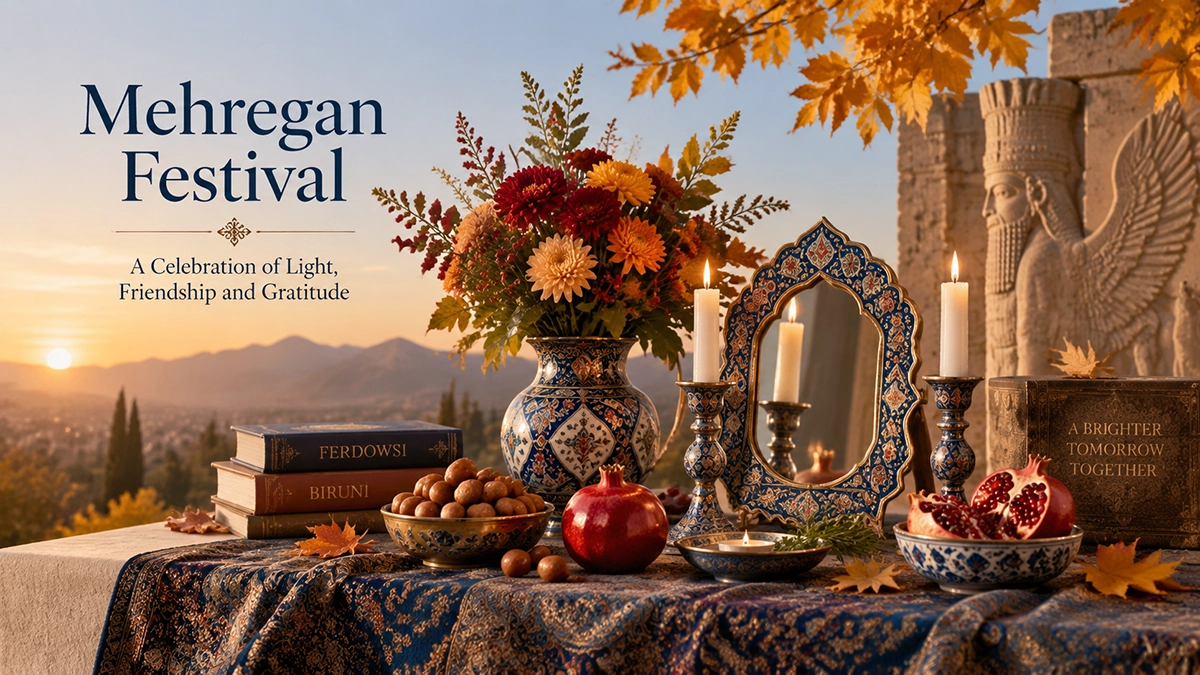
Mehregan festival is a Persian autumn celebration associated with Mehr, gratitude, friendship, light and the abundance of the season. Also written as Mehrgan, Mehragan or Mihragan, it remains part of Persian cultural memory and is marked through gatherings, a symbolic sofreh, seasonal foods and gift giving.
For people outside Persian, Mehregan can be celebrated at home without recreating an elaborate historical setting. A thoughtfully arranged table, a few meaningful objects, seasonal fruit and time shared with family can carry the central ideas of the festival. This guide explains what Mehregan means, when it is celebrated, what belongs on a Mehregan sofreh and how to mark the occasion in a practical way.
What Is Mehregan Festival and Why Is It Celebrated?
Mehregan, or Jashn-e Mehregan, is an old Persian festival connected with Mehr. The celebration is associated with gratitude, friendship, light and the autumn season. It is often described as a Persian autumn festival and is also connected with the harvest and giving thanks for abundance.
The name Mehregan comes from Mehr, a name associated with Mithra. Mehr is also the name of a month in the Persian calendar. This connection between the festival, the month and Mithra helps explain why ideas such as friendship, loyalty and light are closely associated with Mehregan.
The festival also appears within Persian literary and historical traditions. Ferdowsi’s Shahnameh connects Mehregan with the story of Fereydun’s victory over Zahhak. This gives the celebration another layer of meaning within Persian culture, where seasonal celebration and literary memory can exist together.
Historical descriptions of Mehregan also appear in the writings of Abu Rayhan al-Biruni. These references are useful because they show that Mehregan was not simply a modern revival. It has a long place in discussions of the Persian calendar and Persian seasonal customs.
Today, the meaning of Mehregan does not need to be reduced to one interpretation. For many families, it can be a cultural occasion for gathering, giving thanks, setting a beautiful table and maintaining a connection with Persian heritage.
When Is Mehregan Celebrated?
The date of Mehregan can appear differently across modern sources because more than one calendrical convention is used. This is why readers may encounter different October dates even when sources are describing the same festival.
A commonly observed date in the Persian calendar is 16 Mehr. Other traditions connect the celebration with the day of Mehr in the month of Mehr, which can lead to a different date being given. Understanding this distinction is more useful than treating one source as correct and every other source as mistaken.
For the current year, Mehregan 2026 falls on Thursday 8 October 2026, corresponding to 16 Mehr 1405.
This date should not be confused with the autumn equinox. Mehregan belongs to the autumn season, but it is not simply another name for the equinox.
The Mehregan Sofreh: What Is Placed on the Table and What Does It Mean?
A Mehregan sofreh, or sofreh-ye Mehregan, brings the celebration into the home through symbolic objects, seasonal produce and carefully arranged decorative pieces. There is no need for every table to be identical. The purpose is to create a setting that expresses the character of the festival.
A termeh tablecloth can provide the foundation. Termeh has a strong visual connection with Persian decorative arts and gives the spread a defined ceremonial centre without requiring a large amount of decoration.
An ayneh, or mirror, and shamdan, or candle holders, can be placed on the table. Light is particularly appropriate to the themes associated with Mehr. A mirror also appears in other Persian ceremonial spreads, although each celebration has its own meaning and context. Readers interested in another Persian ceremonial spread can read Persis Collection’s guide to What Is a Sofreh Aghd?
Seasonal fruit can add both colour and meaning. Anar, or pomegranate, is particularly effective visually, while senjed can also be included. Ajil, meaning mixed nuts, may be arranged in a small dish.
Golab, or rosewater, and a golabpash can introduce another traditional Persian element. Esfand, also written espand, and sormeh are among the items that may be associated with traditional descriptions of the spread.
Some families may also include a Khordeh Avesta. Readers who want background on the Avesta and its place in Zoroastrian tradition can explore The Avesta: Holy Book of Zoroastrianism and Its Sacred Texts.
The strongest Mehregan table is not necessarily the one with the most objects. A smaller spread with a termeh cloth, mirror, candlelight, fruit and a few carefully chosen pieces can communicate the occasion clearly.
Four Persis Collection pieces can be used naturally within this type of arrangement. Current prices are grouped here so that volatile information remains easy to update.
These pieces are held in stock at our London warehouse and are normally dispatched within two to three days. Anything that shows as on backorder takes two to four weeks before dispatch, so if you are building a Mehregan table for a particular date, it is worth ordering early.
How to Celebrate Mehregan at Home
You can celebrate Mehregan at home by creating a small symbolic spread, gathering with family or friends, sharing seasonal food and exchanging thoughtful gifts. The celebration does not depend on having access to a specialist market or reproducing every historical custom.
Start with the sofreh. Choose a table or smaller surface and cover it with a Persian textile such as termeh. Add a mirror, candles or candle holders, then introduce autumn fruit and a small number of traditional items.
The next part is the gathering itself. Mehregan can be an opportunity to spend time together and talk about why the day matters. For families raising children outside Persian, even explaining the names of the objects on the table can turn the occasion into a simple lesson in Persian language and heritage.
Food can follow the season rather than a rigid menu. Pomegranate, nuts and other autumn produce can make the table feel connected to the time of year.
The key is intention. A compact Mehregan table in a London flat, a family home in Canada or an apartment in the United States can still carry the meaning of the celebration. Persian cultural traditions do not require a particular postcode.
Mehregan Gifts: Choosing Something With Meaning
Gift giving fits naturally with Mehregan because the celebration centres on gratitude, affection and social connection. A useful approach is to choose a gift for its symbolism and relationship to the occasion rather than simply choosing the largest or most expensive object.
Persian decorative pieces can work particularly well because they can be used on the Mehregan table and kept afterwards. A ceramic pomegranate, for example, can form part of the seasonal display before becoming a permanent decorative object. A candle holder can serve the celebration while remaining useful throughout the year.
A termeh tablecloth has a similar advantage. It helps establish the sofreh itself, but it is not restricted to one festival. The same principle applies to a handcrafted mirror and candle holder set.
For a wider selection, readers can browse Persian gifts at Persis Collection.
If you are giving to an Persian family and want to understand the broader etiquette around gifts, the Persis Collection guide to Persian gift giving etiquette explains how cultural context can shape the choice.
Jewellery is another natural Mehregan gift, and the autumn palette suits Persian pieces particularly well. Our guide to autumn jewellery trends with a Persian twist shows how turquoise, Minakari enamel and yellow gold work with seasonal colours.
How Do You Say Happy Mehregan?
The most traditional greeting is Mehregan Shad, pronounced approximately meh-reh-GAAN shaad. It means “Happy Mehregan”, as shad is the Persian word for happy or joyful. Many people prefer it because Mehregan is an ancient Persian festival, and it is the greeting most often used within the Zoroastrian community. You may also hear Mehreganetan Shad, meaning “may your Mehregan be happy”, or Jashn-e Mehregan Shad.
Mehregan Mobarak is also widely heard in everyday Persian. Mobarak comes from Arabic, which is why some people choose Mehregan Shad instead. Either greeting can be used in a message, greeting card or in person.
You may also see the festival written as Mehregan, Mehrgan, Mehragan or Mihragan. The spelling Mehragān also appears in academic writing. For a general English language article, using Mehregan consistently keeps the wording clear while still acknowledging common alternatives.
Both styles of greeting are used for other Persian celebrations too. For comparison, Persis Collection’s guide to saying Happy Nowruz explains Nowruz Mobarak and its use.
Mehregan, Nowruz and Yalda: Three Different Seasonal Celebrations
Mehregan, Nowruz and Yalda are distinct celebrations and should not be treated as interchangeable Persian holidays. Nowruz marks the Persian New Year and the arrival of spring. Mehregan belongs to autumn, while Yalda Night marks a different seasonal gathering later in the year.
Their tables, foods and customs can overlap in small ways because they come from the same broader cultural world, but their meanings remain different. Keeping the comparison brief helps each tradition retain its own identity.
Readers interested in Yalda can explore Persis Collection’s article on Persian Proverbs for Yalda Night.
For more context on symbols connected with Persian heritage, see The Meaning of the Farvahar.
Our Experience at Persis Collection
Our experience with seasonal Persian celebrations shows that meaningful symbols often matter more than the product category itself. Around cultural occasions, people frequently build their choices around recognisable symbols and the story of the celebration.
We also see the importance of smaller pieces when a family is creating a ceremonial spread. A table can be built from several meaningful objects rather than one large decorative purchase. For Mehregan, this supports a practical approach based on a textile, mirror, candlelight and seasonal decorative elements.
Planning is equally important with handmade work. Seasonal purchasing patterns show that families tend to prepare before the celebration rather than leaving everything until the final days. Pieces held in our London warehouse are normally dispatched within two to three days, while backorder items take two to four weeks before dispatch, so it is worth allowing extra time when choosing handmade items.
This is particularly relevant for people celebrating outside Persian. A good Mehregan table does not need to be assembled in one shopping trip. Starting with a few reusable pieces allows the collection to grow over time.
Conclusion
Mehregan is a Persian autumn festival centred on Mehr and associated with gratitude, friendship, light and seasonal abundance. Its long cultural history matters, but the celebration can also be practical and personal today.
For a home celebration, begin simply. Arrange a sofreh with a Persian textile, mirror, candlelight and autumn fruit. Learn the meaning of the objects you choose, gather with people who matter to you and use “Mehregan Shad” to share the occasion.
Those building a Mehregan sofreh with Persian art and handcrafted objects can explore the Persis Collection gifts category.
Frequently Asked Questions
What is the Mehregan Festival?
Mehregan is a Persian autumn festival associated with Mehr, gratitude, friendship, light and seasonal abundance. It is celebrated through gatherings and traditions that can include a symbolic table spread, seasonal foods and gifts.
When is Mehregan celebrated?
A commonly observed date for Mehregan is 16 Mehr in the Persian calendar. Different calendrical traditions can produce different dates in modern sources.
Why do sources give different dates for Mehregan?
Sources give different dates because they may follow different calendrical conventions. Some focus on 16 Mehr, while another tradition connects the festival with the day of Mehr during the month of Mehr.
When is Mehregan 2026?
Mehregan in 2026 is Thursday 8 October, corresponding to 16 Mehr 1405. The article is structured to remain evergreen, so this yearly date can be updated without changing the main guide.
What does Mehregan mean?
Mehregan takes its name from Mehr, which is connected with Mithra and is also the name of a month in the Persian calendar. The festival is associated with ideas including friendship, gratitude and light.
What is placed on the Mehregan table?
A Mehregan table can include a Persian textile such as termeh, a mirror, candles, rosewater, senjed, pomegranate, nuts and other symbolic objects. Traditions vary, so every sofreh does not need to contain an identical set of items.
What are Mehregan traditions?
Mehregan traditions include gathering with family and friends, arranging a symbolic sofreh, sharing seasonal foods and giving gifts. The precise form of the celebration can vary between families and communities.
Do people give gifts at Mehregan?
Gift giving is associated with Mehregan and fits the festival’s themes of affection and social connection. Persian decorative objects, textiles and meaningful pieces that can also form part of the sofreh are practical choices.
How do you say Happy Mehregan?
“Mehregan Shad” is the traditional Persian way to say “Happy Mehregan”. It is pronounced approximately meh-reh-GAAN shaad. “Mehregan Mobarak” is also common in everyday use, although mobarak comes from Arabic.
What is the difference between Mehregan and Nowruz?
Mehregan is an autumn celebration, while Nowruz marks the Persian New Year and the beginning of spring. They are separate Persian celebrations with different seasonal meanings and traditions.
What is the connection between Mehregan and Mithra?
The connection comes through Mehr, which is associated with Mithra. This relationship is part of the historical background to the festival and helps explain the association of Mehregan with concepts such as light and friendship.
How can I celebrate Mehregan outside Persian?
You can celebrate Mehregan anywhere by arranging a small sofreh, using seasonal fruit, lighting candles, gathering with family or friends and exchanging meaningful gifts. Access to an elaborate traditional setting is not necessary for a thoughtful home celebration.
Comments
Christine Roth
Please do not use Mobarak as Happy. It’s Arabic. It is not Persian. It is Mehraneh Shaad.
Mahyar
Thank you, Christine. You are quite right that mobarak comes from Arabic. We have updated the article so that Mehregan Shad is now the main greeting, with a note on why many people prefer it. We really appreciate you taking the time to let us know.