


Marrying into an Iranian Family: A Gift Guide for Non-Iranian Partners
- mahyar
- 1 September 2026
- Gift Guides
- 10 minutes
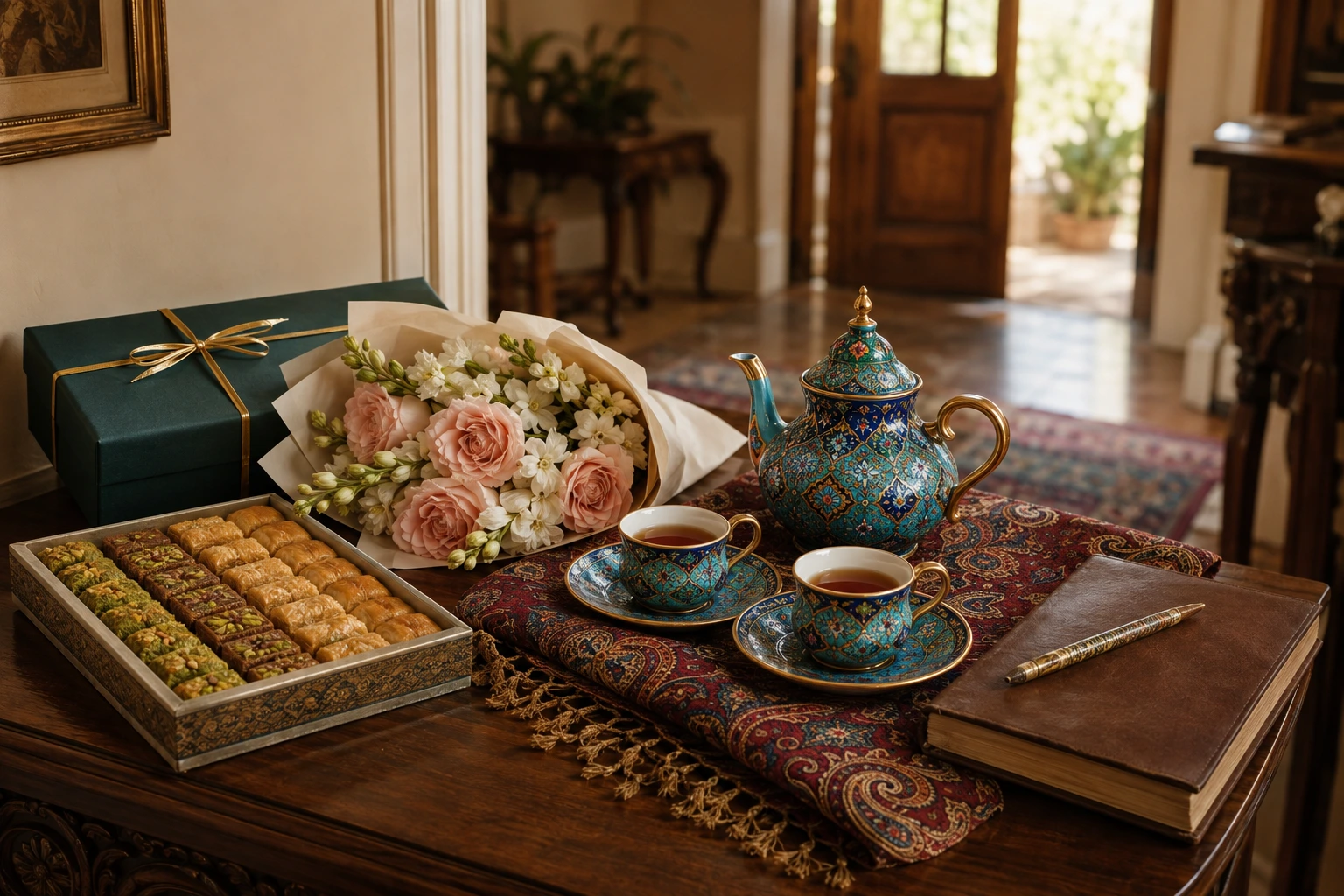
Understanding Persian gift giving etiquette is less about memorising strict rules and more about recognising the importance of family, hospitality and thoughtful presentation. If you are meeting your Persian partner’s parents, attending a Khastegari or joining the family for Nowruz, arrive with something considered rather than something extravagant. A shared household gift, Persian tea set, flowers or Shirini can all work well. Ask your partner about the family’s preferences first, especially before bringing food or drink. The right gift should acknowledge the occasion without turning the meeting into a display of money.
Persian Gift Giving Etiquette: What Matters Most
A thoughtful gift and respectful manner usually matter more than its financial value. Persian families differ widely, so your partner remains the best source of advice about formality, personal tastes and whether each relative expects an individual gift.
Presentation is important. Give the gift directly, preferably with both hands when practical, and say clearly that it is for the host, the parents or the household. The recipient may initially play down the gift, hesitate or say that you should not have brought anything. This may be part of Taarof, a form of ritual politeness, rather than a genuine rejection.
Do not insist aggressively. Offer the gift warmly, allow a polite exchange and follow your partner’s lead. Some families open presents immediately, while others place them aside until later. If you are unsure, simply ask, “Would you like to open it now?”
The safest approach is to choose something useful, shareable or culturally meaningful. A Persian hostess gift can also create an easy conversation, particularly if you can explain why you selected its pattern, craft or use.
What to Bring When Meeting the Family for the First Time
For a first meeting, bring one polished gift for the household rather than arriving with a separate present for every person. Flowers, Shirini, Persian sweets or an attractive serving piece suit a Mehmooni because everyone can enjoy them without creating an uncomfortable sense of obligation.
A tea related gift is especially practical when the meeting is taking place at the family home. The Persian Red Rose Handcrafted Ceramic Tea Gift Set gives the hosts something they can use together. Its role is clear, so you do not need a long explanation at the door.
For a lighter and more playful choice, the Elegant Couple Persian Giveh works as a shared gift for a couple. Giveh also creates a natural opening for conversation about Persian craft without making the first meeting feel overly formal.
Bring the gift in a presentable bag or box and include a short card with both parents’ names if you know them. Confirm names and spellings with your partner. This small check can matter more than adding another decorative item.
A Gift Guide for Each Member of Your Partner’s Family
Choose gifts according to the recipient’s interests and the stage of your relationship. You do not automatically need to buy for every relative, but a more established relationship may justify individual presents for parents, grandparents, siblings or children during important family occasions.
Gift ideas for an Persian mother in law
A gift for your partner’s mother should feel considered without relying on assumptions about her style. Tea pieces, serving ware and decorative crafts are useful choices because your partner can confirm whether the colours and function suit her home.
- Minakari Tea Set for Two: Enamel Gift Set is suitable for someone who enjoys tea and detailed decorative work.
- Persian Handmade Minakari Vase and Plate Gift Set offers a coordinated decorative gift rather than a single personal accessory.
- Persian Handmade Minakari Three Tier Cake Stand suits a host who regularly serves sweets, fruit or cakes at family gatherings.
Ask your partner which Minakari colours or home accessories she already owns. A beautiful object can still be the wrong choice if it duplicates something prominent in her home.
Gift ideas for an Persian father in law
For your partner’s father, consider his reading, writing or office habits rather than choosing a generic men’s gift. Hafez, Khatam and Ghalamzani can give the present a recognisable Persian connection while remaining useful.
- Divane Hafez Gift Set with Khatam and Ghalamzani Stationery combines literary and decorative elements in one coordinated gift.
- Khatam Kari Office Gift Set is a practical choice for someone who uses a study, desk or workplace.
If he does not read Persian or use desk accessories, ask before choosing either option. Cultural meaning should support the recipient’s interests, not replace them.
Grandparents, siblings and children
Smaller presents are usually enough for extended family unless the occasion specifically centres on them. Ask whether the family exchanges gifts collectively, by household or person by person before creating a large list.
A grandparent may appreciate a useful home object or a carefully chosen literary gift. For siblings, choose according to their own interests rather than treating “gifts for Iranians” as one category. Children may receive small seasonal presents or eidi at Nowruz, but your partner should explain what their family normally does.
If you need a gift for a Persian friend or sibling who has recently moved home, a tea set, serving piece or decorative craft can also work as a Persian housewarming gift. Confirm their colours, available space and preferred style before ordering.
Gifts for Khastegari, Baleh Boroon, Engagement and Marriage
The formality of the gift should rise with the significance of the occasion, but there is no universal list that applies to every family. Khastegari, Baleh Boroon, engagement and wedding arrangements can vary, so ask your partner what has been discussed before buying anything ceremonial.
Khastegari
Khastegari is a formal family meeting connected with a proposed marriage. A well presented household gift, flowers or sweets may be appropriate, but you should not introduce an elaborate object as though it were a required part of the ceremony unless both families expect it.
The Persian Love Calligraphy Tea Set can suit a family meeting because it connects the couple’s relationship with the shared ritual of tea. It should be presented as your considered choice, not as a claim about what every Khastegari requires.
Baleh Boroon and engagement
Baleh Boroon normally follows agreement between the families and may be more celebratory than the first meeting. A coordinated gift for the couple or household can reflect that change in tone, provided your partner confirms that a gift is expected.
The Firoozeh Koobi Vases Gift Set offers a paired decorative choice, while the Persian Minakari on Pottery Decanter Luxury Gift Set suits a more formal shared presentation. Before selecting the decanter set, ask what the family serves and how they would use it.
Persian wedding gifts
A wedding gift should be chosen for the couple rather than treated as payment for attending. The family may have specific expectations around money, gold or household gifts, but you should never guess at amounts or obligations from a general article.
For a wider overview, read the guide to Persian wedding gift sets and etiquette and the separate list of Persian wedding gift ideas for the bride and groom. If you are also helping with guest presents, see the guide to Persian wedding favours.
Do not confuse a gift for the couple with objects arranged on the Sofreh Aghd. The guide to the Sofreh Aghd explains the wedding spread and helps non-Persian partners understand why its objects are treated differently from ordinary presents.
How Taarof Changes Giving and Receiving Gifts
Taarof can make a simple exchange sound more complicated than it is. A recipient may say that the gift was unnecessary, and a giver may minimise its importance, even though both understand that the gesture is welcome.
There is no need to turn this into a performance or count refusals. Offer the gift once with warmth. If the recipient hesitates politely, reassure them that you chose it for them. Then follow the tone set by your partner and the family.
- Give the present directly and use both hands where practical.
- State who the gift is for, especially if several relatives are present.
- Accept thanks without discussing the financial value.
- If you receive a gift, show appreciation rather than refusing so firmly that the giver believes you do not want it.
- Ask whether the family would like the present opened immediately.
A short sentence is enough: “We chose this for your home,” or “I wanted to thank you for welcoming me.” You do not need fluent Persian to show good manners.
Gifts to Avoid Unless You Ask First
Avoid gifts based on uncertain personal assumptions. Food restrictions, drink preferences, clothing sizes, colour choices and available space can all turn a generous idea into an awkward one.
Do not bring alcohol without asking your partner first. Families differ, and a general recommendation cannot tell you how a particular household will respond. If you want to bring a drink, confirm the choice before the visit.
Be cautious with clothing and fitted accessories because size was one of the recurring subjects in Persis Collection order notes. Decorative pieces also require a quick check. Ask about colour, dimensions and where the recipient might place the item.
Persian food gifts and Persian gift baskets can be warm choices, particularly for a shared visit, but check ingredients, freshness and the recipient’s preferences. Shirini, Noghl or Golab may fit some occasions, yet none should be treated as compulsory.
Your First Nowruz and Yalda with the Family
Your first Nowruz with your partner’s family is an opportunity to participate rather than prove how much you know. Ask whether the family exchanges gifts, gives eidi to children or prefers something shared for the home.
If the family is preparing a Haft-Sin, learn the basic purpose of the display before buying an object for it. The guide to choosing a Haft-Sin set explains practical differences in styles and materials. For present ideas, see Nowruz gifts for Iranians living abroad. The article about why Nowruz can feel more emotional outside Persian is especially useful for partners who want to understand the family’s connection to the occasion.
Yalda is another family gathering where contribution can matter more than a large present. Ask whether you can bring fruit, sweets or something for the table. The guide to Yalda Night traditions provides cultural context, while the article on fortune telling with Hafez on Yalda Night explains why a Divan of Hafez may appear during the gathering.
When Your Persian Family Gives You a Gift
Receive a family gift with gratitude and do not immediately measure it against what you gave. Gold, a coin, a rug or another lasting object may carry emotional or family significance, but no single item should be expected from every household.
A polite first response can acknowledge the generosity without rejecting the present. Thank the giver, accept with both hands where practical and ask about the object if it has a story. If the gift feels unusually valuable, discuss it privately with your partner later rather than creating tension in front of the family.
You do not need to return a gift instantly with something of equal financial value. A sincere message, hosting the family later or remembering the next important occasion can continue the relationship without turning the exchange into an account.
What We Have Learned From Our Customers
Persis Collection’s recent order data shows that timing, delivery details and product selection create more practical concern than etiquette alone. The figures below come from 1,200 completed or processing orders placed from 1 September 2025 onwards.
Of those orders, 36.9 per cent contained more than one item and the average order contained 2.02 items. This does not prove that customers were buying for several family members, so we do not assign a motive to the figure. It does show that selecting coordinated or multiple pieces is common across the wider order base.
Seven per cent were addressed to someone with a different surname from the buyer, and 11.1 per cent included a customer note. Among 133 notes, the recurring subjects were:
- Thirty two notes, or 24 per cent, concerned arrival dates or urgency.
- Twenty four notes, or 18 per cent, concerned delivery instructions or addresses.
- Twelve notes, or 9 per cent, concerned colour or model selection.
- Six notes, or 5 per cent, requested gift wrapping or a gift card.
- Six notes, or 5 per cent, concerned customs, taxes or delivery costs.
- Five notes, or 4 per cent, concerned size or dimensions.
These are customer concerns, not proof of customer mistakes. Their practical lesson is simple: confirm the recipient’s name and address, check dimensions and colours, and avoid leaving a date specific gift until the last moment.
The market mix also differs. The USA represented 37.9 per cent of the orders, the UK 27.1 per cent, Europe about 17 per cent and Canada 6.8 per cent. Boxed gift sets formed a larger share in Canada and Europe than in the UK. Minakari and Khatam performed more strongly than the overall average in the UK, while Termeh reached its highest share in Europe.
These figures describe the order sample as a whole, not only people marrying into Persian families. They should help with merchandising and presentation, but they do not create a cultural rule for what an individual family wants.
Buying Persian Gifts Outside Persian
You can choose an authentic Persian gift without living near a Persian shopping district. Start with the recipient and occasion, then compare the craft, dimensions, materials and intended use before ordering.
Persis Collection is a London based gallery serving customers worldwide. Its collection of Persian gifts for couples includes options for engagements, weddings, housewarmings and shared family occasions.
If the date matters, read the product information carefully and ask about availability before ordering. No single delivery estimate applies to every handmade piece, destination or customs process.
Conclusion
Good Persian gift giving etiquette begins with attention, not expense. Ask your partner what the family expects, choose something suited to the recipient, present it warmly and allow space for Taarof without making the exchange theatrical.
For a first visit, favour a shared household or hostess gift. For Khastegari, Baleh Boroon, engagement or marriage, confirm the level of formality before choosing a ceremonial or lasting piece. The goal is to show that you have noticed the family and the occasion, not to prove that you already understand every tradition.
Frequently Asked Questions
What should I bring the first time I meet my Persian partner’s parents?
Bring one well presented gift for the household, such as flowers, Shirini, a tea set or a serving piece. Ask your partner about food, drink and colour preferences first. A shared gift usually feels considerate without making the first meeting overly formal.
What is a good gift for an Persian mother in law?
A tea set, decorative vase, serving piece or another item chosen around her actual interests can make a good gift. Do not assume that every Persian mother has the same taste. Ask your partner which colours, crafts and household items she enjoys.
What should I bring to a Khastegari if I am not Persian?
Bring only what your partner confirms is appropriate for that family’s Khastegari. Flowers, sweets or a refined household gift may be suitable, but customs and formality vary. Do not present a product as a compulsory ceremonial object unless both families expect it.
What is the traditional gift given at a Persian wedding?
There is no single wedding gift required across all Persian families. Money, gold, household gifts and decorative crafts may appear in different families, but the relationship to the couple and the family’s own expectations should guide the choice.
What gifts should I never give an Persian family?
Never give a gift you already know conflicts with the family’s preferences. Avoid bringing alcohol without asking first, and check before choosing food, fitted clothing, strongly scented products or large decorative pieces. The recipient’s taste matters more than a general cultural label.
What is Taarof, and do I have to refuse a gift three times?
Taarof is a form of ritual politeness, but you do not need to count three refusals as though it were a fixed test. Acknowledge the offer politely, follow the giver’s tone and accept warmly once their intention is clear. Your partner can help you read the family’s style.
What should I do if my Persian in laws give me an expensive gift?
Thank them and accept respectfully unless your partner advises otherwise. Do not debate its value in front of the family or rush to match it immediately. Ask about its meaning, then discuss any concern privately with your partner.
Where can I buy authentic Persian gifts if I live outside Persian?
Choose a specialist seller that provides clear product information about materials, dimensions, craft and intended use. Persis Collection offers Persian handicrafts and gifts worldwide, including options for couples, parents, weddings, housewarmings and seasonal family gatherings.
Comments