


Khatam Inlay Boxes: A Gift Guide for Collectors
- mahyar
- 12 September 2026
- Uncategorized
- 7 minutes
A real khatam kari box is identified by the construction of its surface, not simply by the presence of a geometric pattern. Traditional khatam marquetry is built from very small pieces of wood, bone and metal assembled into repeating geometric designs, while a printed imitation reproduces the appearance without the same inlaid structure. For a collector, the useful questions are practical: can you see real components in the pattern, how precise is the workmanship, what materials are present, what condition is the box in, and does its price make sense for its quality and age?
This guide explains how to identify khatam kari from a buyer’s point of view, how to assess a Persian inlaid box before adding it to a collection, and what to consider when comparing new work with older pieces.
How to Identify Real Khatam Kari
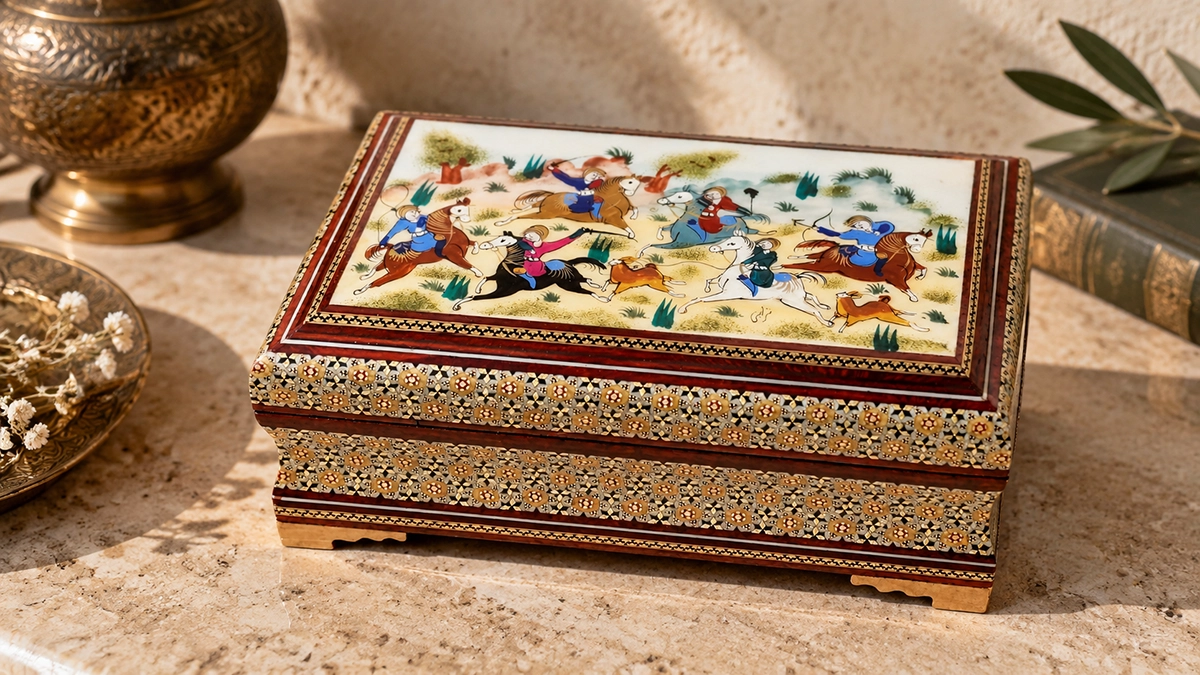
Start by looking at the surface as a constructed pattern rather than an image. Genuine khatam kari is made from physical strips and components assembled into geometric units, then cut and applied to the object. A printed surface may reproduce similar stars and borders, but the pattern itself is not built from separate inlaid materials.
Look closely at transitions within the design. In handmade work, the repeated geometry should remain controlled across corners, borders and larger panels. Tiny natural variations are possible because the work is made by hand, but the overall composition should remain deliberate rather than blurred or mechanically reproduced.
The surface should also make visual sense when examined from different angles. Metal, bone and wood respond differently to light. Brass elements may catch light differently from surrounding wood, while bone components create pale points or lines within the pattern. A flat printed imitation tends to reproduce colour without the same material response.
Do not judge a piece from one photograph alone. Product photography can flatten very fine marquetry. This matters particularly with small boxes, where the visual density of the khatam may be much clearer in person. Persis Collection has received customer feedback describing a piece as even more striking after it arrived than it appeared online.
What Materials Should You Look for in a Khatam Box?
Traditional khatam combines contrasting natural and metal elements to create its geometric surface. Materials confirmed across Persis Collection’s khatam range include woods such as walnut, ebony and jujube, together with camel bone and fine brass or silver wire.
Camel bone is used for pale elements within the pattern. In traditional preparation described in Persis Collection’s khatam material, bone strips may be soaked in lime water for an extended period to achieve the required whiteness before they are incorporated into the work.
The metallic components are not merely decorative colour. Fine metal strips help define the geometry and create the bright lines and points that give khatam its characteristic visual rhythm.
Collectors examining older pieces should be more cautious about assumptions concerning materials. Historical objects may contain materials that are no longer normally used in contemporary work. If an antique seller describes a component as ivory, buyers should verify the material and check the current rules that apply in their own country before purchasing or importing the object. Contemporary khatam pieces sold by Persis Collection use camel bone rather than ivory.
Does a Denser Khatam Pattern Mean Better Quality?
A finer and denser pattern can indicate more intricate work, but density alone does not prove quality. A collector should judge the precision of the geometry, the consistency of joins, the condition of the surface and the overall finish together.
A highly detailed pattern loses much of its value if the geometry breaks down at the borders or if visible gaps interrupt the design. Conversely, a less crowded composition can still be well made when the pattern is carefully aligned and the materials are cleanly integrated.
When inspecting a khatam box, look at four areas in particular:
- Pattern continuity: repeated shapes should remain coherent across the main surface.
- Edges and corners: these are useful places to inspect how carefully the marquetry has been applied.
- Material contrast: wood, bone and metal should form a real inlaid composition rather than a single flat printed image.
- Surface condition: lifting, cracking, distortion or obvious gaps matter, especially on an older piece.
Some khatam designs use recognisable decorative structures such as the shamse star pattern, while others combine geometric marquetry with painted or tazhib decoration. These differences affect appearance and collecting preference, but they should not be treated as a simple quality ranking.
How Much Is a Khatam Kari Box Worth?
Khatam box value varies widely because size, complexity, age, condition and decorative treatment all matter. New handmade examples can begin at accessible gift prices, while larger or more elaborate pieces cost substantially more. Antique pieces operate in a separate market where age, provenance, condition and seller attribution become much more important.
| Example | Verified or observed price | What it shows |
|---|---|---|
| Khatam Chovgan Jewellery Box, 12cm | £22 | Entry level for a small new handmade box |
| Persian Heritage Khatam Kari Jewellery Boxes | £24 to £39 | Price changes across multiple sizes |
| Khatam Jewelry Box, 21cm | £30 | A larger everyday jewellery box within the lower price band |
| Large Tazhib Khatam Kari Jewellery Box, 22 x 14cm | £64 | Higher pricing for a larger decorated piece |
| Current new handmade khatam range observed at Persis Collection | £22 to £240 | Shows the broader span between small boxes and more substantial pieces |
| Vintage examples observed in marketplace research | Approximately $27 to $65 | Age alone does not guarantee high value |
| Higher antique market examples identified during research | Approximately $1,200 to €2,500 | Attributed or earlier pieces can occupy a very different market |
These figures should be treated as reference points rather than a universal valuation system. An old box is not automatically valuable, and a higher asking price does not prove craftsmanship, age or authenticity. Condition and evidence about the object’s origin matter more as prices rise.
Modern or Antique Khatam: Which Should a Collector Buy?
New and antique khatam serve different collecting goals. A modern handmade box is usually easier to assess as a functional object because its condition, dimensions and current use are clear. An antique khatam box may offer age and historical interest, but it requires more careful examination of condition, materials and provenance.
For a first purchase, modern work can be the simpler place to begin. It allows the buyer to learn what real wood, bone and metal marquetry looks like without making age the main reason for buying.
Antique buyers should be especially careful with restoration, surface wear and material descriptions. A seller’s use of words such as antique, vintage or Persian does not establish a date by itself. If age is central to the price, ask what evidence supports the attribution.
For readers interested in the historical development rather than buying criteria, Persis Collection has separate guides to the history of khatam kari and Persian inlay work in Persian Heritage. Keeping those subjects separate makes it easier to judge a box as an object rather than repeating the history of the craft.
Choosing Your First Khatam Kari Box
A first khatam purchase should match how you intend to use or display it. Size, internal capacity, decorative style and budget are more useful starting points than searching for the most elaborate pattern available.
Small boxes work naturally as gifts, keepsake boxes and compact jewellery storage. Larger formats create more surface area for the marquetry and may suit collectors who want the khatam pattern itself to have a stronger visual presence.
Persis Collection currently carries khatam boxes from approximately 12cm through substantially larger formats. The Persian Heritage Khatam Kari Jewellery Boxes, for example, are offered in Small, Medium and Large sizes, measuring 12 x 10 x 7.5cm, 14 x 10 x 7.5cm and 16.5 x 10 x 7.5cm respectively.
Some pieces also combine khatam with other Persian decorative traditions. If that combination appeals to you, the Large Tazhib Khatam Kari Jewellery Box introduces painted decorative work alongside the geometric inlay. Collectors interested in related techniques can also read about the history and art of Firoozeh Koobi, another Persian decorative technique with a very different material language.
To compare current designs, sizes and formats, browse the khatam kari collection. If your main purpose is jewellery storage, the separate Persian jewellery boxes collection provides a more focused starting point.
Our Experience at Persis Collection
Gift buying is one of the clearest patterns we see around khatam pieces. Customers have described buying them for friends who value their cultural heritage, choosing several Persian pieces as Christmas gifts, and experiencing the presentation itself as part of the pleasure of receiving the object.
Packaging and condition also matter strongly to buyers. Customers sometimes mention safe arrival without being asked, including feedback that a piece arrived with no damage or cracks. Presentation packaging has also been noticed specifically. This matters because a khatam object contains fine applied work on a wooden structure, so both presentation and physical protection are part of the buying experience.
We also see behaviour that is recognisably collector led rather than purely functional. One British customer purchased an Persian Heritage khatam tissue box to coordinate with a smaller box previously bought during a trip to Persian Heritage. That is a useful model for a new collector: a collection does not have to begin with a rare antique. It can grow gradually through pieces that share a technique, city, palette or decorative language.
Repeat purchasing appears in customer feedback too. Rather than treating khatam as a single souvenir purchase, some customers return for further Persian pieces after living with the first one.
How to Care for a Khatam Inlay Box
Khatam should be kept away from prolonged direct sunlight, excessive heat and excessive moisture. Because the marquetry is applied to a wooden structure, unsuitable conditions can contribute to swelling, distortion or warping.
Keep the box in a stable indoor environment rather than beside a radiator, in strong direct sun or in an area exposed to persistent damp. For collectors, stable storage is particularly important because small changes that seem cosmetic at first can affect the joins and alignment of fine inlay over time.
Made to order khatam pieces may also require additional production time. Persis Collection states an additional production period of approximately two to four weeks for relevant made to order items before they are ready for dispatch. For a gift purchase, that production period should be considered before choosing the piece.
Conclusion
Learning how to identify khatam kari is less about memorising one test and more about understanding how the object is built. Real khatam uses physical pieces of wood, bone and metal to form its geometry. Quality should then be judged through precision, condition, material contrast, pattern continuity and the overall finish.
For a new collector, modern handmade work provides an accessible reference point before moving into the more complicated antique market. Start with a size and design you genuinely want to live with, examine the workmanship closely, and compare the price with the materials, scale and condition of the piece.
You can explore the current Persis Collection khatam kari range to compare contemporary examples across different sizes and decorative styles.
Frequently Asked Questions
What is khatam kari?
Khatam kari is a Persian decorative inlay technique that creates repeating geometric patterns from very small pieces of materials such as wood, bone and metal. These elements are assembled into patterned units and applied to objects including boxes, frames and decorative pieces.
How can you tell if a khatam box is handmade or printed?
Look for evidence that the pattern is made from separate physical materials rather than reproduced as one flat image. Wood, bone and metal should react differently to light, and the geometry should continue as constructed marquetry across the decorated surface.
Are khatam boxes valuable?
Some are, but value depends on much more than the presence of khatam. Size, craftsmanship, condition, age, decorative complexity and reliable information about an older object’s origin can all affect value.
How much does a khatam kari box cost?
Verified new handmade examples at Persis Collection currently range from approximately £22 to £240. Antique market prices can vary far more widely, so age, condition and provenance need to be assessed before treating a high asking price as evidence of value.
How do you tell an antique khatam box from a modern one?
Age cannot be established from the pattern alone. Examine wear, construction, materials, restoration and provenance, and ask what evidence supports the seller’s dating. If the claimed age substantially affects the price, independent specialist advice may be worthwhile.
Comments