


Ancient Persian Clothing: What the Achaemenids and Sassanids Wore

- mahyar
- 28 October 2026
- Persian History
- 9 minutes
Ancient Persian clothing included long pleated robes, fitted riding outfits, trousers, tunics and distinctive headwear. The Achaemenids and Sasanians dressed differently, but both used clothing to express status and identity. Our knowledge comes mainly from carved reliefs, ancient accounts and surviving works of art.
Clothing also offers a way to explore Persian culture beyond the ancient world. Some words and forms have survived, while today’s traditional Persian clothing for women reflects a much wider history of Persian dress.
What Did Ancient Persians Wear?
Ancient Persians wore different clothes according to the period, their position and the activity involved. Achaemenid court dress was known for its broad sleeves and flowing folds. Sasanian clothing often featured shorter tunics, trousers, belts and decorated outer garments.
The main garments and accessories included:
- Long robes: Loose, pleated garments worn at the Achaemenid court.
- Tunics: Sleeved garments used with other layers of clothing.
- Trousers: Practical leg coverings associated with riding dress.
- Coats and cloaks: Outer garments shown in historical images.
- Belts: Fabric bands or decorated belts used to secure clothing.
- Headwear: Soft caps, royal hats and other distinctive coverings.
- Jewellery: Necklaces, pearls and precious ornaments associated with royal and noble dress.
Two periods offer especially useful evidence: the Achaemenid Empire, from around 550 to 330 BCE, and the Sasanian Empire, from 224 to 651 CE. These periods reveal both differences in dress and the changing ways rulers presented themselves.
Achaemenid Clothing: Court Robes and Riding Outfits
Achaemenid clothing is commonly divided into two main styles: court dress and riding costume. The first was loose and richly folded. The second used closer fitting garments that suited riding.
The distinction was not simply between two peoples. Herodotus, as discussed by Encyclopaedia Iranica, described Persians wearing clothing associated with the Medes. This means a garment alone cannot reliably identify someone’s ethnic background.
The Pleated Persian Court Robe
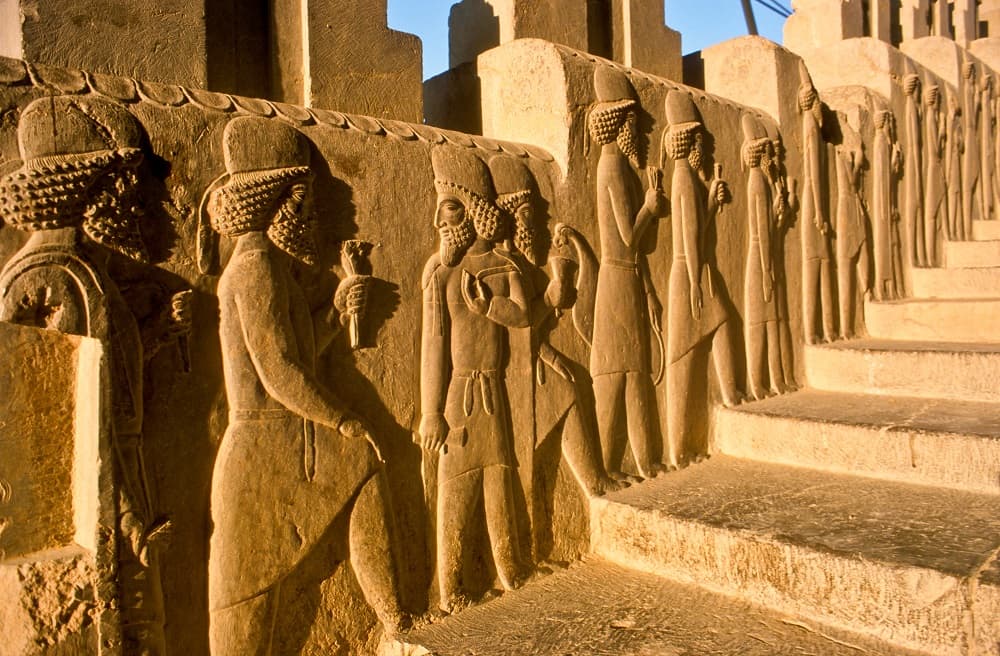
The Achaemenid court robe was long, loose and heavily pleated. It had very wide sleeves and was secured with a broad fabric belt. Its folds gave the garment a distinctive shape.
At Persepolis, known in Persian as Takht-e Jamshid, Darius I, Xerxes and Artaxerxes I appear in this style of royal clothing. The figures also wear distinctive headwear and short, laced shoes.
The robe is one of the clearest examples of ancient persian dress shown in surviving royal art. Its carefully arranged folds make it easy to recognise, although the original fabric construction is harder to establish.
Riding Clothes, Trousers and the Kandys
Achaemenid riding clothing had a different shape. It included trousers, a sleeved tunic, a coat and a soft cap. Together, these garments offered a closer fitting alternative to the court robe.
The coat is usually called a kandys. It was often placed over the shoulders, leaving its sleeves hanging down. Scholars still debate the precise meaning and use of the ancient term.
Trousers were an important part of the riding costume. Some examples also show the lower legs secured with ties. These details distinguish riding dress from the broad folds of court clothing.
Descriptions of achaemenid empire clothing therefore need to include both styles. Focusing only on the royal robe would leave out much of the clothing shown in surviving evidence.
Ancient Persian Headwear and Colours
Ancient Persian headwear included cylindrical royal hats and soft riding caps. The riding cap was known as the tiara or kyrbasia. It could be made from felt, leather or soft fabric, with side pieces covering the cheeks and neck.
According to the historical evidence discussed by Encyclopaedia Iranica, only the king could wear this riding headwear upright. This made the way a cap was worn significant.
Colour also carried meaning in older Persian traditions. Red was associated with warriors, white with priests, and blue with farmers and herders. These associations should not be treated as a complete dress code for everyone.
Traces of red colouring were also found on royal shoes and their laces at Persepolis. Such evidence reminds us that ancient sculptures were not necessarily as plain as they appear today.
Sasanian Clothing: Tunics, Trousers and Royal Dress
Sasanian clothing developed a recognisable style of tunics, trousers and decorated garments. The Sasanian period, also spelled Sassanid, lasted from 224 to 651 CE. Surviving royal images provide much of what we know about its dress.
Compared with Achaemenid court robes, Sasanian royal clothing often placed greater visual emphasis on fitted upper garments, belts, jewellery and patterned surfaces.
Everyday Men’s Clothing and the Kamar
Men in Sasanian images are commonly shown wearing knee length tunics, loose trousers and boots. A belt, called a kamar, secured the tunic around the waist.
Some figures also wear a heavier outer coat fastened across the chest. The combination of trousers and tunics was well suited to riding.
These garments provide a useful starting point for understanding ancient persian clothing male searches. However, surviving images do not provide a complete record of what every man wore in daily life.
Royal Clothing, Jewellery and Ribbons
Sasanian rulers are shown wearing short tunics, finely folded trousers and decorated belts. Their clothing could also include a cloak held with two round fasteners.
Pearl necklaces, precious ornaments and long flowing ribbons were important features of royal appearance. The ribbons appear prominently in representations of kingship.
Noble families could wear silk and jewellery. Kings also presented garments and ornaments as marks of honour. Clothing therefore communicated more than personal taste at the Sasanian court.
This use of dress helps explain ancient persian clothing royalty. The surviving images show how clothing, accessories and symbols worked together to make royal status visible.
Clothing in the Reliefs of Taq-e Bostan
The reliefs at Taq-e Bostan preserve important evidence of late Sasanian royal dress. Images associated with Khosrow II, who ruled from 591 to 628 CE, show richly decorated garments and jewellery.
Some garments feature firm shapes and detailed patterns of flowers, birds and animals. These designs stand apart from the broad pleats of earlier Achaemenid court robes.
Other sources for Sasanian dress include carvings at Naqsh-e Rostam, Naqsh-e Rajab and Firuzabad, alongside the mosaics of Bishapur and decorated silver vessels.
What Did Ancient Persian Women Wear?
Ancient Persian women’s clothing is harder to study than men’s clothing. Official Achaemenid reliefs do not show women, and Sasanian images also represent women far less often than men.
Even so, smaller objects and other surviving images offer useful clues. They show long garments, draped clothing, varied sleeves and different ways of covering the hair.
Women’s Clothing in the Achaemenid Period
Evidence for ancient persian clothing female comes mainly from seals, ivory objects and reliefs from Anatolia. These sources suggest that women wore long tunics or pleated garments resembling court dress.
Some women appear with coverings over their hair and neck, while their faces remain visible. Hair was sometimes gathered into a long braid down the back.
These images do not prove that all women dressed alike. Clothing probably varied, but the surviving evidence cannot establish every difference.
Herodotus also described Amestris, the wife of Xerxes, making a colourful robe for her husband. This account offers a glimpse of how textiles appeared in ancient writing, rather than a complete picture of women’s wardrobes.
Anyone researching ancient persian women’s clothing should therefore distinguish what the objects actually show from modern attempts to fill the gaps.
Women’s Clothing in the Sasanian Period
Sasanian women are shown in long, flowing tunics, sometimes with sleeves and sometimes without. A belt could sit beneath the bust, giving the garment its shape.
Some figures also wear a cloak or draped covering. It could pass over the left shoulder or be drawn over the head.
In Sasanian reliefs, Anahita is depicted wearing clothing associated with a royal woman. This makes her image useful for studying dress, although a religious figure should not be treated as a direct portrait of an ordinary woman.
Representations of women remain much less common than those of men. We should not assume that the surviving images describe every social group or every form of clothing.
Achaemenid vs Sasanian Clothing: Key Differences
The clearest difference lies in the surviving styles of court and royal dress. Achaemenid images show broad pleated robes alongside riding outfits. Sasanian images place strong emphasis on tunics, trousers, belts and decorated royal clothing.
| Feature | Achaemenid period | Sasanian period |
|---|---|---|
| Period | About 550 to 330 BCE | 224 to 651 CE |
| Men’s clothing | Pleated court robes or fitted riding outfits | Knee length tunics, loose trousers and boots |
| Royal dress | Broad sleeves, deep folds and fabric belts | Decorated tunics, jewellery, cloaks and ribbons |
| Women’s clothing | Long tunics, pleated garments and occasional head coverings | Long flowing tunics, belts and draped outer garments |
| Headwear | Royal hats and soft riding caps | Royal headwear and jewellery visible in surviving images |
| Main evidence | Reliefs, seals, small objects and Greek accounts | Rock reliefs, mosaics and silver vessels |
Both periods included trousers, tunics and forms of outer clothing. The differences in the table describe the surviving evidence, not a complete list of every garment worn across either empire.
How Do We Know What Ancient Persians Wore?
Most evidence for ancient Persian clothing comes from images and written accounts rather than surviving garments. Each source tells us something different, and each has limits.
For the Achaemenid period, the main evidence includes the Bisotun relief, the tomb of Darius I at Naqsh-e Rostam, and the Apadana staircase at Persepolis. Ancient writers such as Herodotus and Xenophon offer further descriptions.
The clothing evidence is explained in Encyclopaedia Iranica’s study of Median and Achaemenid dress by Shapur Shahbazi.
For the Sasanian period, carvings at Naqsh-e Rostam, Naqsh-e Rajab, Firuzabad and Taq-e Bostan are especially useful. The Bishapur mosaics and silver vessels add further visual evidence. Elsie H. Peck examines these materials in Encyclopaedia Iranica’s study of Sasanian clothing.
Very little ancient Persian fabric survives. Lloyd Llewellyn-Jones discussed this problem in Cardiff University’s Persian Power Dressing. For the British Museum exhibition Luxury and Power: From Persia to Greece, two Achaemenid outfits were reconstructed, including a gold and yellow wool court robe with a blue linen lining and lion head ornaments.
These reconstructions help us imagine the garments in three dimensions, but they remain interpretations of historical evidence. For readers interested in the original imagery, the Persian Reliefs Bilingual Coloring Book offers another way to explore Achaemenid relief designs.
The monuments at Bisotun and Taq-e Bostan are also introduced in our guide to Persian Heritageshah Province.
What Has Survived from Ancient Persian Clothing?
Some connections to ancient Persian clothing remain visible in words and regional dress. These links do not mean that modern garments are unchanged versions of ancient outfits.
One example is the word shalvar, meaning trousers. The historical relationship between this word and older names for Persian trousers shows how clothing vocabulary can carry traces of the past.
Another example is the rounded felt cap associated with Median riding clothing. A related traditional form has remained visible in parts of Fars and among Bakhtiari communities.
Modern traditional Persian women’s clothing and traditional Persian men’s clothing include many regional styles. They belong to their own living traditions, rather than representing a single ancient costume.
Historical symbols also appear in present day designs. The Cyrus the Great Persian shawl with a Faravahar design draws on the Tomb of Cyrus, the Faravahar motif and the story of Kay Khosrow in the Shahnameh. Readers can explore the motif further in our guide to the Faravahar symbol.
What We Have Learned From Our Customers
At Persis Collection, we have spent more than ten years sourcing Persian art and handicrafts. We work directly with more than 250 Persian artists and craftspeople, without intermediaries.
Many customers are second generation Iranians or people connected to Persian culture through partners, family and close friends. Our traditional clothing is made in small runs, and many pieces are made after an order is placed.
Our Persepolis inspired women’s skirt has been part of the collection since 2021. Our work is centred on contemporary craftsmanship and cultural design, not on selling exact reconstructions of ancient garments.
We hold stock in London and serve customers worldwide, particularly in the UK, USA, Canada and Europe.
Exploring Persian Clothing Today
Ancient Persian dress can be explored through reliefs, research and surviving works of art. Contemporary clothing offers another way to appreciate Persian patterns and regional craftsmanship, without confusing inspiration with historical reconstruction.
Our Persepolis inspired skirt uses motifs drawn from the ancient site. The Bakhtiari costume is a present day regional outfit with its own traditional headwear. Qajar style clothing belongs to a much later design tradition.
These examples are part of a wider collection of traditional and culturally inspired pieces.
You can see each of these pieces below.


To explore the clothing itself, browse our Persian traditional women’s clothing collection.
Frequently Asked Questions
What did ancient Persian women wear?
Achaemenid women are shown in long tunics and pleated garments, sometimes with head coverings. Sasanian images also show flowing tunics, belts and draped outer clothing. Evidence for women’s dress is more limited than evidence for men’s dress.
What did ancient Persian men wear?
Achaemenid men wore pleated court robes or riding outfits with trousers, tunics and coats. Sasanian men are often shown wearing knee length tunics, trousers, boots and belts.
What did Persian royalty wear?
Achaemenid rulers appear in long pleated robes, broad belts and distinctive hats. Sasanian rulers are shown with decorated tunics, jewellery, ribbons and cloaks. Surviving royal art offers more detail than evidence of everyday clothing.
What is the difference between Achaemenid and Sasanian clothing?
Achaemenid royal dress is especially known for broad, pleated robes, alongside fitted riding clothing. Sasanian royal images often show tunics, trousers, decorated belts, jewellery and flowing ribbons. These are differences in the surviving representations, not absolute rules for everyone.
Did ancient Persians wear trousers?
Yes. Trousers formed part of Achaemenid riding outfits and are also prominent in Sasanian clothing. They were worn with tunics and other garments.
What colours did ancient Persians wear?
Ancient Persian traditions associated red with warriors, white with priests and blue with farmers and herders. Evidence from Persepolis also shows red colouring on royal footwear. The surviving information does not establish every colour worn by ordinary people.


Comments