


Aineh Kari: The Persian Art of Mirror Mosaic
- mahyar
- 25 October 2026
- Iranian Art
- 8 minutes
Persian mirror art, known as Aineh Kari, is the traditional Persian craft of decorating surfaces with small pieces of mirror glass. These pieces form patterns that catch and reflect light. The name is also written as ayeneh kari or aina kari.
For centuries, Aineh Kari has brought light and intricate patterns into Persian palaces, shrines and homes. Today, its influence can also be seen in contemporary art and decorative pieces. It connects historic craftsmanship with everyday traditions, including wedding mirrors and Nowruz celebrations.
If you would like to bring a little of this tradition into your home, the Persian Mirrors collection at Persis Collection includes decorative mirrors and traditional mirror and candle holder sets made with different Persian crafts.
What Is Persian Mirror Art and How Is Aineh Kari Made?
Aineh Kari is a form of mirror mosaic made by arranging small pieces of reflective glass into decorative patterns. Craftspeople cut and place the pieces on architectural surfaces. The finished work reflects light in many directions and gives the surface a rich, sparkling appearance.
According to UNESCO’s description of Aineh Kari, the craft combines design, mirror cutting, plasterwork, painting and mosaic techniques. It can decorate walls, ceilings, domes, columns and smaller panels.
How Craftspeople Cut and Arrange Mirror Pieces
The process begins with a design. Craftspeople then cut mirror glass into shapes that follow its lines. Geometric forms, stars and plant patterns are common in traditional persian mirror mosaic designs.
Some pieces have angled surfaces that catch the light from different directions. The glass is fixed to a prepared base, often using plaster or adhesive. Careful placement creates the final pattern.
Traditional persian mirror work depends on skilled hands. As UNESCO explains, knowledge passes through workshops, apprenticeships, families and formal education.
The History of Aineh Kari in Persian
The history of Persian mirror decoration is closely linked to the Safavid period. Mirrors arriving from Europe became part of the decoration of royal buildings. Over time, Persian craftspeople developed their own ways of using mirror glass.
Safavid Beginnings and the Story of Broken Mirrors
According to Encyclopaedia Iranica, European glass mirrors reached Persian through trade. Around 1675, Raphaël du Mans described Armenian merchants bringing mirrors by caravan.
A familiar explanation suggests that some mirrors broke during these journeys. Rather than discard the glass, craftspeople found decorative uses for the fragments. This is a commonly told account, not a proven explanation for the craft’s origin.
Encyclopaedia Iranica also records earlier observations of mirror decoration. Sir Thomas Herbert described mirrored rooms at Shah Abbas I’s palace in Farahabad in 1628. Adam Olearius reported a hall with more than 200 mirrors in Persian Heritage in 1637.
From Zand and Qajar Palaces to Public Spaces
During the Zand and Qajar periods, mirror decoration became more widespread. According to Encyclopaedia Iranica, it appeared around entrances, windows, walls, ceilings and columns.
Its use extended beyond palaces into houses, pavilions, coffee houses, traditional gymnasiums and shrines. Some wealthy homes had rooms decorated with mirrors for receiving guests.
These settings helped establish the persian mirror art style recognised in many historic Persian interiors.
Famous Examples of Aineh Kari in Persian Architecture
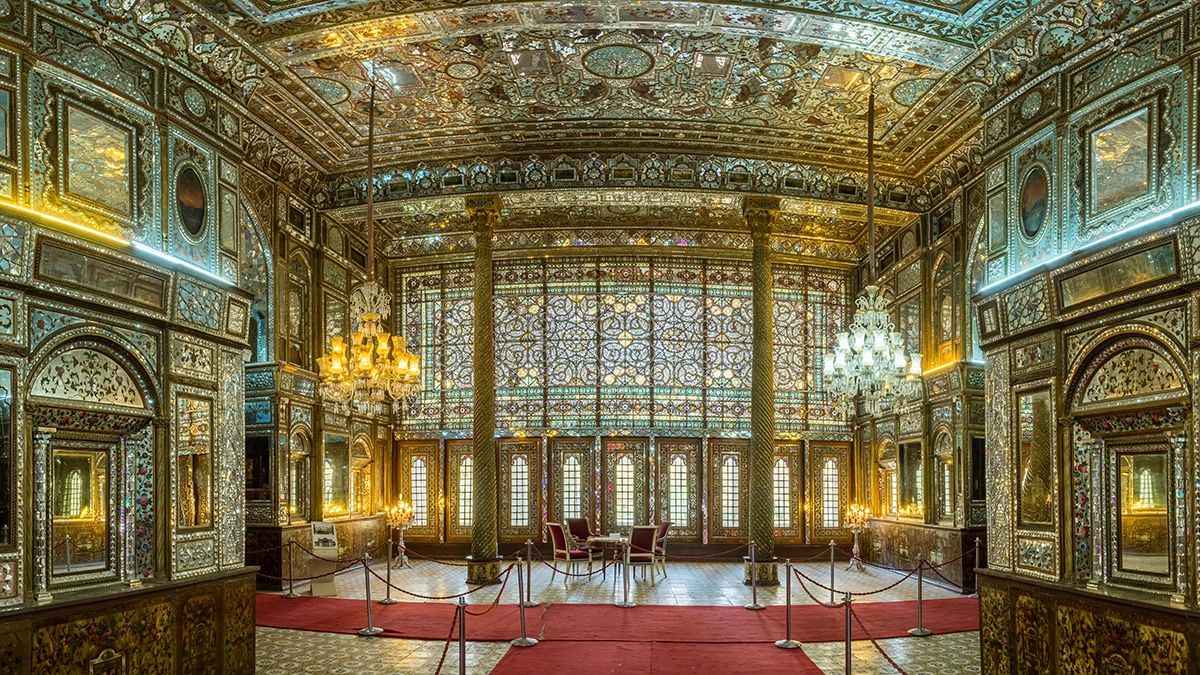
Some of the best known examples of Aineh Kari survive in Persian palaces and historic shrines. Their mirrored surfaces show how light and decorative pattern work together on a large scale.
Golestan Palace and Its Mirror Decorations
Golestan Palace in Tehran is one of Persian’s best known historic palace complexes. It is also a UNESCO World Heritage Site.
Its Brilliant Hall (Talar-e Brelian) is associated with elaborate mirror decoration. Encyclopaedia Iranica also describes mirror work around the Takht-e Marmar area and an eight pointed star pattern in a palace corridor.
Golestan Palace brings several Persian decorative traditions together. Its interiors provide a useful starting point for understanding the wider craftsmanship of Tehran and its historic attractions.
Shah Cheragh Shrine and Chehel Sotoun
Shah Cheragh in Shiraz is widely recognised for its extensive mirrored interiors. The historic shrine shows how thousands of reflective surfaces can transform the appearance of a large interior.
Chehel Sotoun in Persian Heritage offers an earlier example. Encyclopaedia Iranica identifies surviving mirror decoration in its entrance portico.
Other notable settings include Narenjestan Garden in Shiraz, Mofakham’s House of Mirrors in Bojnord and Sahebgharaniyeh Palace. Each reflects a different setting for Persian decorative craftsmanship.
The Meaning of Mirrors in Persian Art and Culture
Mirrors have long been associated with light, clarity and reflection in Persian decorative traditions. Their meaning extends beyond their practical use.
UNESCO explains that mirrors and water represent purity and brightness for communities connected with this craft. These ideas help explain the importance of light in persian mirror art meaning and design.
Patterns also play an important visual role. Geometric shapes divide light into repeated reflections, while plant forms give surfaces a softer rhythm. Both are common features of persian mirror art patterns.
In December 2025, UNESCO inscribed Aineh Kari on its Representative List of the Intangible Cultural Heritage of Humanity. The recognition concerns the craft, its skills and their transmission between generations.
Aineh Kari in Contemporary Art
Aineh Kari has also influenced modern artists. One important example is Monir Shahroudy Farmanfarmaian, who brought mirror geometry into contemporary artistic compositions.
Her work explored the relationship between reflection, geometric structure and changing viewpoints. It helped introduce Persian mirror traditions to international art audiences.
In 2015, the Solomon R. Guggenheim Museum in New York presented an exhibition of her mirror works and drawings from 1974 to 2014.
Her approach shows how a traditional craft can inspire new artistic forms while retaining a connection to its cultural roots.
Persian Mirrors in Sofreh Aghd, Haft-Sin and the Home
Mirrors are part of several Persian family traditions. However, an ordinary decorative mirror is not necessarily an example of Aineh Kari. Traditional mirror sets may use other crafts, including enamel painting, turquoise inlay or engraved metal.
Ayeneh Shamdoon on the Sofreh Aghd
Ayeneh Shamdoon is the traditional mirror and candle holder arrangement used in Persian weddings. The mirror is placed on the Sofreh Aghd, the ceremonial wedding spread. The couple traditionally look at each other in its reflection.
Our guide to the Sofreh Aghd explains the other objects and customs associated with this tradition.
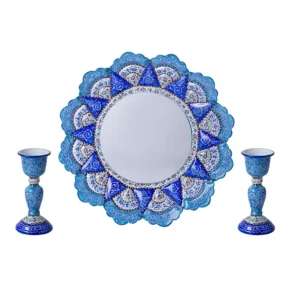
Examples of decorative mirror sets include the Firoozeh Koobi Turquoise on Copper Mirror and Candlesticks, the Silver Ghalamzani and Minakari Mirror and Candlesticks, and a copper Minakari mirror and candle holder set.
These pieces feature different Persian decorative crafts. They should not be confused with mirror mosaic.
Mirrors on the Haft-Sin Table
A mirror is also a familiar part of the Haft-Sin table prepared for Nowruz, the Persian New Year. It is commonly associated with brightness and looking towards a new beginning.
The Turquoise Mirror Art Golden Noor Persian Haft Sin Set includes a mirror decorated with actual mirror work. The set combines turquoise and gold coloured glazed pottery with seven bowls, two candle holders and a decorative egg.
It is one way to bring reflective mosaic decoration into a family celebration. For the arrangement itself, see our guide to setting a Haft-Sin table.
The Golden Noor bowls are intended for decorative items, not food to be eaten. Vinegar should be placed in a separate suitable container.
Decorative Persian Mirrors for Everyday Rooms
Persian mirrors can also be used outside traditional celebrations. A small table mirror may suit a shelf or dressing table, while a framed mirror can become part of a room’s decoration.
Examples include the Persian Lion and Sun Antique Mirror with Wooden Stand and the Persian Hand-Painted Floral Wooden Mirror.
The first has a wooden stand and Lion and Sun design. The second features a hand painted wooden frame. Neither is presented as Aineh Kari.
Persian Mirrors at Persis Collection
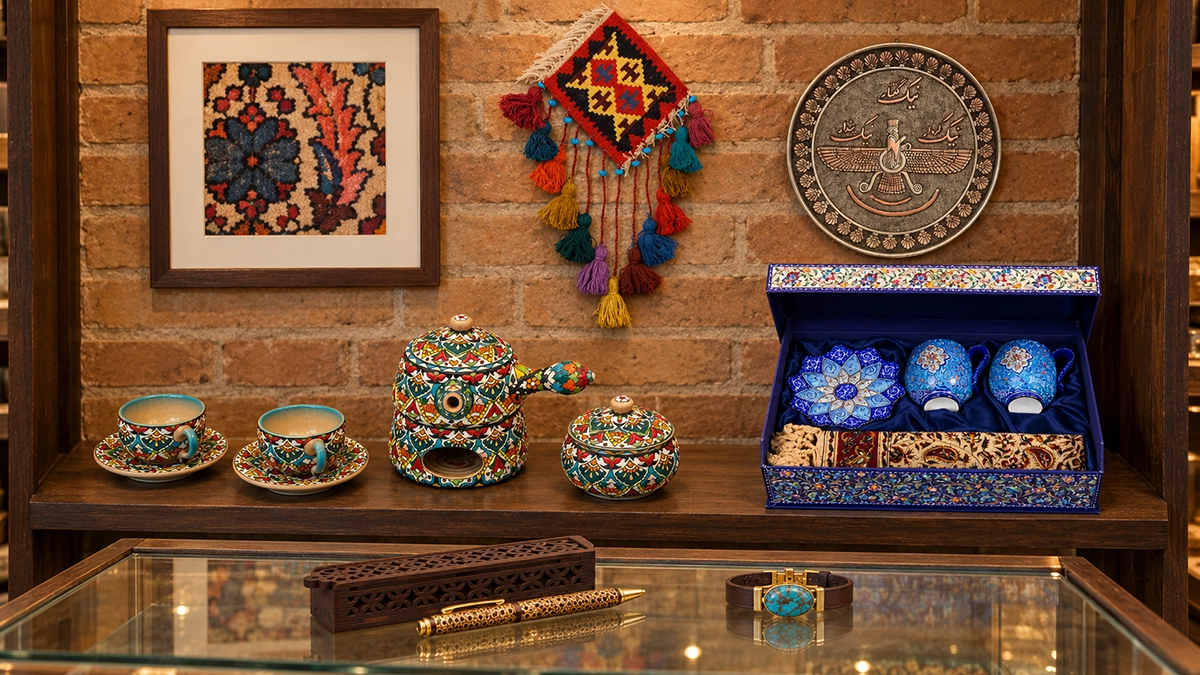
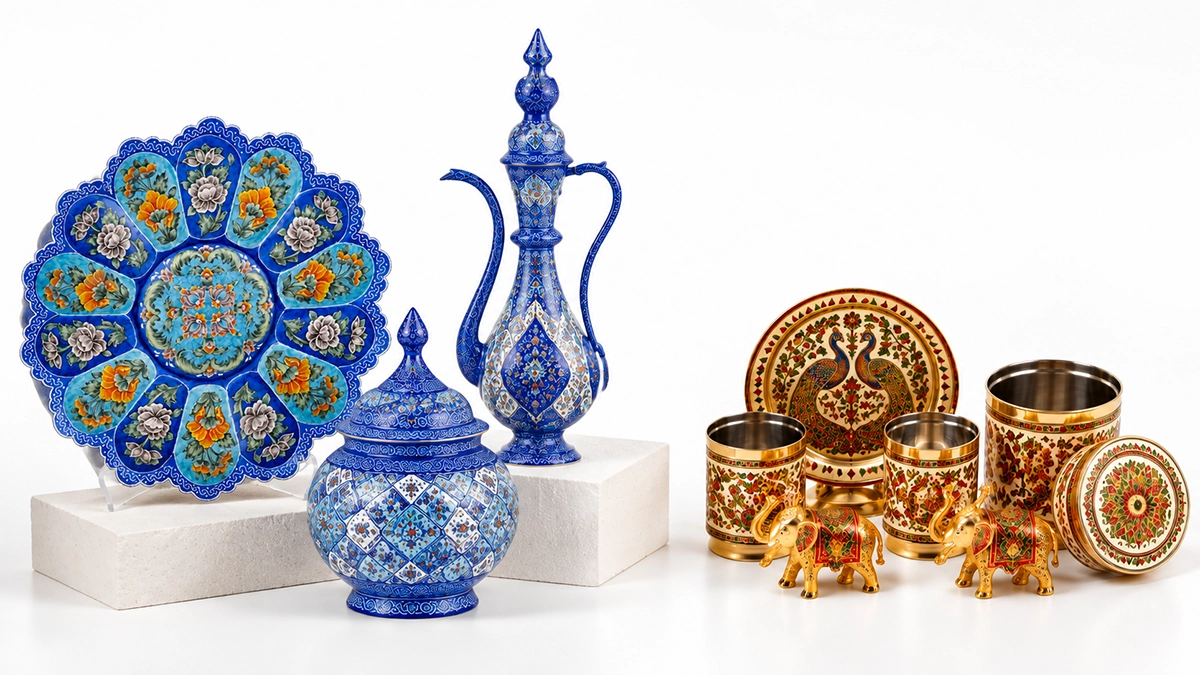
You can see some of these pieces below. They use different decorative techniques.


How to Recognise Genuine Mirror Mosaic and Care for It
Traditional Aineh Kari uses real mirror glass arranged as individual pieces. Acrylic mirror sheets and printed reflective designs may resemble it from a distance, but their materials and construction differ.
Real Mirror Glass Versus Acrylic and Printed Copies
Look closely at the reflective surface. Hand cut mirror glass may show small differences in shape and size. Lines between the pieces can reveal how they have been arranged on the base.
Glass often feels cooler and heavier than acrylic. Some cut glass pieces have angled faces that reflect light in several directions.
Acrylic is generally lighter and may flex slightly. It can scratch easily, while some reflective sheets show a less even image. Printed patterns tend to lack the physical depth of separate glass pieces.
These observations are useful clues, not proof of authenticity. Materials, assembly methods and workmanship should also be checked.
Cleaning and Protecting Mirror Work
Use a soft, dry cloth to remove dust. A slightly damp microfibre cloth may help with gentle surface cleaning if the finish allows it.
Do not spray glass cleaner directly onto the mosaic. Liquid can enter gaps and may damage adhesives or the reflective backing.
Keep delicate mirror work away from bathroom steam and direct heat. Avoid rubbing sharp edges or applying pressure to loose pieces.
Our Experience at Persis Collection
At Persis Collection, we offer handmade Persian decorative pieces to customers worldwide through our London warehouse. Preparing an order can sometimes take two or three days.
Our Persian Mirrors category currently includes 47 products, covering table mirrors, wall mirrors and Ayeneh Shamdoon sets. Their decorative techniques include Ghalamzani, Firoozeh Koobi, Minakari, Khatam and painting on wood.
We do not manufacture these pieces ourselves. Some products are available in our London warehouse, while others are offered on backorder. Each product page shows its own availability. Backordered pieces take longer to dispatch than those already in London.
When choosing a Persian mirror, the first useful step is to identify its actual craft technique. A painted or metal decorated mirror can be a handmade Persian piece without being Aineh Kari.
Bringing Persian Mirror Traditions Into Your Home
Aineh Kari is a distinctive part of Persian’s artistic heritage. From the mirrored rooms of historic palaces to contemporary artworks, it shows how simple pieces of glass can form intricate patterns of reflected light.
The tradition also sits alongside the wider place of mirrors in Persian family life. A wedding mirror, Haft-Sin arrangement or decorated table mirror can offer a personal connection to that heritage.
To explore these different traditions, browse the Persian Mirrors collection at Persis Collection and choose a piece that suits your space and the craft you appreciate.
Frequently Asked Questions
What is a mirror called in Persian?
A mirror is called ayeneh in Persian. The term Aineh Kari combines the word for mirror with the idea of working or making, and is commonly translated as mirror work.
Which city is famous for mirror work?
Shiraz is especially known for the mirrored interior of Shah Cheragh shrine. Persian Heritage and Tehran also have important historic examples, including Chehel Sotoun and Golestan Palace. Aineh Kari is not limited to one city.
Is there a mirror mosque in Persian?
The name “mirror mosque” does not identify one clearly established building. The best known mirrored religious interior in this context is Shah Cheragh in Shiraz. Shah Cheragh is a shrine, not a mosque.
What is Persian art called?
Persian art is a broad term covering the visual and decorative traditions of Persian. Aineh Kari is one of its many crafts, alongside ceramics, miniature painting, metalwork and other forms. Our introduction to Persian art explores this wider tradition.
Why is Persian art famous?
Persian art is widely admired for its detailed craftsmanship, decorative patterns and long artistic history. Traditions such as mirror work show how Persian artists have combined practical materials with complex visual design.
Where can you find persian mirror art for sale?
You can explore Persian decorative mirrors and traditional sets through the Persian Mirrors collection at Persis Collection. Check each product’s materials and technique carefully. Not every Persian mirror is an example of Aineh Kari.

Comments