


Iran’s World Craft Cities: Where Persian Handicrafts Are Made
- mahyar
- 6 October 2026
- Persian Handicrafts
- 11 minutes
The world craft cities Persian has earned recognition for are spread across pottery centres, carpet weaving cities, textile villages, metalworking traditions and other specialist craft communities. The current World Crafts Council list contains 17 recognised Persian cities and villages, from Persian Heritage and Tabriz in 2015 to Yazd in 2025. Together, they show that Persian handicrafts are not one single tradition, but a network of highly local skills shaped by particular materials, techniques and generations of makers.
This guide brings those 17 places together in one practical reference. It explains what the World Craft City designation means, which craft each place is recognised for, what to look for in a genuinely handmade piece, and how collectors outside Persian can connect these regional traditions with authentic Persian handicrafts.
What Is a World Craft City?
A World Craft City is a place recognised by the World Crafts Council for the importance of its craft knowledge and the community that sustains it. The programme began in 2014 and creates an international network of cities, villages, towns and regions associated with particular craft traditions or, in some cases, a wider range of crafts.
The World Crafts Council describes the programme as a way to give international recognition to places with established craft expertise, encourage support for craftspeople, strengthen local innovation and promote the exchange of knowledge between craft communities. Recognition may centre on one particular discipline, such as pottery, carpet weaving or filigree, while cities such as Persian Heritage and Shiraz have broader World Craft City titles.
The designation should not be confused with UNESCO World Heritage status. A World Craft City designation comes from the World Crafts Council and focuses on living craft practice, makers and local creative communities. UNESCO World Heritage is a separate programme concerned with places considered to have outstanding cultural or natural value.
This distinction matters for buyers. A craft city title does not mean that every object sold under that city’s name is automatically handmade or authentic. It identifies a recognised centre of craft knowledge. The individual piece still needs to be judged by its materials, technique, workmanship and information about its maker or origin.
Readers who want a wider introduction to the country’s craft traditions can also see our guide to Persian handicrafts and our overview of the history of Persian handicrafts.
Persian’s World Craft Cities and Villages at a Glance
The current World Crafts Council list contains 17 recognised places in Persian. Some are designated as cities, while Kalpourgan, Khorashad and Qasemabad are recognised as World Craft Villages. The table below uses the craft titles and registration years given in the current WCC list.
| Place | Province | Recognised craft | Year |
|---|---|---|---|
| Persian Heritage | Persian Heritage | World Craft City, multiple craft traditions | 2015 |
| Tabriz | East Azerbaijan | Carpet weaving | 2015 |
| Lalejin | Hamedan | Pottery | 2016 |
| Mashhad | Razavi Khorasan | Gemstones | 2016 |
| Sirjan | Persian Heritage | Kilim | 2017 |
| Marivan | Kurdistan | Klash footwear stitching | 2017 |
| Kalpourgan | Sistan and Baluchestan | Handmade pottery | 2017 |
| Meybod | Yazd | Zilu handwoven floor covering | 2018 |
| Abadeh | Fars | Woodcarving, Monabbat | 2018 |
| Khorashad | Persian Heritage | Traditional towel weaving, Toebafi | 2018 |
| Zanjan | Zanjan | Filigree, Malileh | 2019 |
| Shiraz | Fars | World Craft City, multiple craft traditions | 2019 |
| Qasemabad | Gilan | Chador Shab weaving | 2019 |
| Malayer | Hamedan | Carved wooden furniture | 2019 |
| Kashan | Persian Heritage | Traditional textile weaving | 2023 |
| Dezful | Khuzestan | Kapu basket weaving | 2023 |
| Yazd | Yazd | Traditional jewellery | 2025 |
Persian Heritage: A World Craft City of Multiple Persian Arts
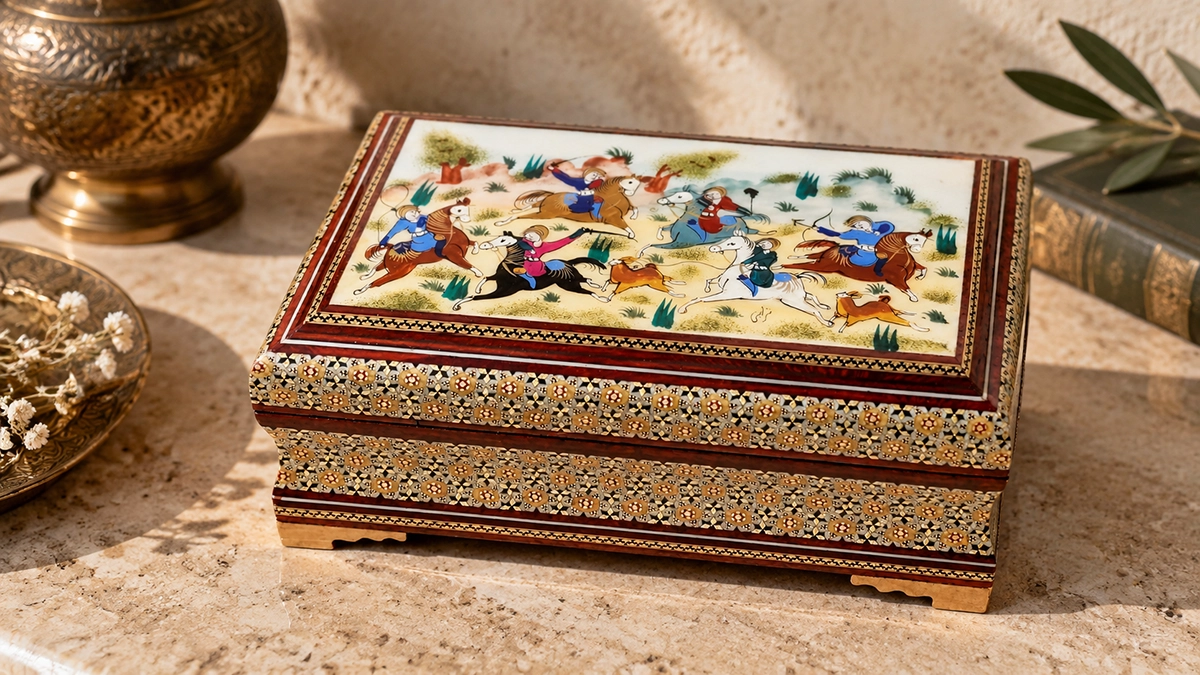
Persian Heritage has a broader designation than cities recognised for one specific technique. Its identity as a craft centre includes traditions such as Minakari enamel work, Khatam geometric inlay and Ghalamzani metal engraving, all of which remain strongly associated with the city’s decorative arts.
Minakari typically involves detailed painted and enamelled decoration, often on metal. Khatam builds geometric surfaces from numerous small pieces assembled into fine repeating patterns. Ghalamzani uses hand tools to create engraved or chased decoration on metal surfaces. Each requires a different type of skill, so the word “Persian Heritage handicraft” alone tells a buyer far less than the actual technique used.
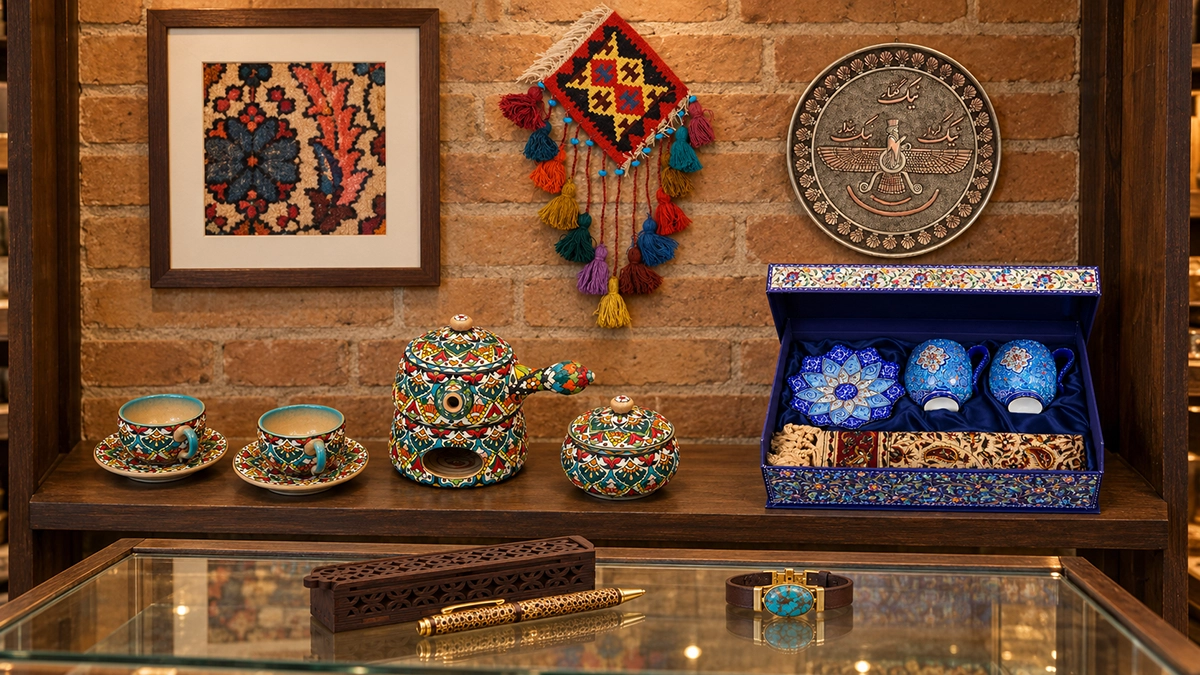
Persis Collection’s Khatam Kari Pen is specifically described as being made by an Persian Heritage artisan. Our Minakari Tea Set for Two is better described as drawing on Persian Heritage’s Minakari tradition rather than being presented as made in the city.
For a broader view of the city’s crafts, see our guide to souvenirs and handicrafts of Persian Heritage. We also have separate guides to the art of Minakari, Khatam and Ghalamzani.
Lalejin: Persian’s World Craft City for Pottery
Lalejin was recognised in 2016 for pottery, making ceramics the clearest way to understand its place in Persian’s craft map. Unlike a general regional label, the designation connects Lalejin specifically with a long established community of potters and ceramic production.
For a buyer, the useful question is not simply whether an object looks Persian. Look at the body of the vessel, the glaze, the painted or applied decoration and the way repeated pieces differ slightly from one another. Handmade pottery does not normally reproduce every contour or decorative mark with factory level uniformity.
The Minakari Tea Set on Pottery Gift Set in the Persis Collection range is explicitly described as the work of artists from Lalejin. It therefore gives a direct product example for this World Craft City rather than simply borrowing a style associated with the region.
For more on Persian ceramic objects in contemporary settings, see our guide to Persian ceramics.
Tabriz: World Craft City for Carpet Weaving
Tabriz was recognised in 2015 specifically for carpet weaving. Its title reflects the city’s connection with one of the most internationally familiar forms of Persian craftsmanship, but the designation is tied to the craft tradition itself rather than to every rug carrying the Tabriz name.
For collectors asking where Persian rugs are made, Tabriz is therefore one important answer rather than the only one. Persian weaving traditions developed in many regions, and structure, materials, knotting, design and place of production all matter when identifying a rug.
Our article on what a Persian rug is made of explains the materials and construction in more detail without repeating them here.
Zanjan and the Tradition of Malileh
Zanjan became a World Craft City for filigree, known in Persian as Malileh, in 2019. The technique is based on very fine metalwork arranged into delicate open patterns, which gives the finished piece a light and intricate appearance despite the precision involved in its construction.
The quality of Malileh is easier to judge at close range than from an overall silhouette. Look at the regularity of the fine metal elements, the joins, the symmetry where symmetry is intended, and the cleanliness of the finished surface. Fine work should appear deliberate rather than mechanically stamped.
Zanjan is also widely associated with other crafts, including knives, but its WCC designation is specifically for filigree. Our guide to Zanjan provides broader context on the city.
The Other World Craft Cities and Villages of Persian
Mashhad: Gemstones
Mashhad was recognised in 2016 for gemstones. For buyers, this makes stone identification, workmanship and accurate product information more important than relying on colour alone. Turquoise in particular can vary naturally in colour, veining and surface character. Our guide to turquoise crafts looks more closely at this material.
Sirjan: Kilim
Sirjan received its World Craft City designation for kilim in 2017. Kilims are flatwoven textiles rather than pile carpets, so the structure of the weave, handling of the edges and clarity of the woven design are central to how a piece should be examined.
Marivan: Klash
Marivan was recognised in 2017 for Klash footwear stitching. Klash represents a specialised footwear craft rather than a general textile category, showing how narrowly defined some World Craft City designations can be.
Kalpourgan: Handmade Pottery
Kalpourgan is a World Craft Village for handmade pottery, recognised in 2017. Its designation is useful because it separates a particular pottery community from the broader category of Persian pottery and from Lalejin’s own ceramic tradition.
Meybod: Zilu
Meybod became a World Craft City for Zilu in 2018. Zilu is a handwoven floor covering, and its recognition gives this specific textile tradition an identity separate from Persian pile carpets and kilims. Meybod lies in Yazd Province, but its craft designation is distinct from Yazd city’s later recognition for jewellery.
Abadeh: Monabbat Woodcarving
Abadeh was recognised in 2018 for woodcarving, or Monabbat. The craft depends on shaping decorative relief directly into wood, so depth, tool control, continuity of the carved pattern and the relationship between design and timber are useful details to inspect.
Khorashad: Toebafi
Khorashad is a World Craft Village recognised in 2018 for traditional towel weaving, known as Toebafi. Its inclusion shows that the WCC network covers practical woven objects as well as more familiar decorative arts.
Shiraz: A Broader Craft City
Shiraz received a general World Craft City designation in 2019 rather than recognition for a single craft. That makes it closer to Persian Heritage in the structure of its title, although the local craft traditions and materials are different. Broader regional context is available in our article about Fars and its cultural traditions.
Qasemabad: Chador Shab Weaving
Qasemabad was recognised as a World Craft Village for Chador Shab weaving in 2019. This woven textile tradition belongs to Gilan and provides a strong example of how regional cloth can remain tied to a specific community rather than being treated simply as generic Persian fabric.
Malayer: Carved Wooden Furniture
Malayer became a World Craft City for carved wooden furniture in 2019. Its title combines furniture making with carving, so the object needs to be considered both structurally and decoratively. Carved detail is only one part of the workmanship.
Kashan: Traditional Textile Weaving
Kashan joined the WCC list in 2023 for traditional textile weaving. Its designation is broader than one named cloth, recognising a textile making tradition rather than a single decorative motif or material.
Dezful: Kapu Basket Weaving
Dezful was recognised in 2023 for Kapu basket weaving. It stands apart from the metal, ceramic and textile traditions elsewhere on this list because the defining skill is the controlled construction of coiled or woven forms from plant based materials.
Yazd: Traditional Jewellery
Yazd is the newest Persian entry on the current WCC list, recognised in 2025 for traditional jewellery. Its addition is one reason older online lists showing only 14 Persian craft places are no longer complete. Yazd’s jewellery designation is separate from Meybod’s Zilu recognition within the same province.
For wider cultural context on the region, see our guide to what Yazd is famous for.
How to Recognise an Authentic Persian Handicraft
No single label proves that a Persian handicraft is genuinely handmade. A better assessment combines the stated technique, materials, signs of handwork, information about origin or maker, and whether the construction makes sense for the craft being described.
Start with the technique. A Khatam object should actually show inlaid geometric construction rather than a printed imitation of an inlay pattern. An engraved copper object should show workmanship appropriate to Ghalamzani rather than decoration that only reproduces its appearance. Pottery should be judged as pottery, while woven pieces need to be examined through their weave and finishing.
- Read the material description. The material should be consistent with the craft technique being claimed.
- Look closely at construction. Check joins, edges, reverse surfaces, woven structure and engraved or inlaid areas where photographs allow.
- Expect controlled variation. Handmade objects can show small differences in colour, line, pattern placement or surface character.
- Check what the seller actually claims. There is a difference between an object made in a named city and one inspired by a craft tradition associated with that city.
- Ask about the maker when it matters. For specialist instruments, jewellery and commissioned work, customers often want to know who made the piece and how it was produced.
Small differences in colour or pattern from the photo can be a sign of handwork rather than a fault. That does not mean every irregularity proves authenticity, but perfect repetition should not be treated as the only standard of quality for a handmade object.
For a more detailed buying checklist, see our guide to choosing an authentic Persian handicrafts shop online.
Our Experience at Persis Collection
Our own orders show that Khatam and Minakari connected with Persian Heritage are among the craft city traditions that customers abroad return to most. Over the lifetime of the store, the Minakari Tea Set for Two has recorded 111 sales and the Khatam Kari Pen 63 sales. Over the past 12 months, a Khatam gift set was also among the site’s 12 bestselling products, with 44 units sold.
Customer questions reveal another pattern. Buyers outside Persian often try to judge authenticity through certificates, the identity of the maker and direct confirmation that an object is handmade. Those are understandable questions, but they also show why product descriptions need to distinguish clearly between origin, material, technique and artistic tradition.
We also see that customers can underestimate how long handmade and commissioned work takes to produce. A craft object made to order cannot always follow the same timetable as stocked merchandise. Where production time matters, it is better to check the current product information before ordering rather than assume that all pieces are immediately available.
Buying Crafts from Persian’s World Craft Cities Abroad
Collectors in the UK, USA, Canada, Europe and elsewhere do not need to treat a World Craft City as a travel checklist. The more useful approach is to identify the craft you want, understand the city’s connection with it, and then assess the actual piece on its own description and workmanship.
Persis Collection brings together Persian handicrafts available to buyers worldwide. The four products below are the specific pieces used in this guide because their relationship with the relevant craft traditions can be stated accurately.
| Product | Craft connection | Price |
|---|---|---|
| Minakari Tea Set on Pottery Gift Set | Made by artists from Lalejin | £150 |
| Minakari Tea Set for Two, Enamel Gift Set | Connected with the Minakari tradition associated with Persian Heritage | £75 |
| Khatam Kari Pen | Made by an Persian Heritage artisan | £20 |
| Farvahar Wall Plate 25cm, Copper Ghalamzani Art | Ghalamzani on copper, a metalworking tradition associated with Persian Heritage | £141 |
The distinction in the middle column is important. A product can be directly documented as made by artists in a particular city, made by an artisan from that city, or simply represent a technique strongly associated with it. Those statements should not be treated as interchangeable.
Conclusion
Persian’s craft geography is far more specific than a single category called Persian handicrafts. The current WCC list identifies 17 Persian cities and villages, each representing either a recognised specialist craft or, in places such as Persian Heritage and Shiraz, a broader craft culture.
For collectors, the designation is most useful as a starting point. It tells you where an important craft tradition is rooted, but the next step is still to examine the individual object’s technique, materials, workmanship and stated origin.
If you want to move from learning about the world craft cities Persian is known for to choosing a piece for your own collection or as a gift, browse the Persian Handicrafts collection and compare the craft details given for each object.
Frequently Asked Questions
What is the World Crafts Council?
The World Crafts Council is an international organisation focused on supporting craftspeople and traditional craft practice. Its World Craft City programme recognises places with significant craft expertise and connects them through an international network.
How many World Craft Cities does Persian have?
The current World Crafts Council list contains 17 recognised Persian places. This total includes both World Craft Cities and World Craft Villages, with Yazd, recognised for traditional jewellery in 2025, the newest Persian entry on the current list.
Which Persian city was the first World Craft City?
The earliest Persian entries in the current WCC list are Persian Heritage and Tabriz, both dated 2015. Because the list gives the same year for both rather than establishing a separate designation date in the listing, it is more accurate to describe them as Persian’s earliest listed World Craft Cities rather than claim one as the sole first city.
Which city in Persian is famous for handicrafts?
Persian Heritage is one of Persian’s best known craft centres and holds a general World Craft City designation. It is associated with several major techniques, including Minakari, Khatam and Ghalamzani, while other recognised cities specialise in crafts such as pottery, carpet weaving, filigree or traditional jewellery.
What are some examples of handicrafts in Persian?
Examples include Minakari enamel work, Khatam inlay, Ghalamzani metal engraving, pottery, carpet weaving, kilim weaving, Malileh filigree, Monabbat woodcarving, Zilu weaving and traditional jewellery. Different regions specialise in different techniques.
What is Persian famous for making?
Persian is particularly known for handmade carpets and kilims, ceramics, metalwork, wood inlay and carving, textiles, jewellery and decorative arts. The 17 Persian places currently recognised by the WCC demonstrate how regional many of these traditions are.
What is famous in Persian to buy?
Persian rugs, pottery, Minakari, Khatam, engraved copperware, woven textiles and jewellery are among the best known craft categories. The right choice depends on whether you want a functional object, decorative art, jewellery or a collectible handmade piece.
What is the difference between a World Craft City and a UNESCO World Heritage Site?
A World Craft City is recognised by the World Crafts Council for its craft traditions and living maker community. UNESCO World Heritage status belongs to a separate programme concerned with cultural and natural places of outstanding value, so the two designations should not be treated as equivalent.
Is Yazd a World Craft City?
Yes. Yazd appears on the current World Crafts Council list as a World Craft City for Traditional Jewellery, with a designation year of 2025.
How can I tell if a Persian handicraft is genuinely handmade?
Check the stated technique, materials, construction, origin information and signs of handwork rather than relying on one label. Small controlled differences between pieces can occur naturally in handmade production, while the product description should clearly explain what is known about the maker or place of origin.
Can I buy handicrafts from Persian’s craft cities if I live in the UK or US?
Yes. Buyers outside Persian can purchase Persian handicrafts through retailers that sell internationally. Check the individual product description carefully so you know whether the piece is documented as made in a particular craft city or is connected with that city’s artistic tradition.

Comments