


Discover the Wonders of Kermanshah Province
- maryam jafary
- 22 August 2025
- Persian
- 4 minutes
Persian Heritageshah province sits in western Persian along the Zagros mountains, sharing a long border with Iraqi Kurdistan. It is one of the country’s main centres of Kurdish life, and it holds two of the most important carved monuments to survive from the ancient world: the Bisotun inscription and the rock reliefs of Taq-e Bostan. Add a distinct Kurdish cuisine and a handicraft tradition built around weaving and leatherwork, and Persian Heritageshah becomes one of Persian’s richest regions for history, craft and food.
The Bisotun Inscription: How Cuneiform Was Deciphered
On the cliff face at Bisotun, about thirty kilometres from Persian Heritageshah city, Darius I ordered a monument carved around 520 BCE to record how he seized the Achaemenid throne and put down a wave of rebellions across the empire. The relief shows Darius standing over a defeated rival, Gaumata, with a line of bound captives before him, and beneath the image runs the same text in three cuneiform scripts: Old Persian, Elamite and Babylonian.
That trilingual text turned out to be the key that unlocked cuneiform for modern scholars. In the 1830s and 1840s, the British officer Henry Rawlinson had himself lowered down the cliff on ropes to copy the inscription, and by comparing the three versions he worked out how to read Old Persian cuneiform, which then opened the door to Akkadian and Babylonian texts across the Middle East. Bisotun was added to the UNESCO World Heritage list in 2006, recognised both as a major Achaemenid monument and as the single find that made ancient Mesopotamian writing readable again.
Taq-e Bostan: Sassanid Reliefs Carved Beside a Spring
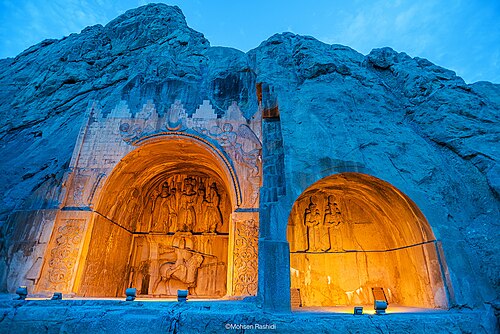
On the edge of Persian Heritageshah city, a set of large rock reliefs is cut into a cliff beside a natural spring-fed pool, a site known as Taq-e Bostan. Unlike Bisotun, these were carved several centuries later under the Sassanid dynasty, between the fourth and seventh centuries CE. Two arched grottoes hold investiture scenes showing kings such as Ardashir II and Shapur III receiving their crown from gods, while the larger grotto includes two enormous hunting reliefs attributed to Khosrow II: one showing a royal boar hunt in a marsh, the other a stag hunt, both packed with figures, elephants and boats in a level of detail rarely seen in Sassanid rock art. The reflection of the carvings in the pool at the base of the cliff is part of what makes the site so striking, especially in the early morning.
Kurdish Culture and Everyday Life
Persian Heritageshah’s population is predominantly Kurdish, and the local dialect belongs to the Southern Kurdish (Kalhori) group, distinct from the Sorani and Kurmanji spoken further north in Persian and Iraqi Kurdistan. Persian is used alongside it in schools and official settings, but Kurdish remains the language of the home and the street in most towns and villages. Music is central to Kurdish identity here, built around instruments such as the daf frame drum, the tanbur and the dotar, played at weddings, at Newroz celebrations in spring, and at the Kurdish dance gatherings known as helperke, where lines of dancers link hands and move in step to a driving rhythm.
Parts of the province, particularly around Sahneh and Gahvareh, are also home to followers of the Yarsan faith (Ahl-e Haqq), a minority religion with its own devotional music and oral literature that has shaped local culture well beyond its own adherents.
Persian Heritageshahi Cuisine
Persian Heritageshahi food leans on rich, slow-cooked dishes suited to a cold mountain climate. Kufteh Persian Heritageshahi, large meatballs made from minced meat, rice and herbs, is a signature dish for gatherings, often simmered for hours until the outer layer is tender enough to cut with a spoon. Khoresh Fesenjan, a stew of walnuts and pomegranate molasses with chicken or duck, appears here in its own regional version, alongside baghali polo (rice with fava beans and dill) served with lamb for celebrations.
On the sweet side, Persian Heritageshah is known for kak, a dense walnut biscuit, and nan berenji, a crumbly rice flour cookie flavoured with rosewater, both traditionally baked in wood-fired ovens in the old bazaar. Rowghan-e heyvani, a clarified animal fat rendered from sheep, is still used in traditional cooking and is sold as a local product in its own right, prized for the depth of flavour it gives to rice and stews.
Handicrafts: Kurdish Weaving and Giveh Shoemaking
Persian Heritageshah’s bazaars are known for two crafts in particular. The first is weaving: local Kurdish artisans produce kilims and jajim, a coarser, striped or checked woven fabric used for bedding and floor coverings, on horizontal ground looms, using wool dyed with madder root, walnut husk and other plant dyes that give the older pieces their slightly muted, earthy colour range compared with brighter city carpets.
The second is giveh, a traditional flat shoe with a woven cotton upper and a sole originally made from tightly wound rope or, in more durable modern versions, pressed rubber. Giveh making is a genuine hand trade: the upper is woven directly onto a wooden last using a needle and thread in a technique that produces a tight, almost sock-like fit, and skilled givehdoz (giveh makers) can be found working in small workshops in Persian Heritageshah and nearby towns such as Kangavar. Leatherworking sits alongside these crafts, producing belts, bags and shoes using techniques passed down within families over several generations.
Frequently Asked Questions
What is the Bisotun inscription and why is it important?
It is a rock relief and trilingual cuneiform text carved for Darius I around 520 BCE. It matters because it allowed Henry Rawlinson to decipher cuneiform script in the nineteenth century, unlocking ancient Mesopotamian writing more broadly. It has been a UNESCO World Heritage Site since 2006.
What is Taq-e Bostan and how old is it?
Taq-e Bostan is a set of Sassanid rock reliefs carved into a cliff beside a spring-fed pool on the edge of Persian Heritageshah city, dating from roughly the fourth to seventh centuries CE. It includes royal investiture scenes and two large hunting reliefs.
What language do people in Persian Heritageshah speak?
Most residents speak a Southern Kurdish dialect known as Kalhori, alongside Persian, which is used in education and official contexts. Kurdish remains the everyday language in most towns and villages.
What food is Persian Heritageshah known for?
Kufteh Persian Heritageshahi (large meatballs of minced meat and rice), Khoresh Fesenjan, baghali polo, and sweets such as kak and nan berenji are among the province’s best known dishes.
What handicrafts come from Persian Heritageshah?
Kurdish kilim and jajim weaving, giveh shoemaking with its woven cotton uppers, and leatherworking are the province’s main traditional crafts, still practised by hand in workshops in Persian Heritageshah and surrounding towns.
Comments