


How to Clean Gold Jewellery at Home Without Damaging It
- mahyar
- 30 September 2026
- Persian Jewellery
- 8 minutes
The safest way to clean gold jewellery at home is usually with lukewarm water, a small amount of mild washing-up liquid and a very soft brush or lint-free cloth. However, that method is not suitable for every piece. Gold-plated jewellery, resin-covered designs, turquoise, leather and delicate decorative details all need different care.
Before cleaning anything, check what the entire piece is made from, not just the gold-coloured section. A necklace described as gold jewellery may combine an 18k gold pendant with a differently made chain, while another design may contain gold beneath resin. Knowing the construction is the first step towards cleaning it safely.
What Is the Best Way to Clean Gold Jewellery at Home?
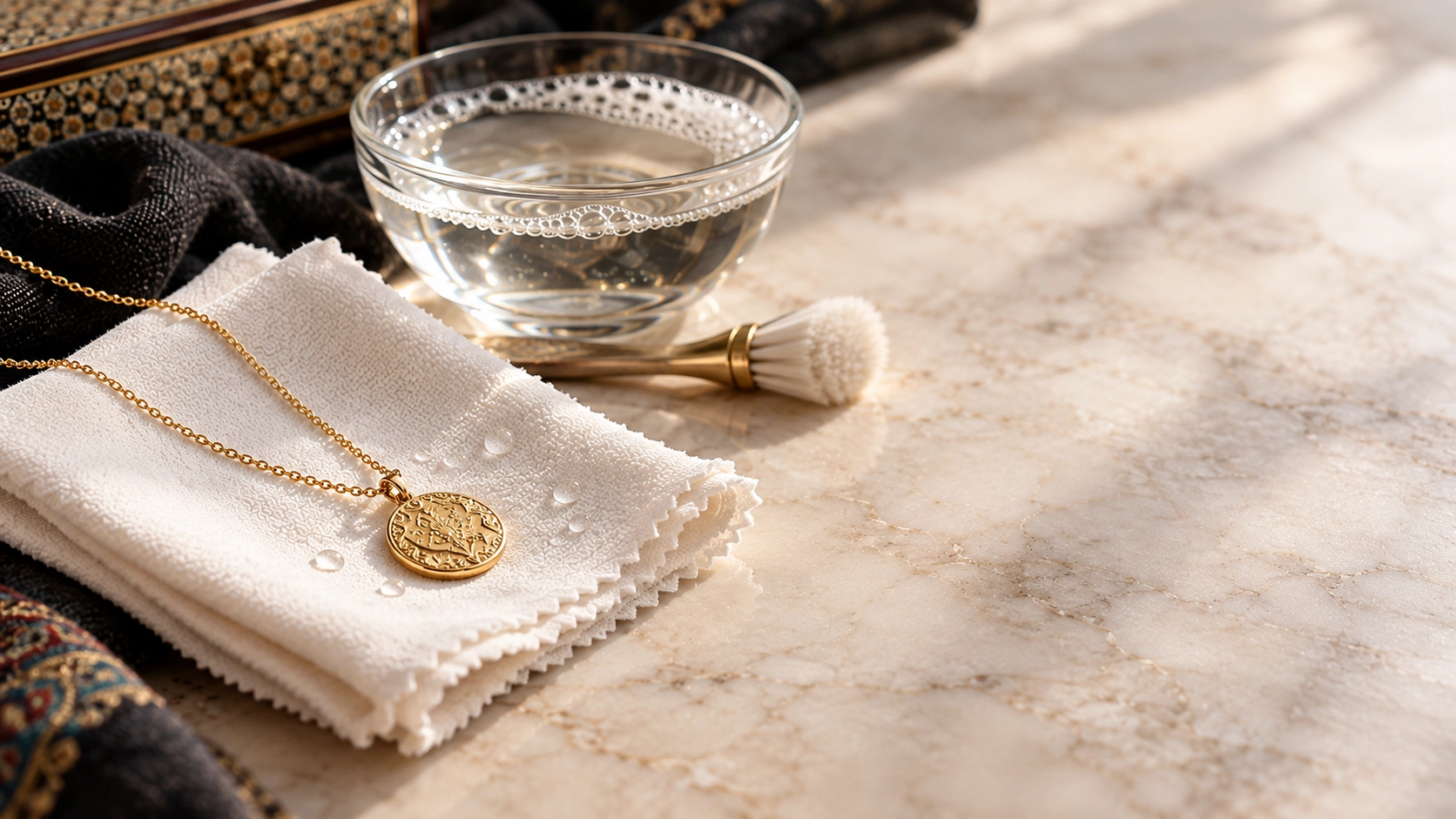
For plain solid gold without delicate stones or other materials, gentle washing is the safest starting point. Use lukewarm water, mild washing-up liquid, a very soft toothbrush and a clean lint-free cloth.
- Fill a small bowl with lukewarm water.
- Add a small amount of mild washing-up liquid.
- Place plain solid gold jewellery in the solution briefly.
- Use a very soft toothbrush to loosen residue gently, particularly around small recesses.
- Rinse carefully with clean lukewarm water.
- Pat dry with a lint-free cloth and allow the piece to dry completely before storing it.
Do not assume this method applies to every piece simply because the product name includes the word gold. Jewellery containing plating, resin, turquoise, leather or other sensitive materials should not automatically be soaked.
Check What Your Jewellery Is Made From Before Cleaning
Before deciding how to clean gold at home, identify the materials and construction of the whole piece. This matters particularly with Persian jewellery, where gold may be combined with stones, engraving, leather, resin or another metal.
Look for an assay mark or hallmark where applicable and check the original product description if you still have it. Terms such as 18ct and 18k both describe 18 carat gold, although product naming conventions vary. More importantly, distinguish solid gold from gold plating and from decorative pieces in which gold is protected beneath another material.
Persis Collection pieces demonstrate why this distinction matters. The Dainty 18k Gold Farvahar Necklace has an approximately 1.1 g gold pendant, while the 18k Gold Persian Heritage Necklace with Persian Map has an approximately 1.55 g pendant. These are small, lightweight pieces, so cleaning should be gentle rather than vigorous.
If you are choosing between precious-metal types rather than cleaning an existing piece, our guide to gold versus silver Persian jewellery explains the differences in more detail.
How to Clean Solid Gold Jewellery at Home
Plain solid gold can usually be cleaned with mild washing-up liquid and lukewarm water, provided the piece does not contain a material that requires different care. Use only light pressure because higher-purity gold and fine, lightweight components can be relatively soft and vulnerable to scratching or distortion.
Never scrub simply because dirt remains in a recess. Allowing mild soapy water to loosen ordinary residue and then working gently with a very soft brush is preferable to applying greater pressure.
This is particularly important around fine edges, attachment points and decorative cut-outs. After cleaning, rinse away soap residue and dry the piece thoroughly with a soft lint-free cloth.
How to Clean Gold Chains, Necklaces, Rings and Earrings
The basic cleaning method depends more on materials than on whether the piece is a ring, chain, necklace or pair of earrings. The shape does, however, determine where residue is likely to collect and where extra care is needed.
- Gold chains: handle links gently and avoid pulling or twisting them while cleaning.
- Gold necklaces: check the pendant, chain, clasp and connecting rings separately because they may not all be made from the same material.
- Gold rings: pay particular attention to the inside of the band and any settings or recessed decoration.
- Gold earrings: clean around posts, backs and decorative recesses carefully without bending fine components.
A good example of why the whole piece needs checking is the Dainty 18k Gold Farvahar Necklace. Its pendant is gold, but its chain is silver with plating. The cleaning method therefore needs to respect both components rather than treating the entire necklace as solid gold.
How to Clean Gold Plated and Resin Jewellery
Gold-plated and resin-covered jewellery should be treated more cautiously than plain solid gold. Avoid aggressive polishing and do not assume that soaking is safe.
The Lion and Sun Necklace, for example, is made from 925 silver with 18k gold plating. Repeated abrasive polishing could affect a plated surface, so gentle wiping is preferable to scrubbing.
Product names also need to be read alongside their material descriptions. The 24k Gold Farvahar Turquoise Necklace contains a 24k gold design protected beneath resin. It is not a piece of solid 24k gold that should be cleaned using the same soaking and brushing method as plain solid gold.
For this type of resin-covered design, use a clean, soft, dry cloth. Do not soak it and do not scrub the resin surface.
How to Clean Gold Jewellery with Turquoise
Gold jewellery containing turquoise needs a more cautious approach than plain gold because the stone must be considered as well as the metal. Do not automatically immerse the entire piece in the cleaning solution used for plain solid gold.
Avoid harsh chemicals, abrasive cleaners, steam and ultrasonic cleaning on turquoise pieces. Where the construction allows, clean accessible metal surfaces gently without saturating the stone or its setting.
For a fuller explanation of day-to-day protection and cleaning, see our dedicated guide to caring for turquoise jewellery.
How to Clean Gold Jewellery with Leather
Do not soak jewellery that combines gold with leather. Clean the gold component carefully while keeping water and cleaning solution away from the leather wherever possible.
The 18K Gold Leather Bracelet Beloved Soul illustrates this construction. It combines an approximately 0.28 g engraved gold component with natural cow leather from Tabriz.
Rather than placing the bracelet in a bowl of water, use a soft cloth to clean the gold locally. This prevents a cleaning method intended for the metal from unnecessarily wetting the leather.
How to Clean Engraved and Calligraphy Gold Jewellery
Engraved and calligraphy jewellery needs gentle cleaning around recessed details. Fine lines should never be attacked with a stiff brush, sharp tool or abrasive paste in an attempt to remove residue.
The Beloved Soul bracelet, with its engraved Jan-e Man Ast Oo calligraphy, is a good example. Because the gold element is also small and lightweight, cleaning should preserve both the engraved surface and the surrounding leather.
If a plain solid-gold engraved piece has no sensitive material attached, a very soft brush can be used lightly around recesses. If the engraving is part of a mixed-material piece, clean each material according to its own requirements.
Which Cleaning Method Is Safe for Your Jewellery?
The safest method is determined by the most sensitive material in the piece. If one component cannot safely be soaked or brushed, do not immerse the entire piece simply because another component is solid gold.
| Jewellery type | Recommended home care | Soak? | Avoid |
|---|---|---|---|
| Plain solid gold | Lukewarm water, mild washing-up liquid, very soft brush, lint-free cloth | Usually, briefly | Harsh chemicals and abrasive scrubbing |
| Fine or lightweight solid gold | Same gentle method with minimal pressure | Usually, if no sensitive materials are present | Stiff brushes, bending and heavy pressure |
| Gold-plated jewellery | Gentle wiping with a soft cloth | Best avoided unless specific care instructions allow it | Abrasive polishing and vigorous brushing |
| Resin-covered gold design | Soft, clean, dry cloth | No | Soaking, abrasive cleaning and scrubbing |
| Gold with turquoise | Clean exposed metal cautiously and follow stone-specific care | Do not routinely soak | Steam, ultrasonic cleaning and harsh chemicals |
| Gold with leather | Clean the gold locally with a soft cloth | No | Wet cleaning of the whole piece |
| Engraved solid gold | Very soft brush with minimal pressure if the rest of the piece permits | Depends on other materials | Sharp tools and abrasive paste |
How to Make Gold Jewellery Shine Again
Removing surface residue and then drying gold carefully with a clean lint-free cloth can restore much of its natural shine. Polishing harder is not necessarily better, particularly with plated, fine or mixed-material jewellery.
If a solid-gold piece remains dull after gentle cleaning, or if it is scratched, damaged or has a loose setting, professional assessment is safer than escalating to stronger household cleaning methods.
For plated jewellery, trying to polish through discolouration can make matters worse if the plating itself has worn. Cleaning removes dirt, but it cannot replace missing plating. Restoration of a worn plated surface is a different process from routine cleaning.
What Not to Use to Clean Gold Jewellery
Avoid household methods that rely on abrasion or strong chemicals. The fact that a substance can remove residue does not mean it is appropriate for fine jewellery, plating, stones, resin or decorative surfaces.
- Do not use toothpaste as a gold polish.
- Do not use bleach or chlorine.
- Do not use ammonia as a general home-cleaning recommendation.
- Do not mix household cleaning chemicals.
- Do not scrub with a hard toothbrush or abrasive pad.
- Do not use steam or ultrasonic cleaning on turquoise, resin, enamel or leather pieces.
- Do not soak a mixed-material piece unless every component is suitable for immersion.
Bicarbonate of soda and vinegar are also unnecessary for routine gold cleaning. A mild method is easier to control and avoids introducing extra risks to plating, stones and mixed materials.
Our Experience at Persis Collection
Working with the construction details of our Persian gold jewellery shows why a single cleaning instruction cannot cover every piece. Jewellery described using gold terminology can have very different constructions, and the care method must follow the actual materials.
Our current pieces include lightweight 18k gold pendants, gold combined with natural leather, 18k gold plating over silver and 24k gold decorative elements protected beneath resin. For example, the Dainty Farvahar pendant is approximately 1.1 g, the Persian Map pendant approximately 1.55 g and the gold element of the Beloved Soul bracelet approximately 0.28 g.
These product specifications lead to a practical rule: identify every material before cleaning and use the method required by the most sensitive component. A piece combining gold and leather should not be submerged just because the gold itself could tolerate gentle washing. Likewise, a resin-covered 24k gold design should not be treated as solid 24k gold.
Readers interested specifically in this type of jewellery can explore the 18K Gold Jewelry collection, Persian gold necklaces and Persian gold bracelets.
Conclusion
The best way to clean gold jewellery is not to begin with a cleaner. Begin by identifying what the piece is actually made from.
Plain solid gold can generally be cleaned gently with lukewarm water, mild washing-up liquid, a very soft brush and a lint-free cloth. Gold plating needs less abrasion. Resin-covered designs should stay dry. Turquoise requires stone-specific care, while leather should not be soaked. Engraved and lightweight pieces require particularly gentle handling.
If you are unsure about a material, setting or surface treatment, choose the least invasive option rather than experimenting with stronger cleaners. You can also browse Persis Collection’s wider Persian jewellery collection to see how different metals, materials and Persian motifs are used across individual pieces.
Frequently Asked Questions
What is the best way to clean gold jewellery at home?
For plain solid gold without sensitive stones or other materials, use lukewarm water with a small amount of mild washing-up liquid, followed by gentle cleaning with a very soft toothbrush and drying with a lint-free cloth. Mixed-material, plated and resin pieces need different methods.
How can I make my gold jewellery shine again?
Gentle cleaning followed by thorough drying with a soft lint-free cloth can remove residue that reduces the appearance of shine. Avoid aggressive polishing, especially on plated jewellery.
Can you clean gold with bicarbonate of soda?
Bicarbonate of soda is not necessary for routine gold jewellery care and should not be treated as a universal gold cleaner. Mild washing-up liquid and lukewarm water are a more controlled option for suitable plain solid-gold pieces.
Can I use vinegar to clean gold jewellery?
Vinegar is not recommended here as a general jewellery-cleaning method because a piece may include plating, stones, resin, leather or other materials. Use a cleaning method suited to the complete construction instead.
Can you clean gold jewellery with toothpaste?
No. Toothpaste is abrasive and should not be used as a routine gold jewellery cleaner, particularly on polished surfaces, plating or delicate details.
Can you remove tarnish from gold?
First determine what has caused the change in appearance and what the piece is made from. Surface residue can often be removed through gentle cleaning, but worn plating, scratches and other surface changes are not corrected simply by washing the jewellery.
How can you clean gold plated jewellery at home?
Clean gold-plated jewellery gently with a soft cloth and avoid abrasive polishing or vigorous brushing. If the plating has worn away, cleaning will not restore the missing layer.
Why is my gold plated jewellery turning black?
A darkened appearance should not automatically be treated as dirt. Because plated jewellery consists of a surface layer over another material, changes in that surface may require assessment rather than stronger cleaning or polishing.
How often should you clean gold jewellery?
There is no single cleaning schedule suitable for every piece. Clean jewellery when residue becomes noticeable, while minimising unnecessary brushing, polishing and exposure to cleaning solutions.
Can I wear my gold jewellery in the shower?
Whether a piece can tolerate water depends on its complete construction, not simply the presence of gold. Jewellery containing leather, resin, plating or sensitive stones should not be treated like plain solid gold, so removing mixed-material pieces before showering is the safer approach.


Comments