


How to Wear a Persian Shawl or Scarf: Silk and Men’s Styles

- mahyar
- 3 October 2026
- Persian Textile
- 9 minutes
Learning how to wear a Persian shawl starts with the piece itself. A square silk scarf behaves very differently from a long scarf, and a style that works neatly around the neck may not work when draped over a coat or worn over the head.
Persian scarves also bring pattern into the outfit. Designs inspired by Persian poetry, the Shahnameh, gardens, pomegranates, tiles and architecture can become the focal point rather than simply an extra layer.
This guide covers practical ways to wear Persian scarves for women and men, from square silk scarves to long draped styles, with ideas for everyday outfits, dresses, weddings and colder weather.
How to Wear a Persian Shawl: Start With the Shape and Fabric
Before deciding how to wrap a shawl, look at its shape, length and fabric. These determine how much structure the scarf has, how easily it can be knotted and how much of its design remains visible once worn.
A square silk scarf is particularly suited to neat folds and smaller knots around the neck or head. A long scarf gives you more fabric for draping over the shoulders, wrapping around the neck or wearing over outerwear.
| Scarf type | Works well for | Styling approach |
|---|---|---|
| Square silk scarf | Neck, head, dress styling | Fold, knot or drape |
| Long scarf | Shoulders, coats, dresses | Drape or wrap |
| Long unisex scarf | Men’s and women’s styling | Loose neck wrap or straight drape |
| Decorative Persian scarf | Making the design visible | Keep knots simple and show more fabric |
The pattern matters too. If a scarf contains detailed artwork, poetry or architectural imagery, an elaborate knot can hide the part that makes the piece distinctive. In those cases, a simpler drape often works better.
You can explore the current collection of Persian women’s scarves to compare different shapes and designs.
How to Wear a Long Persian Shawl
The simplest way to wear a long Persian shawl is to let it fall naturally from the shoulders or wrap it once around the neck. Long scarves offer enough fabric to create volume while still leaving a substantial part of the pattern visible.
Drape It Over Both Shoulders
Place the centre of the shawl behind your neck and allow both ends to fall evenly at the front. This is one of the easiest ways to wear a patterned scarf because very little of the design is hidden.
With a dress, this method can also provide a light additional layer without competing with the shape of the outfit.
Wear It Over One Shoulder
Place the shawl around your shoulders, then take one end and move it over the opposite shoulder. Leave the other end hanging naturally.
This asymmetrical style works particularly well when you want the scarf to look less formal and more relaxed.
Wrap It Once Around the Neck
For autumn and winter, place one end slightly longer than the other and take the longer end once around your neck. Keep the wrap relatively loose.
This works particularly well with coats and jackets because it provides some volume without creating a complicated knot.
The Pomegranate Tree Double Sided Scarf, measuring 50 x 200 cm, is an example of the long format that can be used for these draped and wrapped styles.
Secure a Shawl With a Brooch
A brooch can hold two sections of a shawl together and reduce the need for a knot. It can be positioned at the shoulder or towards the front, depending on the outfit.
For a distinctly Persian detail, the Heritage Faravahar Pin Brooch can be used as a decorative element with an appropriate scarf or garment.
Avoid placing a pin through delicate fabric without first considering whether it could leave a visible mark.
How to Wear a Persian Silk Scarf
A square Persian silk scarf can be worn around the neck, over the hair or incorporated into an outfit as a smaller decorative accent. The key is to use folds and knots that leave enough of the artwork visible.
The Simple Triangle
Fold a square scarf diagonally to create a triangle. Place the triangle towards the front or slightly to one side, then bring the ends around the neck.
You can either leave the ends loose or secure them with a small knot.
This is useful when the centre of the scarf carries an important motif that you want to keep visible.
The Folded Neck Scarf
Fold the scarf diagonally, then continue folding it until you have a narrower band. Wrap it around the neck and finish with a simple knot at the front or side.
This gives a cleaner silhouette and works well with a shirt, jacket or plain top.
How to Wear a Persian Silk Scarf on Your Head
For a simple headscarf style, fold a square scarf diagonally into a triangle. Position the folded edge over the top of the head, then bring the two ends down and secure them according to the look you want.
A looser knot gives a relaxed result, while a more controlled fold keeps the scarf closer to the head.
Because smooth scarves can move during wear, avoid building a complicated style that depends on several loose folds staying in exactly the same position.
The Silk Shahnameh Scarf and Art of Persian Tiles Scarf show how Persian literature and decorative art can be carried into contemporary scarf design.
How Men Can Wear a Persian Scarf
Men can wear a Persian scarf with a coat, jacket or simple everyday clothing. The easiest approach is usually a restrained drape or a single loose wrap rather than an elaborate knot.
One simple option is to place a long scarf behind the neck and allow both ends to hang vertically down the front. This keeps the full design visible and works particularly well over a plain coat.
For colder weather, wrap the scarf once around the neck and allow the ends to remain loose. With a patterned scarf, pairing it with relatively simple clothing prevents the outfit from becoming visually crowded.
Another option is to tuck the lower sections partly inside a coat while leaving the upper section visible around the collar.
Men’s styling is not a marginal part of this category at Persis Collection. Of the 556 units sold across the 64 women’s and men’s scarf products reviewed, 65 were from products classified only as men’s scarves. A further 148 sales came from products appearing across both categories. This suggests that long unisex styles form an important part of the range alongside specifically men’s designs.
For dedicated designs, browse the Persian men’s scarf collection. Examples include the Shahnameh Poetry Persian Men’s Scarf and Men’s Scarf with Persian Architectural Design.
How to Wear a Persian Shawl With a Dress or to a Wedding
With a dress, a Persian shawl usually works best when it complements rather than covers the main shape of the outfit. A shoulder drape, one shoulder style or restrained front wrap keeps the scarf visible without adding excessive volume.
For a formal occasion or wedding, place a long scarf evenly over both shoulders for a classic appearance. For a slightly less formal result, move one end over the opposite shoulder.
A square silk scarf offers another option. Rather than using it as a full shoulder covering, it can be folded and worn around the neck to introduce Persian pattern and colour to a simple dress.
If the dress itself is heavily patterned, a quieter scarf arrangement usually gives the outfit more balance. If the dress is plain, the scarf can take a more prominent role.
A Pomegranate Garden Scarf, for example, can introduce a recognisably Persian decorative theme without requiring additional jewellery or accessories to carry the entire look.
Wearing Persian Scarves Through the Seasons and for Cultural Occasions
Persian scarves can move between everyday and occasion dressing simply by changing how they are worn. In autumn and winter, longer scarves work naturally over coats and jackets, while square scarves can provide a lighter decorative element throughout the year.
For Nowruz, a Persian scarf can form part of an outfit that references Persian art and culture without requiring traditional clothing from head to toe. The same principle can work for Yalda gatherings, particularly through motifs and colours that suit the occasion.
Persis Collection’s overall store data shows particularly strong order volumes around February and March, associated with the Nowruz period, and November and December, which include Yalda and Christmas shopping. These figures cover the entire shop rather than scarves specifically, so they should not be interpreted as a seasonal sales pattern for scarves alone.
For more ideas around Persian New Year clothing, see our guide to Nowruz fashion.
Where Termeh Fits Into Persian Dress
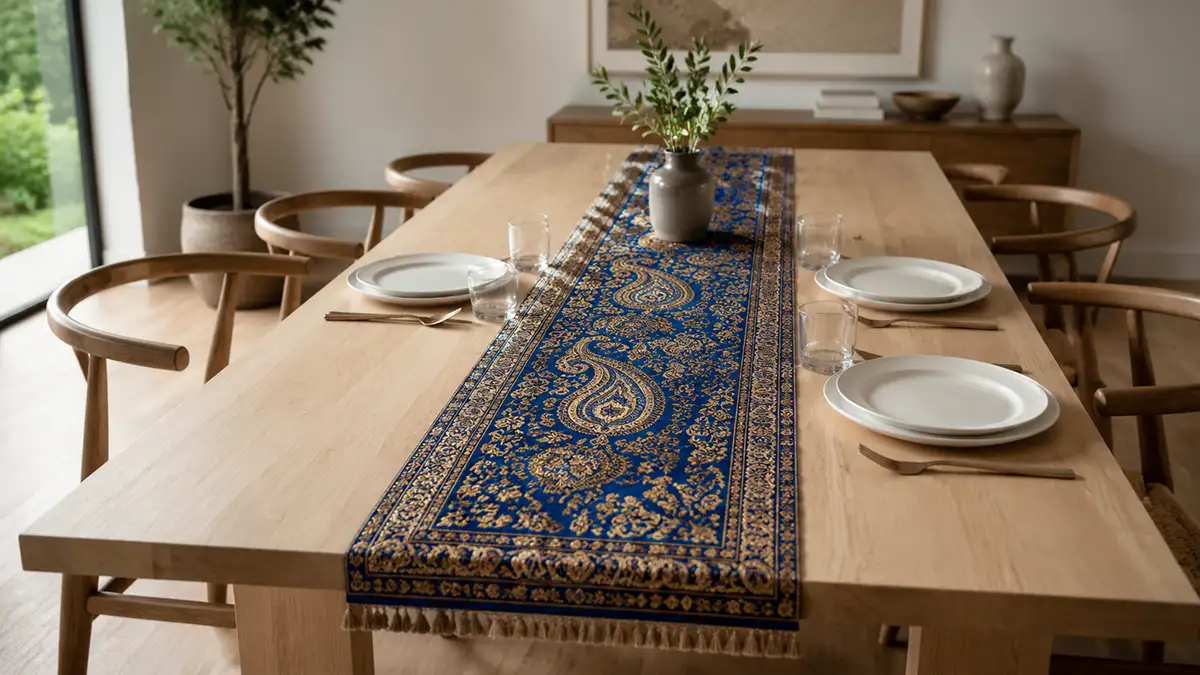
Termeh is an important Persian textile, but it should not automatically be treated as another name for a wearable Persian shawl. At Persis Collection, the current scarf range does not include a wearable Termeh shawl, so the two should not be presented as interchangeable products.
Termeh does, however, appear in fashion accessories and clothing. One example is the Termeh Persian Belt with Boteh Jegheh Motif, which allows the textile and its characteristic decorative language to become part of an outfit.
The boteh jegheh motif is particularly relevant here because it also connects Persian textile traditions with what English speakers commonly recognise as paisley.
For a fuller introduction to the textile itself, read what a Persian Termeh textile is.
What We Have Learned From Our Customers
Sales across 64 scarf products at Persis Collection give a useful picture of which Persian designs people actually choose. The products reviewed account for 556 units sold since their respective publication dates.
Women’s only products account for 343 units, or about 62 per cent. Products appearing in both the women’s and men’s categories account for another 148 units, around 27 per cent, while men’s only products account for 65 units, around 12 per cent.
The design data is equally revealing. Shahnameh, poetry and calligraphy related designs form the largest group, with 165 units sold, approximately 30 per cent of the total reviewed. Floral, garden and pomegranate designs account for 124 units, while tile and architectural designs account for 114.
The Silk Shahnameh Scarf is the strongest seller among the products reviewed, with 46 units sold. These figures suggest that for many customers, the Persian identity of a scarf is not limited to its shape. Literature, calligraphy, gardens, architecture and familiar visual motifs are also an important part of the appeal.
This is one reason a Persian scarf often benefits from simple styling. If the artwork is central to the piece, leaving more of the fabric visible allows that story to remain part of the outfit.
For an introduction to the broader range of designs, read our guide to traditional and modern Persian scarf and shawl styles.
How to Fold and Store Persian Scarves
Good storage starts with avoiding unnecessary pressure, sharp folds and contact with anything that could catch delicate fabric. Before storing a scarf, make sure it is clean and completely dry.
Fold scarves neatly rather than forcing them into an overcrowded drawer. Keep brooches and other sharp accessories separate rather than leaving them attached during storage.
For silk and other delicate materials, follow the specific care instructions supplied with the product. Do not assume that every Persian scarf can be washed or treated in the same way, as material and construction vary between products.
Conclusion
Knowing how to wear a Persian shawl is less about learning one perfect knot and more about matching the styling method to the scarf in front of you. Square silk scarves lend themselves to folds and smaller knots, while long scarves are better suited to shoulder drapes, loose wraps and layering over coats.
For men, simple long drapes and single wraps offer an easy way to wear Persian patterns without making the scarf feel overly formal. For dresses and special occasions, keeping the arrangement relatively simple allows the artwork itself to remain visible.
Persian scarves can also carry something beyond colour and pattern. Shahnameh, poetry, calligraphy, gardens, pomegranates, tiles and architecture all appear in the designs customers have chosen from Persis Collection.
Explore our Persian scarves to find a shape and design that suits the way you want to wear it.
Frequently Asked Questions
What is a Persian shawl?
A Persian shawl is a scarf or shawl distinguished by its connection to Persian design, art or textile traditions. Depending on the individual piece, this can appear through motifs, calligraphy, poetry, architectural imagery or other forms of Persian visual culture.
The term does not describe one single material or shape, so it is important to check the dimensions and material of an individual scarf before deciding how to style it.
How do people wear Persian shawls?
Persian shawls can be draped over both shoulders, worn over one shoulder, wrapped loosely around the neck or styled over a coat or dress. Square scarves can also be folded into triangles or narrower bands for wearing around the neck or over the head.
What are traditional Persian scarf styles?
Persian scarf styles vary considerably, and there is no single style that represents every period or region. Our guide to traditional and modern Persian scarf and shawl styles looks more closely at the different forms and their design context.
Can men wear a Persian scarf?
Yes. Persian scarves can be worn by men with coats, jackets and everyday clothing. A straight drape or single loose wrap is one of the simplest approaches, and long unisex scarves provide additional options beyond designs classified specifically as men’s scarves.
How do you wear a Persian silk headscarf?
Fold a square silk scarf diagonally into a triangle, place the folded edge over the head and bring the ends down to secure them in the style you prefer. Keep the arrangement relatively simple if you want a central motif or border to remain visible.
How do you wear a shawl with a dress?
Drape the shawl evenly over both shoulders for a classic look, or move one end over the opposite shoulder for an asymmetrical style. With a heavily patterned dress, a simple arrangement usually creates better visual balance.
How do you wear a shawl to a wedding?
For a wedding, a shawl can be placed evenly over the shoulders, worn over one shoulder or secured carefully with a decorative brooch. Choose a method that works with the neckline and shape of the dress rather than covering its main details.
What is the difference between a shawl and a pashmina?
A shawl is a broad term for a piece of fabric worn around the shoulders, upper body or neck. Pashmina refers more specifically to a particular type of fine fibre and the textiles associated with it, so the two terms are not automatically interchangeable.
How should a man wear a shawl?
A man can wear a long shawl hanging straight from the neck, wrapped once loosely around the neck or partially tucked inside a coat. Keeping the arrangement simple is particularly effective when the scarf itself contains detailed Persian patterns or writing.
Can you wear a Termeh shawl?
Termeh has historically been used for different textile purposes, but not every product described as Termeh is intended to be worn as a shawl. Persis Collection does not currently offer a wearable Termeh shawl, so check the intended use and construction of an individual Termeh piece rather than assuming it is designed as a scarf.

Comments