


Birthstones by Month and the Persian Stones That Match Them
- mahyar
- 12 October 2026
- Persian Jewellery
- 9 minutes
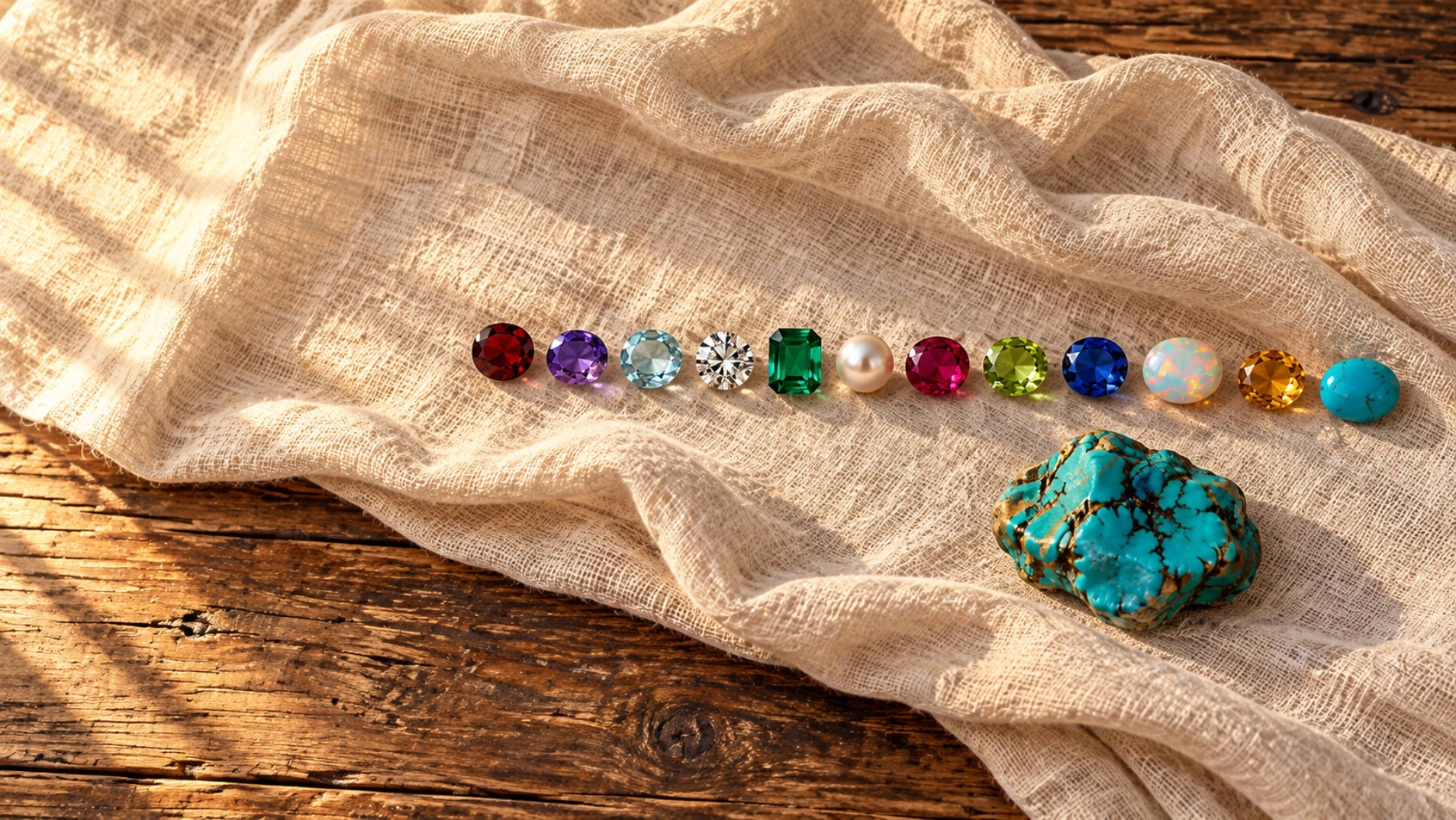
Birthstones by month traditionally associate each of the 12 calendar months with one or more gemstones. January is linked to garnet, February to amethyst, June to pearl and December to turquoise, among other choices. The stones are often given symbolic meanings, although these meanings come from cultural traditions rather than scientific evidence.
For people celebrating birthdays according to the Persian (Solar Hijri) calendar, choosing a birthstone takes another step. Each Persian month overlaps two Gregorian months, which means someone born in Farvardin, for example, might have aquamarine or diamond as their birthstone. This guide includes a complete birthstone chart, a Persian calendar conversion table and a closer look at gemstones with connections to Persian jewellery traditions.
Birthstone Chart: All 12 Months at a Glance
The birthstone chart below shows the gemstones commonly associated with each month, their typical colours and their traditional symbolic meanings. Some months have several recognised stones, and lists can vary between jewellery organisations and historical traditions.
| Month | Common Birthstones | Typical Colours | Traditional Symbolism |
|---|---|---|---|
| January | Garnet | Deep red, also green and other colours | Friendship and protection |
| February | Amethyst | Purple and violet | Calm and clarity |
| March | Aquamarine, bloodstone | Light blue, dark green with red markings | Courage and serenity |
| April | Diamond | Colourless and various colours | Love and endurance |
| May | Emerald | Green | Renewal and hope |
| June | Pearl, alexandrite, moonstone | White, cream and colour-changing or iridescent tones | Purity and harmony |
| July | Ruby | Red | Passion and courage |
| August | Peridot, spinel, sardonyx | Green, varied colours and banded tones | Strength and happiness |
| September | Sapphire | Usually blue, also other colours | Wisdom and loyalty |
| October | Opal, tourmaline | Multicoloured, pink, green and other colours | Creativity and hope |
| November | Topaz, citrine | Yellow, orange and various other colours | Warmth and friendship |
| December | Turquoise, tanzanite, zircon | Blue, blue-green and other colours | Good fortune and friendship |
These associations are cultural conventions, not fixed properties of the stones. Their meanings can also differ between communities and historical periods.
Traditional vs Modern Birthstones: Why Some Months Have Two
Traditional and modern birthstone lists reflect different periods of jewellery history. Older lists developed through religious, cultural and regional customs, while modern lists have been standardised and revised by jewellery organisations. Neither system is the only possible way to choose a birthstone.
March, for example, is commonly associated with aquamarine in modern jewellery lists and bloodstone in traditional ones. June has pearl, moonstone and alexandrite. August has peridot, sardonyx and spinel, while December includes turquoise, zircon and tanzanite.
This explains why two birthstone charts may show different stones for the same birthday. Differences do not necessarily mean that either chart is incorrect. Some lists emphasise historical associations, while others reflect more recent additions.
For a gift, the recipient’s preferred colour, the jewellery design and the stone’s suitability for regular wear can matter as much as whether it belongs to a traditional or modern list.
Birthstones by Month: What Each Stone Represents
Every month has a gemstone tradition, but the symbolism attached to individual stones should be understood as cultural meaning rather than a promise of a particular effect. Here is a closer look at the 12 months and the jewellery choices associated with them.
January: Garnet
Garnet is January’s birthstone and is particularly familiar in deep red, although garnets occur in other colours. It has traditionally represented friendship and protection. Persian-inspired designs featuring garnet include the 24k Gold Love Pattern Necklace, which features red garnet and the Persian verse ‘To mara jan o jahani’. The 24k Gold Pomegranate Pattern Necklace also incorporates red garnet.
February: Amethyst
Amethyst is the purple variety of quartz associated with February. Its violet colour has long made it a distinctive decorative gemstone, traditionally connected with clarity and composure. The Anahita Shell Necklace with Amethyst Stone offers an example of amethyst in a contemporary Persian-inspired design.
March: Aquamarine and Bloodstone
Aquamarine is generally pale blue to blue-green and is associated with calm and the sea. Bloodstone, a dark green stone with red markings, is a traditional March alternative. Both have histories of symbolic association with courage or protection.
April: Diamond
Diamond is April’s best-known birthstone. Although colourless diamonds are especially familiar, diamonds occur in several colours. Their durability and use in jewellery have helped establish their traditional associations with lasting love and endurance.
May: Emerald
Emerald, with its characteristic green colour, represents May. Across different jewellery traditions, green has been associated with spring, renewal and growth. Emerald’s colour makes it immediately recognisable among the monthly birthstones.
June: Pearl, Alexandrite and Moonstone
June has three widely recognised birthstones. Pearl is traditionally associated with purity, alexandrite is valued for its colour-changing appearance, and moonstone is known for its soft, shifting sheen. Persian-inspired pearl designs include the Shir o Khorshid Pearls Necklace and Love Calligraphy Pearl Earrings.
July: Ruby
Ruby is July’s birthstone, recognised for its red colour. It has traditionally symbolised love, passion and courage. Ruby belongs to the corundum mineral family, which also includes sapphire.
August: Peridot, Spinel and Sardonyx
August offers several choices. Peridot is typically yellowish green, spinel occurs in various colours, and sardonyx is recognised for its contrasting bands. These different appearances make August one of the most varied months in a birthstone chart.
September: Sapphire
Sapphire is September’s birthstone. Blue sapphire is the most familiar variety, but the gemstone also occurs in other colours. It has traditionally been associated with loyalty and wisdom, making it a longstanding choice for symbolic jewellery.
October: Opal and Tourmaline
October is associated with opal and tourmaline. Precious opal can display changing flashes of colour, while tourmaline occurs in a particularly broad colour range. Both offer alternatives to gemstones with a single dominant colour.
November: Topaz and Citrine
Topaz and citrine are November’s commonly recognised birthstones. Citrine is generally yellow to orange, while topaz occurs naturally in several colours. Traditional associations include friendship, warmth and generosity.
December: Turquoise, Tanzanite and Zircon
December has three widely recognised birthstones, with turquoise holding particular significance in Persian jewellery. Turquoise ranges from blue to greenish blue and has been used in decorative arts and jewellery for centuries. Tanzanite and zircon provide other recognised December choices.
Persian has a longstanding tradition of turquoise jewellery, especially associated with Neyshabur. Persian designs range from simple rings to intricate metalwork incorporating turquoise. Explore the Persian turquoise jewellery collection for examples of contemporary and traditional designs.
Persian Birth Months: Matching the Persian Calendar to Birthstones
The Persian (Solar Hijri) calendar has 12 months, but their dates do not align with Gregorian calendar months. Each Persian month normally spans parts of two Gregorian months, so it can correspond to two different birthstone groups.
The approximate date ranges below are a starting point. Exact boundaries may vary by a day depending on the year. To identify your birthstone accurately, convert your full Persian birth date, including the year, into its Gregorian equivalent.
| Persian Month | Approximate Gregorian Dates | Possible Birthstones |
|---|---|---|
| Farvardin | 21 March to 20 April | Aquamarine or diamond |
| Ordibehesht | 21 April to 21 May | Diamond or emerald |
| Khordad | 22 May to 21 June | Emerald or pearl |
| Tir | 22 June to 22 July | Pearl or ruby |
| Mordad | 23 July to 22 August | Ruby or peridot |
| Shahrivar | 23 August to 22 September | Peridot or sapphire |
| Mehr | 23 September to 22 October | Sapphire or opal |
| Aban | 23 October to 21 November | Opal or topaz |
| Azar | 22 November to 21 December | Topaz or turquoise |
| Dey | 22 December to 20 January | Turquoise or garnet |
| Bahman | 21 January to 19 February | Garnet or amethyst |
| Esfand | 20 February to 20 March | Amethyst or aquamarine |
The table uses one familiar birthstone for each Gregorian month to make the comparison easier. Where a month has several accepted stones, such as June, August or December, the full birthstone chart above provides the additional choices.
For example, a person born in early Dey may have turquoise as their December birthstone, while someone born later in Dey may have garnet as their January birthstone. The Persian month alone does not determine which one applies.
This distinction is particularly useful when choosing birthday jewellery for someone who knows their birth date only in the Persian calendar.
Persian Gemstones and Their Place in Jewellery Traditions
Persian jewellery traditions include gemstones that appear in international birthstone lists as well as stones valued independently of those lists. Turquoise, garnet, pearl, Lajvard and Aqiq offer different connections between jewellery design, craftsmanship and cultural identity.
Neyshabur Turquoise and the December Birthstone
Turquoise, known in Persian as Firoozeh, is a recognised December birthstone. Neyshabur is particularly associated with Persian turquoise, prized for its distinctive blue and blue-green appearance. The stone also appears in Firoozeh Koobi, the decorative technique of setting small turquoise pieces into metal surfaces.
Persian turquoise jewellery includes the Handmade Turquoise Ring and Turquoise Farvahar Statement Earrings, which pair turquoise with the Farvahar, one of the oldest symbols of Persian heritage.
Pieces explicitly identified with Neyshabur in their product names include the Neishabour Turquoise Bracelet, the Nishapur Persian Turquoise Silver Necklace with Bird Engraving, combining turquoise with Ghalamzani, and the 18K Gold and Neshabur Turquoise Earrings.
Turquoise is relatively porous and requires thoughtful care. Perfume, creams and prolonged contact with water can affect its appearance. Read our guide to caring for turquoise jewellery for practical advice. For more background, explore the history and art of Firoozeh Koobi in Persian and traditional turquoise crafts.
Garnet, Amethyst and Pearl in Persian Jewellery
Garnet, amethyst and pearl connect three different birth months with Persian-inspired jewellery. Garnet represents January, amethyst February and pearl is one of June’s recognised stones.
Garnet offers a particularly expressive pairing with Persian poetry and pomegranate motifs. Amethyst introduces purple tones into jewellery, while pearls can complement designs incorporating Persian calligraphy or the Lion and Sun motif.
Pearls also have a historical connection to the Persian Gulf, where pearl gathering and trade formed part of regional maritime life for centuries.
Lajvard and Aqiq: Persian Stones Beyond the Modern Birthstone Chart
Not every gemstone valued in Persian jewellery belongs to a modern birthstone list. Lajvard, or lapis lazuli, and Aqiq, or agate, are examples of stones with their own decorative and cultural importance.
Lajvard is known for its deep blue colour and its historical presence in artistic traditions across the region. The 18K Gold Persian Necklace with Lapis Lazuli Stone Pendant shows how this deep blue stone is set in Persian goldwork, even though it does not appear on modern birthstone charts.
Aqiq is appreciated in Persian jewellery for its varied colours and patterns. Examples include the Persian Agate Ring and Agate Pomegranate Earrings.
To explore the wider subject, see our Persian gemstone overview and introduction to gemstones.
How to Choose a Birthstone Gift
A birthstone gift works best when the recipient’s birth month, personal taste and intended use are considered together. The traditional association gives the gift meaning, while the design, gemstone and metal determine how comfortably it fits into everyday life.
- Confirm the Gregorian birth month. If the recipient uses the Persian calendar, convert the complete date before selecting a stone.
- Consider their preferred colours. A person born in December might prefer a blue turquoise design, while someone born in June may favour pearls.
- Choose a meaningful design. Persian poetry, pomegranates, Farvahar motifs and calligraphy can make a piece feel more personal. Our guide to Persian motifs in jewellery explains the meaning behind Boteh, the cypress and the Simorgh.
- Think about materials and care. Some stones need more protection from moisture, cosmetics or impact than others. Our comparison of gold and silver Persian jewellery can help with metal selection.
For jewellery maintenance, our guides explain how to clean tarnished silver jewellery and how to clean gold jewellery without damaging it.
The following selection shows Persis Collection pieces set with birthstones or with other stones valued in Persian jewellery. Prices are in pounds sterling, and each product page shows the current price and availability.
| Stone / Month | Persis Collection Jewellery | Price |
|---|---|---|
| Turquoise / December | Handmade Turquoise Ring | £28 |
| Turquoise / December | Turquoise Farvahar Statement Earrings | £40 |
| Turquoise / December | Neishabour Turquoise Bracelet | £100 |
| Turquoise / December | Nishapur Persian Turquoise Silver Necklace with Bird Engraving | £150 |
| Turquoise / December | 18K Gold and Neshabur Turquoise Earrings | £500 |
| Garnet / January | 24k Gold Love Pattern Necklace | £60 |
| Garnet / January | 24k Gold Pomegranate Pattern Necklace | £100 |
| Amethyst / February | Anahita Shell Necklace with Amethyst Stone | £154 |
| Pearl / June | Shir o Khorshid Pearls Necklace | £35 (sale price, originally £45) |
| Pearl / June | Love Calligraphy Pearl Earrings | £50 |
| Lapis lazuli / Additional Persian gemstone | 18K Gold Persian Necklace with Lapis Lazuli Stone Pendant | From £525 (pendant only) to £650 (with 40 cm Flaming chain) |
| Agate / Additional Persian gemstone | Persian Agate Ring | £28 |
| Agate / Additional Persian gemstone | Agate Pomegranate Earrings | £28 |
Our Experience at Persis Collection
At Persis Collection, jewellery is our strongest-selling category throughout the year. Our WooCommerce order records show that jewellery sales during November to March rise to approximately two to three times their level in other months, a period that includes Yalda Night, Christmas, Valentine’s Day and Nowruz.
Personalisation is also important to our customers. Our bestselling jewellery piece over the preceding 18 months has been a made-to-order Persian name necklace, reflecting interest in pieces connected to personal identity and meaningful gifting.
From April 2025 to March 2026, approximately 69% of our orders were placed outside the UK. The USA accounted for the largest share of international orders, followed by Canada and Germany. Orders are dispatched from our London warehouse.
We also offer individual Persian turquoise stones for customers interested in the gemstone itself, beyond finished jewellery. This reflects another way people explore Persian craftsmanship and materials.
For birthday gifts, preparation time matters. Made-to-order and backorder pieces typically require two to four weeks for production. Items already stocked in London can be dispatched within a few days, but delivery timing depends on the order and destination.
Conclusion
Understanding birthstones by month begins with a simple chart, but the choices become more interesting when personal taste and cultural traditions are considered. The Persian calendar adds another consideration: a Persian birth month usually crosses two Gregorian months, so the complete birth date determines which birthstone applies.
Turquoise, garnet, amethyst and pearl connect familiar birthstone traditions with Persian-inspired jewellery, while Lajvard and Aqiq offer meaningful decorative alternatives outside the modern monthly chart.
For a birthday gift or a personal piece with a connection to Persian craftsmanship, explore our collection of Persian turquoise rings, necklaces, bracelets and earrings.
Frequently Asked Questions
What are the 12 month birthstones?
The most familiar birthstones for January to December are garnet, amethyst, aquamarine, diamond, emerald, pearl, ruby, peridot, sapphire, opal, topaz and turquoise. Several months also have recognised alternatives, including June, August, October, November and December.
What month has two birthstones?
Several months have two or more recognised birthstones. March has aquamarine and bloodstone, October has opal and tourmaline, and November has topaz and citrine. June, August and December also have three commonly recognised options.
What is the luckiest birthstone?
There is no scientifically established luckiest birthstone. Different cultures have associated stones such as turquoise, garnet and other gemstones with good fortune or protection, but these meanings are traditional beliefs rather than proven effects.
What are the 12 zodiac birthstones?
Zodiac birthstones are gemstones associated with astrological signs rather than calendar months. Their lists vary between traditions and do not correspond exactly to the standard January-to-December birthstone chart. A zodiac sign can overlap two Gregorian months, just as a Persian calendar month does.
What is the birthstone for December, and is turquoise one of them?
Yes, turquoise is one of December’s recognised birthstones, alongside zircon and tanzanite. Turquoise is particularly relevant to Persian jewellery because of its longstanding place in Persian decorative arts and the association of Neyshabur with turquoise.
What is the difference between modern and traditional birthstones?
Traditional birthstones reflect older cultural and historical associations, while modern birthstone lists have been established and updated by jewellery organisations. Some stones appear in both systems, while others were added or became more prominent later. Both can provide meaningful choices for birthday jewellery.


Comments