


The Meaning of the Farvahar: Symbol, History and Why Iranians Wear It
- Persis Collection
- 18 June 2026
- Persian Jewellery
- 5 minutes
At Persis Collection we have spent more than ten years bringing Persian art and symbols to homes around the world, working directly with over 250 Persian artists and makers. In that time, few symbols have come up as often as the Farvahar. It is one of the pieces our customers reach for most when they want to carry their heritage with them, and one of the questions we are asked most is simply: what does it actually mean?
This guide answers that. We explain what the Farvahar is, where it comes from, what each part represents, and how it is made, drawing on what we have learned from a decade of crafting and shipping these pieces. It is also spelled Faravahar or Foruhar, and all three are correct.
What is the Farvahar?
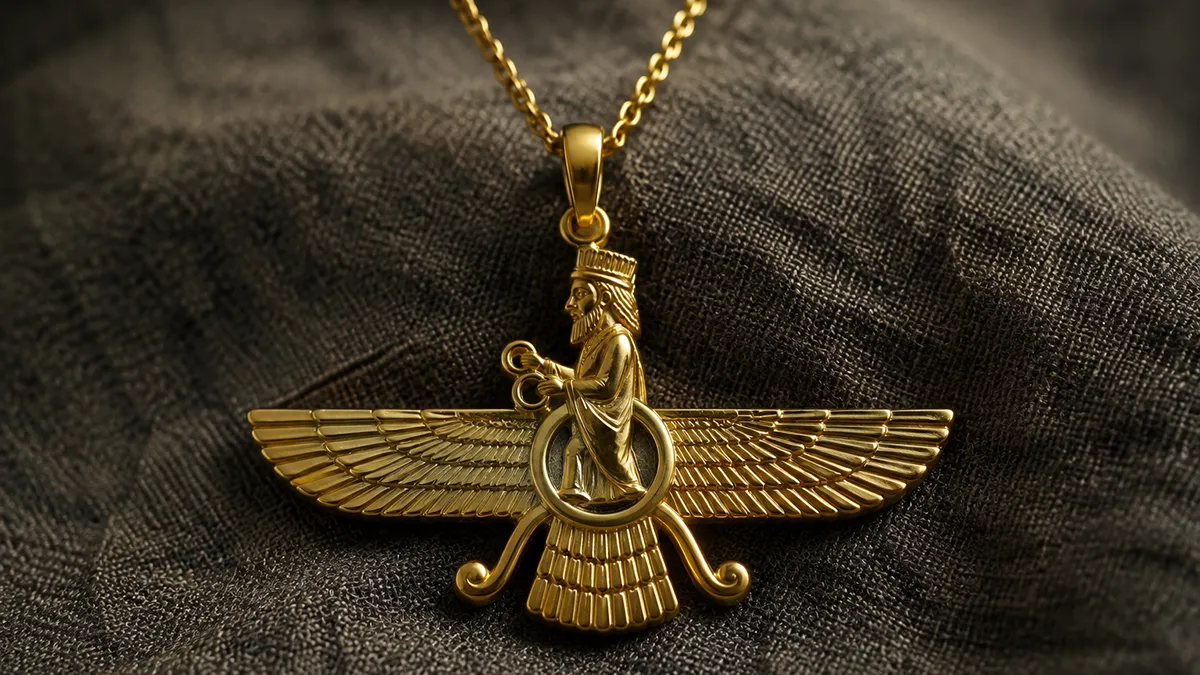
The Farvahar is a winged symbol showing the figure of a bearded man rising from a ring of feathers, with two outstretched wings and a tail beneath. It has been a powerful emblem for more than 2,500 years, prominently carved into the stone reliefs of the Achaemenid period, especially at Persepolis. It began as a religious and royal symbol and has become, over time, a much loved sign of Persian identity worn by people of every faith and background.
The origins of the Farvahar
The roots of the Farvahar reach back to Zoroastrianism, one of the world’s oldest religions, and the teachings of the prophet Zarathustra. In Zoroastrian belief the symbol is linked to the idea of a guardian spirit that accompanies a person through life, and to the immortality of the soul and its connection with the divine. You can still see it watching over kings in the great carvings of ancient Persia.
It is worth being honest that scholars do not entirely agree on what the symbol meant to the ancient Persians. The detailed, part by part meanings that most Iranians know today were drawn out and popularised more recently. They have nonetheless become the heart of how the symbol is understood, and the reason it still resonates so deeply.
What each part of the Farvahar means
The most widely taught reading gives a meaning to almost every part of the design. Together they form a short guide to living a good life, which is exactly why people like to keep it close.
- The figure of the elder represents wisdom and intellect, the experience gathered over a lifetime.
- The two wings, with their rows of feathers, stand for spiritual ascent and for the central Zoroastrian teaching of good thoughts, good words and good deeds, the qualities that lift a person upward.
- The large circle signifies eternity and continuity, a universe with no beginning and no end, and the idea that our actions return to us.
- The ring held in the hand is often read as a symbol of loyalty and of keeping promises.
- The raised hand points upward, a reminder to keep striving towards goodness.
- The tail and the two streamers below represent the choices we face, between good and its opposite, that shape the direction of a life.
Interpretations vary, and some are more modern than ancient, but at its core the Farvahar carries one simple message: choose good thoughts, good words and good deeds, and keep moving forward.
Is the Farvahar religious or cultural?
The Farvahar began in a Zoroastrian setting, yet it has grown into something broader. Over the last century it has become a secular symbol of Persian independence and national pride, embraced by Iranians whatever their religion. It is the centrepiece of our Persian Proud collection. For most people today, wearing a Farvahar is an expression of cultural identity and a link to thousands of years of history, rather than a statement of faith.
How the Farvahar is made at Persis Collection
Because we work directly with Persian artisans, every Farvahar piece we offer is handmade rather than mass produced, and the range is wider than people expect. Alongside the classic 18k gold Farvahar necklace, our collection includes cufflinks in 24k gold and in 925 silver, suit pins, pin badges, keychains, men’s ties and larger decorative pieces such as Farvahar wall art and copper wall plates.
Many of those copper and metal pieces are made using Ghalam Zani, the traditional Persian art of engraving by hand. A master artisan taps a fine design into the surface of the metal with small tools, line by line, so that no two pieces are ever quite identical. It is slow, skilled work, and it is part of why a handmade Farvahar feels so different from a machine-stamped one.
One thing we have noticed over the years is how much of the Farvahar range is chosen for men. Cufflinks, suit pins and ties make the symbol easy to wear every day, which is why our Farvahar gift set for him is such a popular present. The necklaces, of course, are worn and loved by everyone.
Why the Farvahar makes such a meaningful gift
More than almost anything else we sell, the Farvahar is bought as a gift. It is a favourite for Nowruz, the Persian New Year, and for graduations, weddings and birthdays, both among Iranians and among partners and friends who share a love of Persian culture. Giving one is a quiet way of saying, this is where you come from, and I see it.
The feedback we hear most often from customers is not only about the pieces themselves but about how they arrive: dispatched quickly, carefully and beautifully packaged, and true to the photographs. For a gift that carries this much meaning, that care matters, and it is something we take seriously.
Choosing your Farvahar piece
If you are buying your first Farvahar, a few simple choices help. A necklace is the classic option and suits everyone, while cufflinks, a suit pin or a tie are elegant ways for men to wear the symbol day to day. For something for the home, a Ghalam Zani copper wall plate makes a striking centrepiece.
On materials, solid gold in 18k or 24k is the choice for heirloom gifts and lasting value, while gold-plated 925 silver and solid silver offer the same design at a gentler price. You can see the full range in our Farvahar collection and our Persian gold jewellery, part of our wider Persian jewelry range.
Caring for your Farvahar
A handmade piece lasts longer with a little care. Keep gold and silver jewellery dry, take it off before swimming or showering, and store each piece separately so they do not scratch. A soft polishing cloth will keep gold bright and lift any tarnish from silver. Gold-plated pieces last best when kept away from perfume and harsh cleaning products. For copper Ghalam Zani art, a gentle dust and an occasional polish are all that is needed to keep the engraving sharp.
Frequently asked questions
What does the Farvahar symbolise? It is best known as a reminder to live by good thoughts, good words and good deeds, with the figure, wings and circle each carrying part of that message.
Is the Farvahar a Zoroastrian symbol? Yes, it has Zoroastrian roots and appears in ancient Persian reliefs, but today it is widely worn as a secular symbol of Persian identity.
Can anyone wear a Farvahar? Yes. It is worn by Iranians of all faiths and by people around the world who feel a connection to Persian culture.
What is a Persis Collection Farvahar made from? Depending on the piece, 18k or 24k gold, gold-plated or solid 925 silver, or hand-engraved copper, all handmade by Persian artisans.
Do you ship worldwide? Yes. We ship worldwide, with express delivery to the USA, the UK and Europe, and a flexible return policy.
Whether you wear it for its meaning, its history or simply its beauty, the Farvahar carries a message that has lasted thousands of years. When you are ready to choose one, take a look at our handmade Farvahar collection and find a piece to call your own.

Comments