


The Nazar Symbol: What the Blue Evil Eye Means and How It Is Made
- Negin Masihi
- 19 August 2025
- Persian Jewellery
- 4 minutes
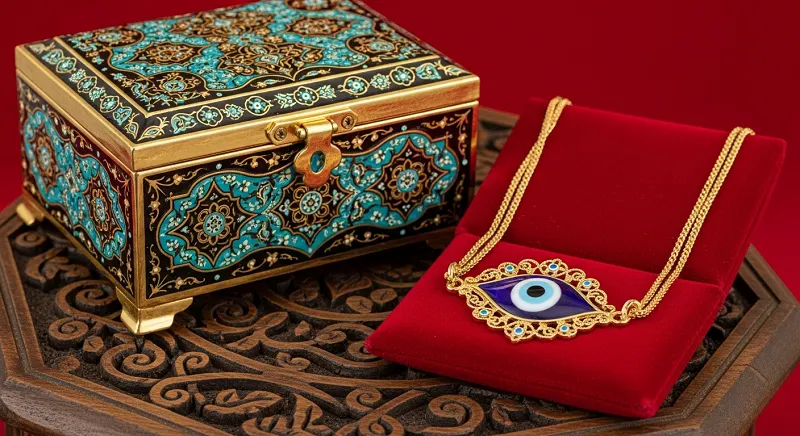
The evil eye, known in Persian as چشم نظر (cheshm nazar) or simply nazar, is one of the oldest protective symbols still in everyday use. In Persian, and across a wide belt of countries stretching from the Balkans through Turkey, the Levant and North Africa, people have worn or displayed some version of this blue-and-white eye for thousands of years. It is not a religious object. It is a folk tradition about warding off envy, and it has stayed remarkably consistent in colour and shape across cultures that otherwise have very little else in common.
Where the Evil Eye Symbol Comes From
The belief behind the evil eye is simple: a look given with envy or ill will, even unintentionally, can bring bad luck to the person it lands on. Archaeologists have traced eye-shaped amulets back roughly 3,000 years to Mesopotamia, and the idea spread from there through the ancient Mediterranean world. Ancient Greek and Roman writers referred to it directly, and by the time trade routes connected Anatolia, Persia and the wider Mediterranean, the blue glass eye bead had become a shared visual language for protection, understood in Athens, Istanbul, Cairo and Persian Heritage alike.
What makes the symbol interesting is that it never really needed translation. A market trader in Tehran and one in Athens would recognise the same blue-and-white disc for the same reason, even without a shared language for it.
The Nazar in Persian Culture
In Persian the symbol is usually called nazar, from the Arabic word for “sight” or “gaze”, and cheshm nazar or cheshm zakhm (eye of envy) is the phrase used for the harm itself. Persian families have long hung a nazar near the front door, tucked one into a baby’s cot, or pinned one to a child’s clothing, all for the same reason: to catch an envious glance before it reaches the person it’s aimed at. It sits alongside other Persian protective customs, such as burning esfand (wild rue) to clear a room of bad energy, as part of a broader everyday habit of looking after loved ones against ill fortune rather than a formal religious practice.
How the Blue Glass Bead Is Traditionally Made
The classic nazar bead is handmade from molten glass, built up in rings of colour around a central black or dark blue “pupil”: typically dark blue, then white, then a lighter blue, sometimes with a further white ring at the edge. Glassmakers add cobalt oxide to the glass to get that deep blue, and the bead is shaped while the glass is still hot, either by hand-turning it on a rod or by pressing it into a mould, before it is slowly cooled to stop it cracking. Because each bead is worked by hand, no two are perfectly identical. Small variations in the rings, in the exact shade of blue, or in the shape of the bead are part of what makes traditional pieces feel different from mass-produced plastic or resin versions.
If you’d like to see how this technique looks in finished pieces, our evil eye jewellery collection includes handmade bracelets, pendants and rings made using this bead-making method.
Common Ways People Wear and Display It
Jewellery
The most familiar form is a single bead set into a bracelet, pendant or ring, though a lot of Persian and Turkish jewellery scatters several small beads through one piece rather than using just one. Bracelets are especially popular as gifts because they’re easy to give and easy to wear every day without a second thought.
Wall Hangings and Home Décor
Larger nazar discs, sometimes 15cm or more across, are hung near doorways, in hallways or above a bed. Some households keep several scattered through different rooms rather than relying on just one, particularly near entrances where guests come and go.
Keychains and Everyday Objects
Smaller beads turn up on keyrings, phone charms, car mirrors, and even sewn into rugs and textiles. The idea is the same wherever it appears: keep the symbol somewhere it will be seen often, since it’s the visibility that’s thought to do the work.
Why People Gift Evil Eye Jewellery
Giving someone a nazar bracelet or pendant is a way of saying you wish them well, not a statement of religious belief. It’s a common gift for a new baby, a house-warming, a friend starting a new job, or simply someone going through a difficult patch. The gesture carries the same sentiment as saying “take care” or “good luck”, just expressed through an object instead of words. That’s part of why the symbol has travelled so well outside Persian and the Middle East: you don’t need to share a specific belief to understand what giving one means.
For second-generation Iranians in particular, wearing a nazar piece is often as much about connection to family and heritage as it is about protection itself. It’s a small, wearable link back to a grandmother’s front door or a childhood visit to Persian.
If you’re building a collection or buying for someone else, our guide to what the evil eye bracelet really means and complete buying guide cover the details worth knowing before you choose a piece. We’ve also written about how to wear an evil eye necklace, the difference between an evil eye bracelet and a nazar bracelet, our pick of evil eye jewellery for men, and the history of the symbol in Persian culture.
Frequently Asked Questions
What does the evil eye symbol actually protect against?
Traditionally, it’s believed to guard against harm caused by an envious or ill-wishing look, rather than against illness or misfortune generally. It’s a defence specifically against that one kind of bad luck.
Is the evil eye a religious symbol?
No. It predates Islam, Christianity and Judaism, and it’s found across religious communities in Persian, Turkey, Greece and beyond. It’s a folk custom rather than a doctrine belonging to any particular faith.
Why is the evil eye almost always blue?
Blue glass was historically rare and valued, and deep blue was thought to be especially effective at deflecting an envious gaze. The colour became so tied to the symbol that even modern plastic or resin versions almost always keep it.
Can you wear more than one evil eye piece at once?
Yes, there’s no rule against it. Many people layer a bracelet with a pendant, or wear several beads on one piece, without it losing meaning.
Is it appropriate to buy evil eye jewellery as a gift for someone outside Persian culture?
Yes, it’s commonly given as a well-wishing gift across many cultures, and most people receive it exactly as it’s intended: a thoughtful gesture of good wishes and protection.
How do I look after a handmade glass nazar piece?
Handmade glass beads are sturdy for everyday wear but can chip if knocked hard against something solid. Take bracelets off before heavy manual work or swimming, and store loose pieces somewhere they won’t rattle against other jewellery.


Comments