


The Avesta: Holy Book of Zoroastrianism and Its Sacred Texts
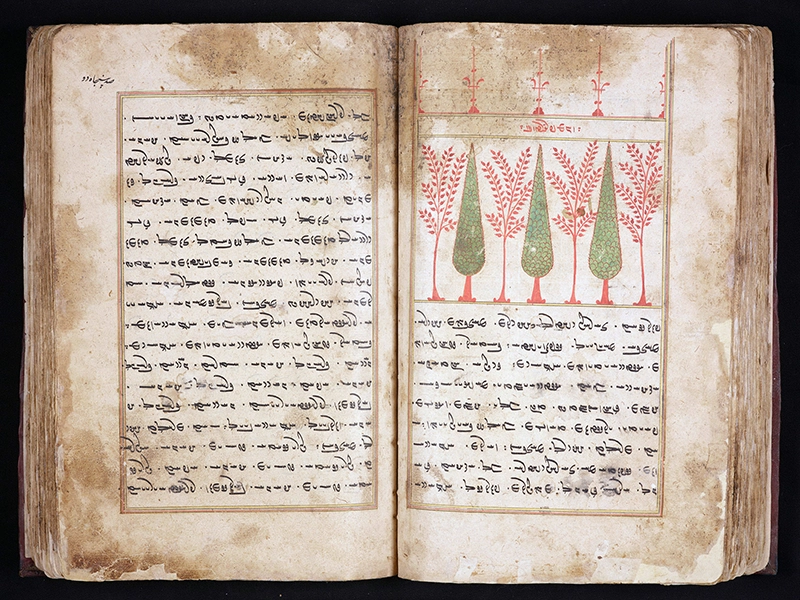
Few religious texts in human history carry the weight of the Avesta holy book. Composed in one of the world’s oldest known languages, recited by priests for millennia before a single word was written down, and nearly destroyed by the sword of a Macedonian conqueror, the Avesta is both the spiritual heartbeat and the historical record of one of humanity’s earliest faiths. For anyone drawn to the roots of Persian civilisation, or curious about a religion that shaped the moral vocabulary of Judaism, Christianity and Islam alike, the Zoroastrian sacred texts offer a window into a world that is at once ancient and startlingly relevant. This guide covers everything you need to know about the Avesta Book — its origins, its contents, its language and its enduring legacy.
What Is the Avesta Holy Book?
The Avesta is the collective name for the body of religious literature belonging to Zoroastrianism, one of the world’s oldest monotheistic religions. Written in the Avestan language and recorded in the distinctive Avestan alphabet, these texts represent the largest surviving literature of the Old Persian period and contain the oldest known writings in any Persian language.
At its heart, the Avesta is not a single book in the way the Bible or the Quran is understood today. It is better described as a scriptural collection — a gathering of hymns, liturgical prayers, legal codes, cosmological teachings and mythological passages assembled over many centuries. Its closest parallel in world literature may be the Rigveda of ancient India, and the two texts share deep linguistic and cultural roots, a connection we will explore in detail below.
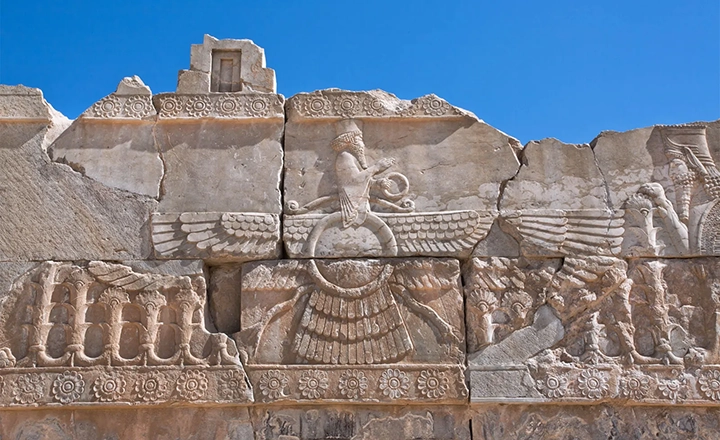
In the Zoroastrian tradition, the sacred name of God is Ahura Mazda — meaning “Wise Lord” — who is presented throughout the Avesta as the supreme force of light, truth and purity. The three central moral principles of Zoroastrianism, stated explicitly in its scriptures, are good thoughts, good words and good deeds (Humata, Hukhta, Hvarshta). These are not abstract ideals but practical guides for daily life, and they run through every layer of the Avesta scripture. The Farvahar — the winged symbol depicting the human soul on its journey towards Ahura Mazda — remains the most recognisable emblem of this faith, a visual expression of the very values the Avesta teaches.
The Origins of the Avesta and the Zoroastrianism Holy Book Tradition
An Oral Tradition Before a Written One
The texts that make up the Avesta holy book were not originally written at all. Like the Vedic hymns of ancient India, they were oral compositions — memorised, chanted and transmitted from priest to student across generations with extraordinary precision. Scholars believe the earliest layers of the text, particularly the Gathas (the hymns attributed directly to the prophet Zoroaster himself), were composed somewhere between 1500 BCE and 900 BCE, placing them among the most ancient religious poetry ever preserved.
Written transmission only began during the Sasanian Empire (224–651 CE), when the Avestan alphabet was specifically created to capture the precise sounds of a sacred language that was already ancient and no longer spoken as a living tongue. This written canon became known as the Sasanian Avesta.
Alexander and the Burning of the Ancient Avesta
One of the most significant and poignant episodes in the history of the Avesta involves the conquest of Persia by Alexander the Great. Persian tradition holds that when Alexander burned the royal palace at Persepolis, he also destroyed the great Avesta — said at the time to comprise 21 nasks (books) amounting to 815 chapters. These texts had reportedly been inscribed on ox hides in golden ink and stored in the royal treasury. The burning of Persepolis was not merely the destruction of a building; for Zoroastrians, it was a catastrophic loss of their most sacred knowledge.
Following this devastation, it was a Parthian emperor — Vologases (Balash) — who issued orders for the scattered and surviving fragments of the Avesta to be gathered from across the cities of Persian, collecting both written remnants and the oral versions preserved by priests. This effort laid the groundwork for the later Sasanian compilation.
The Sasanian Canon and What Survived
Under the Sasanian rulers, a formal effort was made to consolidate the surviving Zoroastrian sacred texts into a definitive canon. The original Sasanian Avesta reportedly contained 21 nasks organised thematically. Today, only five of those original sections survive in any meaningful form — a fraction of what once existed. Most of the Sasanian Avesta was lost following the Islamic conquest of Persian in the 7th century CE.
What we possess today survives largely because these particular texts were actively used in priestly rituals. Texts that remained in daily liturgical practice were copied and recopied; texts that fell out of use were simply forgotten. It is a sobering reminder of how close civilisation came to losing one of its most extraordinary spiritual inheritances entirely.
The Oldest Known Manuscript of the Avesta
The oldest surviving handwritten manuscript of the Avesta dates to 1323 CE — a remarkable fact that underscores just how much was lost over the intervening centuries. This manuscript is now held in Copenhagen, Denmark, having been brought to Europe by the eminent Danish orientalist N.L. Westergaard, who carried it back from Persian in the nineteenth century. Westergaard’s work played a foundational role in Western scholarship on the Avestan language and the study of Zoroastrianism’s holy book.
The Avestan Language: The Voice of the Zoroastrian Sacred Texts
Old Avestan and Younger Avestan
The Avesta language is actually divided into two closely related but distinct forms: Old Avestan and Younger Avestan. Old Avestan is the older and more archaic of the two — this is the language of the Gathas and certain other ancient hymns. Younger Avestan, used in the majority of the remaining texts, represents a later and slightly simplified stage of the same language.
Old Avestan is strikingly similar to Vedic Sanskrit, the language of the Rigveda. Both descended from Proto-Indo-Persian, the ancestral tongue shared by the ancient peoples who eventually separated into the Persian and Indian branches of civilisation. In practical terms, this means that a scholar fluent in one of these ancient languages would find the other partially intelligible — a linguistic echo of a shared cultural heritage stretching back four thousand years or more.
A Language Kept Alive by Priests
By the time the Sasanian scribes created the Avestan alphabet to write down the sacred oral tradition, Avestan had already ceased to be a spoken everyday language — probably around 400 BCE. It survived solely in the mouths of Zoroastrian priests (known as mobeds), who preserved it through the rigorous oral training at the heart of their vocation. Today, Avestan is not spoken as a living language; it exists only within the liturgy of the Zoroastrian faith, recited by practising mobeds in religious ceremonies worldwide.
The Contents of the Avesta: A Guide to the Zoroastrian Sacred Texts
The surviving Avesta holy book is divided into several major sections, each serving a distinct purpose within Zoroastrian religious life.
The Yasna: Heart of the Avesta Scripture
The Yasna is the primary liturgical text of the Avesta and takes its name from the main Zoroastrian ceremony in which it is recited. It consists of 72 chapters and includes the Gathas — the most ancient part of all Avesta scripture, comprising 17 hymns attributed directly to the prophet Zoroaster. Written in Old Avestan, the Gathas are deeply poetic, philosophically rich meditations on the nature of truth, righteousness, the human soul and its relationship to Ahura Mazda.
The Visperad
The Visperad (“all the masters”) is a supplementary liturgical text used alongside the Yasna during high ceremonial occasions. It consists of 24 sections of invocations and praises addressed to holy beings and sacred forces. In ceremonial recitation, its sections are inserted between the Yasna chapters in a manner not unlike the structure of a formal church service.
The Vendidad: The Code Against the Demons
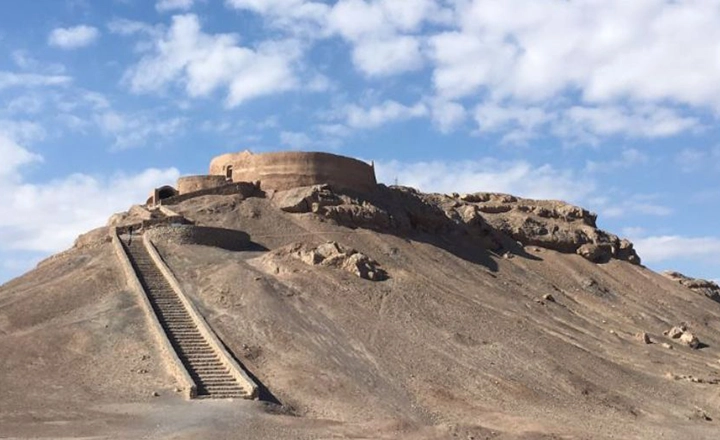
The Vendidad (or Videvdat, meaning “given against the demons”) stands apart from the other sections of the Avesta as a largely legal and ritual text. It covers topics including purity laws, moral codes, descriptions of the afterlife, and rules governing the treatment of the dead. One of its most notable aspects is the Zoroastrian approach to the four sacred elements — water, earth, air and fire — all of which are regarded as holy and must not be contaminated or defiled. This is why, traditionally, Zoroastrians did not bury their dead in the ground: to do so would be to pollute the sacred earth. Instead, bodies were placed in “towers of silence” (dakhmas), exposed to the elements and scavenging birds.
The Yashts: Hymns to the Divine
The Yashts are a collection of 21 hymns praising various divine beings (Yazatas) within the Zoroastrian cosmology. They are among the most poetically compelling sections of the Avesta and contain rich mythological and epic content. Unlike the High Liturgy texts, the Yashts are accessible to all Zoroastrians, not only priests.
The Khordeh Avesta: The Little Avesta
The Khordeh Avesta, or “Little Avesta”, is a collection of shorter prayers, blessings and daily devotional texts designed for use by ordinary Zoroastrians in their everyday religious life. It includes prayers for different times of day, blessings for meals and various occasions, and selections from the Yashts. If the full Avesta is the complete scriptural canon, the Khordeh Avesta is the personal prayer book that most ordinary believers would use.
The Zend-Avesta: Understanding the Term
You may encounter the Avesta referred to as the Zend Avesta or Zend-Avesta. This term, which became popular in Western scholarship particularly from the 18th and 19th centuries, combines “Avesta” with “Zend” — the latter referring to the exegetical commentary and translation of the sacred texts into Middle Persian (Pahlavi). In its strictest technical sense, the Zend is not part of the Avesta itself but rather the interpretive layer added around it. The distinction matters to scholars, though in popular usage the terms are often used interchangeably to refer to the full corpus of Zoroastrian sacred literature.
James Darmesteter, the French orientalist, produced what became for many years the most widely read English translation of the Zend-Avesta (published in three volumes in the 1880s–1890s as part of the Sacred Books of the East series). His translation remains freely accessible online and is a valuable starting point for anyone wishing to read the Avesta in English.
The Avesta’s Influence on World Religion
The significance of the Zoroastrianism holy book extends far beyond the boundaries of the Zoroastrian community. Scholars have long noted that Zoroastrian theology — as expressed throughout the Avesta — introduced or greatly developed several doctrines that later became central to Judaism, Christianity and Islam: the cosmic struggle between good and evil, individual moral judgement after death, concepts of heaven and hell, the resurrection of the body, a final day of judgement, and the idea of a messianic saviour figure.
In other words, the Avesta holy book may be understood as one of the most influential religious texts ever composed — not merely for its own community, but for the broader trajectory of Western and Middle Eastern religious thought. When Zoroastrian ideas reached the Jewish communities during the Babylonian exile, and when those ideas in turn shaped nascent Christianity and later Islam, the chain of influence traced back, ultimately, to the Avestan hymns chanted by ancient Persian priests.
Conclusion
The Avesta holy book is one of humanity’s great spiritual and literary treasures — a text that survived oral transmission across millennia, the destructive ambitions of Alexander the Great, the upheaval of conquest and the slow erosion of time. What remains is a remarkable body of Zoroastrian sacred texts: hymns of breathtaking antiquity, legal codes rooted in a profound respect for the natural world, and philosophical teachings that shaped the moral imagination of civilisations far beyond Persia’s borders.
To read the Avesta in English today — whether Darmesteter’s classic translation or a more recent scholarly edition — is to encounter a voice from the very dawn of recorded human spirituality. And to understand the Zoroastrianism holy book is to understand something essential not only about ancient Persian, but about the deep roots of the world’s major faiths. At Persis Collection, we celebrate this extraordinary heritage and are proud to bring authentic Persian culture and craftsmanship to people around the world.
FAQ
What does the word Avesta mean?
It derives from the Middle Persian abestāg, meaning received, authoritative knowledge — distinct from interpretive commentary.
Are Zoroastrians Muslims?
No. Zoroastrianism is a separate, older religion. Its holy book is the Avesta, not the Quran.
Is the Avesta older than the Rigveda?
Most scholars consider the Rigveda older by 500–1,000 years, though both datings remain speculative.
What is the best English translation of the Avesta?
James Darmesteter’s translation (1880s–1890s) is the most accessible. Stanley Insler’s is preferred for the Gathas specifically.
What is the connection between the Avesta and the Rigveda?
Both descend from the same Proto-Indo-Persian tradition, sharing closely related languages, myths and poetic structures.
Is the Avestan language still spoken today?
No. It has been extinct for around 2,400 years, though priests still recite it in religious ceremonies.
What happened to the original Avesta?
Alexander the Great reportedly destroyed it. Surviving fragments were later compiled during the Sasanian Empire.
Who wrote the Avesta?
The Gathas are attributed to Zoroaster. The remaining texts were composed by priests over many centuries.


Comments