


Inspiring Ways to Use Persian Tiles in Bathrooms
- Negin Masihi
- 29 August 2025
- Home Decor
- 4 minutes
Persian tilework brings genuine colour and pattern to a bathroom in a way few other materials manage, but getting it right means understanding what you’re actually buying. Traditional Persian tiles fall into two distinct techniques, Haft Rang (seven colour) and Moaraq mosaic work, and each behaves differently on a wall, costs differently, and suits different parts of a bathroom. This guide covers both, along with the motifs, colour pairings and practical fitting advice worth knowing before you tile.
Haft Rang and Moaraq: Two Different Techniques
Moaraq, sometimes called Kashi Moaraq or mosaic faience, is the older and more labour intensive of the two. Each tile is fired in a single glaze colour, then cut by hand into small shaped pieces, which are fitted together like a jigsaw to build up a pattern, similar in principle to stained glass. This is the technique behind the great domes and iwans of the Sheikh Lotfollah Mosque and the Shah Mosque in Persian Heritage, and it produces exceptionally crisp, saturated colour because each piece is a solid single glaze rather than a painted design.
Haft Rang developed as a faster, cheaper alternative during the Safavid period. Instead of cutting and assembling individual coloured pieces, artists paint several colours directly onto a single square tile before firing, allowing a whole pattern to be built up across a grid of flat tiles rather than piece by piece. It is quicker to produce and easier to lay flat, which is why most Persian-style bathroom tiling today, including tiles suited to a home renovation, uses the Haft Rang method rather than true mosaic.
Traditional Motifs and Colour Palettes
Three motif families turn up again and again in Persian tile design. Eslimi is the flowing arabesque scrollwork based on stylised vine tendrils, used to fill borders and backgrounds. Khatai patterns are floral, built from repeating blossoms and leaves in a tighter, more symmetrical grid. Girih is geometric strapwork, interlocking star and polygon shapes that read as pure pattern rather than plant form, often used on borders and dado panels.
The colour palette is just as recognisable as the motifs. Firuzeyi, a bright turquoise, is the dominant colour in most Safavid-era schemes, paired with lajevardi cobalt blue for outlines and background fields. White is used generously to stop the pattern from feeling heavy, and older pieces sometimes bring in touches of yellow ochre or a deep aubergine purple as accent colours within a border. For a bathroom, sticking mainly to turquoise, cobalt and white keeps the look authentic without becoming overwhelming.
Where to Use the Tiles in a Bathroom
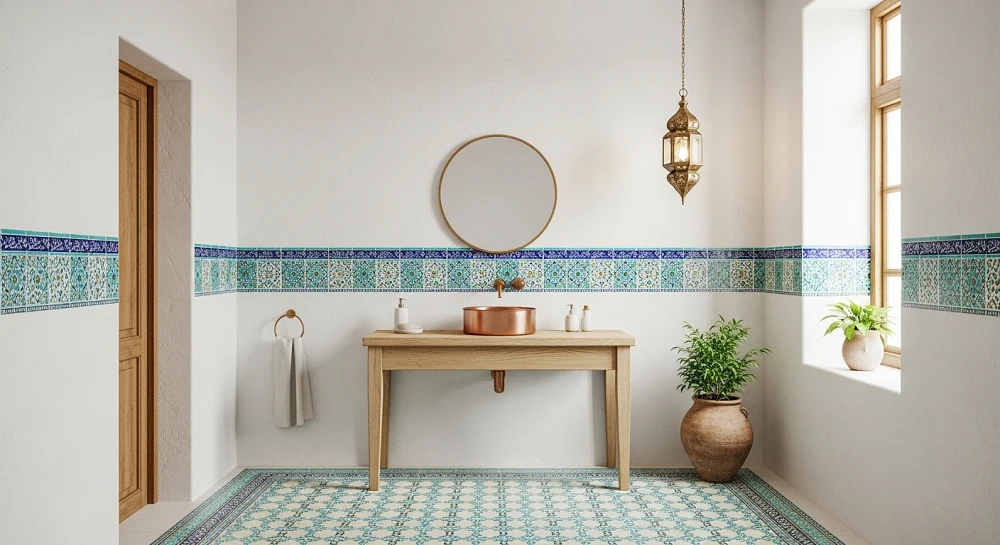
Persian pattern tiles work best used with restraint. A full shower surround or a single feature wall behind a freestanding bath gives the pattern room to read properly, whereas covering every wall in a small bathroom tends to flatten the effect and make the room feel smaller rather than richer. A narrow border strip of Moaraq-style geometric tiles run along a plain wall, or a mosaic panel set into an alcove or niche, is another way to use a small quantity of the more expensive mosaic work without needing to tile an entire surface.
Floors are a slightly different matter. Glazed pattern tiles can be slippery when wet, so they suit a dry vanity area or a raised step better than the floor of a walk-in shower, where a matte, textured tile with a similar colour palette is a safer choice.
Pairing Persian Tiles with Fixtures and Other Materials
Plain white or pale grey tiles on the surrounding walls let a turquoise and cobalt feature area do the talking, and this pairing also keeps the overall cost down since only a portion of the room needs the more expensive pattern tile. Brass and aged brass fittings, whether a tap, a mirror frame or door hardware, sit particularly well against turquoise and cobalt, echoing the gold and yellow accents that appear in many historic Safavid schemes. Chrome and matte black fittings also work, giving a cleaner, more contemporary contrast against the pattern rather than trying to match its warmth.
Caring for Persian Tile Installations
Handmade glazed tiles need proper sealing at installation, particularly around grout lines and any cut edges where the unglazed body of the tile is exposed, since that raw ceramic can absorb moisture if left unprotected in a wet area. A cement-based grout suited to wet rooms, applied with attention to full coverage rather than just surface appearance, prevents water tracking behind the tiles over time. Day to day, a soft cloth and a pH-neutral cleaner is enough; acidic bathroom cleaners and abrasive scouring pads can dull or scratch a hand-glazed surface in a way that ordinary factory porcelain would tolerate. Good extraction or ventilation in the room also matters more with these tiles than with standard porcelain, since it reduces the amount of standing moisture the grout and edges are exposed to.
Frequently Asked Questions
What is the difference between Haft Rang and Moaraq tiles?
Haft Rang tiles are painted with several colours on one flat tile before firing. Moaraq tiles are cut from single-colour glazed pieces and assembled like a mosaic. Moaraq is more labour intensive and typically more expensive.
Are Persian tiles suitable for a shower floor?
Glazed pattern tiles can be slippery underfoot when wet, so a matte or textured tile in a similar colour scheme is generally a better choice for a shower floor, keeping the glazed pattern tiles for walls.
Do Persian tiles need special maintenance?
They benefit from a pH-neutral cleaner rather than acidic products, and proper sealing of grout and any cut edges at installation is important to stop moisture getting into the tile body over time.
How much of a bathroom should be covered in pattern tile?
A single feature wall, a shower surround, or a border strip is usually more effective than covering every surface, which can overwhelm a small room and add unnecessary cost.
What colours pair well with turquoise Persian tiles?
Cobalt blue and white are the traditional pairing. For fixtures, brass and aged brass echo the warmth of historic schemes, while chrome or matte black gives a more contemporary contrast.


Comments