


Iranian Handicrafts: A Guide to Persia’s Traditional Crafts
- Persis Collection
- 16 July 2018
- Persian Handicrafts
- 4 minutes
Persian handicrafts cover a remarkable range of traditions, from hand-knotted rugs and glazed pottery to hammered copper, hand-woven textiles and inlaid wood. Each craft grew up in a particular Persian city or region, shaped by the materials available there and by generations of artisans who passed their skills from parent to child or master to apprentice. For anyone new to Persian handicrafts, this guide works through the major traditions one by one, so you can recognise what you are looking at and understand why it is made the way it is.
Persian Rugs and Carpets
Rug weaving is the best known of all Persian crafts, and it is practised differently from city to city. Tabriz, in the north west, produces rugs with fine, dense knotting and medallion designs woven from memory by weavers who never draw the pattern out. Persian Heritage rugs are prized for their curling vine and floral motifs, often woven in silk as well as wool. Kashan is known for its deep red palette and traditional medallion layouts, while Qom has become a centre for silk rugs woven to an especially high knot count. Alongside the city workshops, tribal groups such as the Qashqai and the Bakhtiari weave rugs on horizontal ground looms, using bolder geometric patterns passed down within the tribe rather than drawn from a formal design.
Two knotting techniques are used across Persian: the asymmetrical Persian knot, also called the Senneh knot, and the symmetrical Turkish knot, used more in tribal and north western weaving. Wool is usually dyed with natural sources such as madder root for red, indigo for blue and walnut husk for brown, though many workshops today also use synthetic dyes for a wider colour range.
Pottery and Ceramics
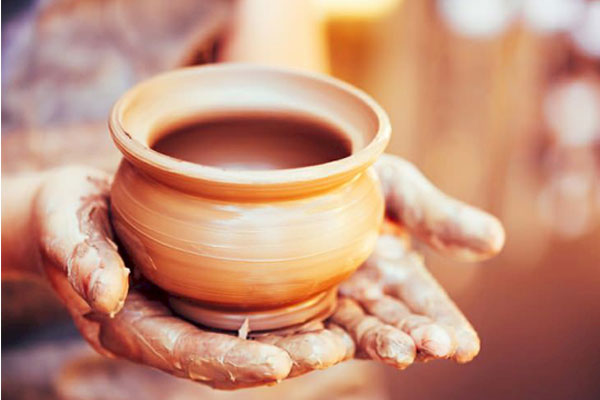
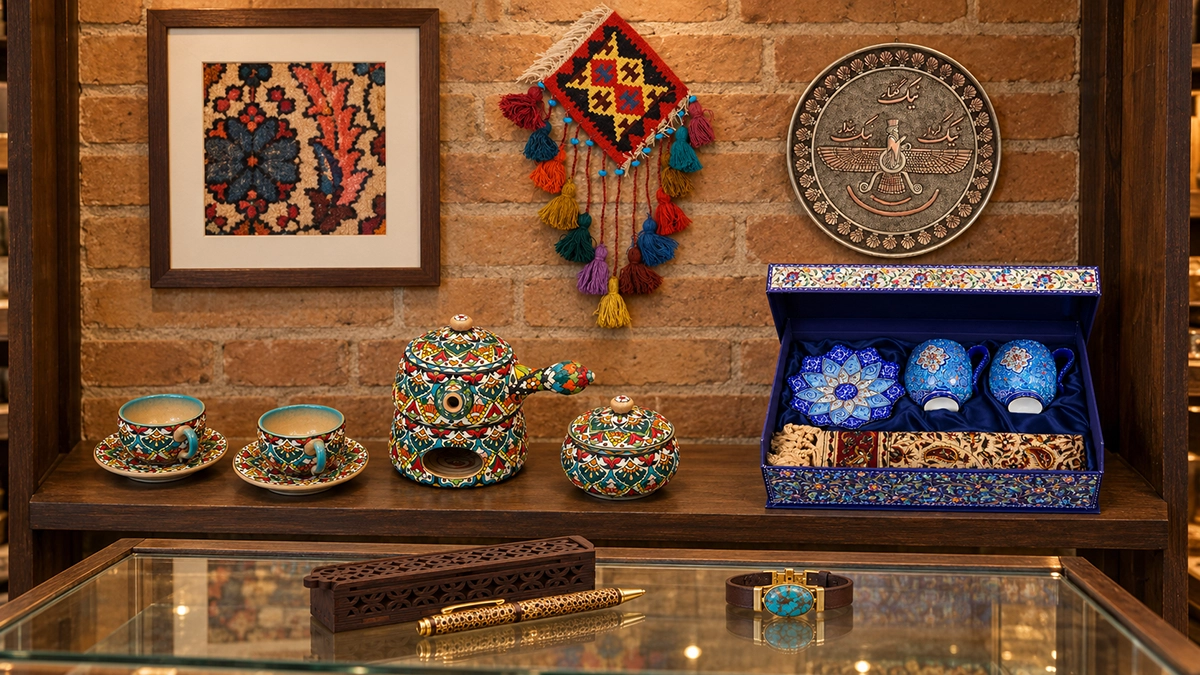
Persian pottery has two quite different faces. In Lalejin, a small town near Hamadan often called the pottery capital of Persian, artisans throw everyday glazed stoneware on the wheel, from bowls and jugs to large decorative vases, using techniques that go back centuries in that town alone. In Persian Heritage and Kashan, potters instead work on tilework, most famously haft rang, or seven colour tiles, in which several glaze colours are fired onto a single tile to build up the turquoise, cobalt and ochre patterns seen on mosque domes and courtyards across the country. Meybod, near Yazd, is another old pottery centre, known for unglazed and lightly glazed earthenware fired in traditional kilns.
Persian Metalwork
Persian Heritage is the centre of Persian metalwork, particularly hand engraving on copper, known as ghalam zani. An artisan taps a design into a copper sheet or vessel with a small hammer and a set of fine chisels, working the whole surface by eye, line by line, so no two engraved pieces are ever identical. The same city produces minakari, enamelwork painted onto copper and fired in a kiln to fix the colour, usually in blues and turquoises with floral or hunting scenes. Zanjan, further north, is known for a different metal skill, malileh, a fine silver filigree in which thin wires are twisted and soldered into lace-like patterns, used for boxes, jewellery and small decorative bowls.
Textiles and Weaving
Yazd, a desert city on the old Silk Road, is home to termeh, a hand-woven textile made from wool, and sometimes silk, worked with gold or coloured thread on a traditional loom to create the paisley-like boteh pattern. Termeh is used for tablecloths, shawls and ceremonial cloths, and pieces are still woven for weddings and formal occasions today. Persian Heritage is also known for qalamkar, a technique of hand block printing and painting patterns onto cotton, traditionally used for tablecloths and bedspreads, with each colour applied using a separately carved wooden block.
Woodwork and Marquetry
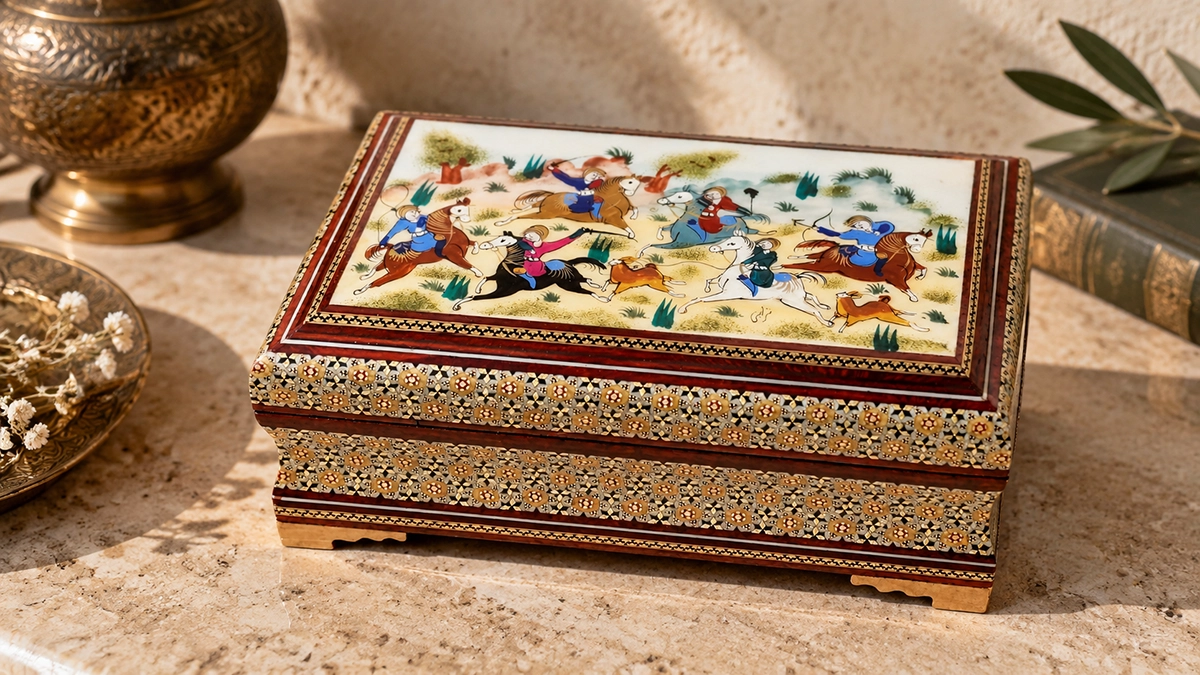
Khatam kari, Persian marquetry, is produced mainly in Persian Heritage and Shiraz. Thin rods of wood, bone, brass and camel bone are bundled together, glued and cut into cross sections so that each slice already contains a tiny geometric star pattern, which is then applied as a veneer to boxes, frames, backgammon sets and furniture. It is slow, exacting work, since the pattern has to line up across every joint. Sanandaj, in Persian’s Kurdish region, has its own woodworking tradition, monabbat kari, in which patterns are carved directly into solid wood panels rather than built up from inlay, producing deep relief work often seen on doors and screens.
Why These Crafts Still Matter
Most of these techniques are still taught in the same way they always were, hands on, from an experienced artisan to someone learning the trade, rather than in a factory setting. That is part of why handmade Persian pieces vary slightly from one another and why collectors often ask which city or workshop a piece came from. Knowing the difference between a Tabriz rug and a Qashqai one, or between qalamkar printing and khatam inlay, makes it much easier to understand what you are buying and why it was made that way.
Frequently Asked Questions
What is the most famous Persian handicraft?
Persian rug weaving is the best known Persian craft internationally, though pottery, metalwork, termeh textiles and khatam marquetry are all long-standing traditions in their own right.
What is ghalam zani?
Ghalam zani is the Persian art of hand engraving metal, usually copper, using a hammer and small chisels to tap a design into the surface line by line.
Where does termeh come from?
Termeh is traditionally woven in Yazd, a desert city in central Persian, from wool and sometimes silk with metallic thread woven through the pattern.
What is khatam kari?
Khatam kari is Persian marquetry, made by bundling thin rods of wood, bone and brass, cutting them into cross sections and applying the resulting geometric pattern as a veneer.
Are Persian handicrafts still handmade today?
Yes. Most of the crafts described here, from rug weaving to metal engraving and marquetry, are still made by hand by artisans working in the towns and cities where each tradition began.

Comments