


How to Set Up a Backgammon Board
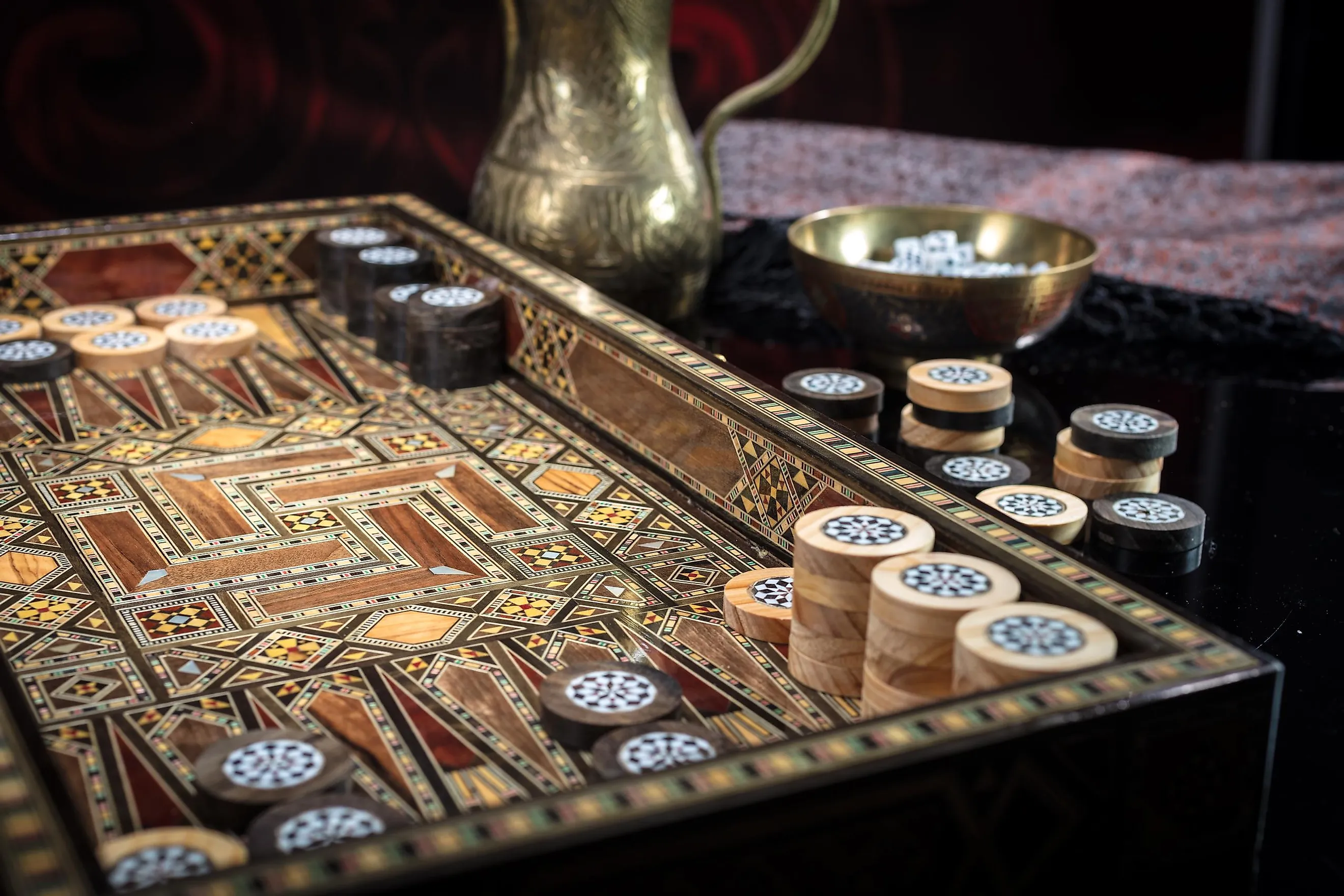
- Persis Collection
- 15 January 2024
- Game
- 4 minutes
Setting up a backgammon board correctly is the first thing to get right before a game can begin, and it trips up more beginners than any of the actual strategy does. Backgammon, known in Persian as Takhteh Nard, uses 15 checkers per player, two dice each, and a fixed starting layout that never changes from game to game. Once you know the layout and the basic flow of play, setting the board takes under a minute.
The Board and the Pieces
Points and Quadrants
A backgammon board has 24 narrow triangles called points, split into four quadrants of six points each: your home board, your outer board, your opponent’s outer board and your opponent’s home board. A central divider called the bar separates the two home boards from the two outer boards. Points are numbered from 1 to 24, but each player counts from their own side, so your 1-point is your opponent’s 24-point and vice versa. This is why two people can look at the same board and describe the same triangle with a different number.
Checkers, Dice and the Doubling Cube
Each player has 15 checkers in a single colour, plus two six-sided dice and a dice cup for shaking them. A third item, the doubling cube, shows the numbers 2, 4, 8, 16, 32 and 64 and is used to raise the stakes of a game once play is underway. You will not need the doubling cube for your first few games, but it is worth having on the board from the start since it also acts as a simple turn marker in casual play.
Setting Up the Checkers
The starting position is identical for both players, mirrored across the board. Working from your own 24-point, which is the point furthest from your home board, place your checkers as follows:
- Two checkers on your 24-point
- Five checkers on your 13-point
- Three checkers on your 8-point
- Five checkers on your 6-point
That accounts for all 15 checkers. Your opponent sets up the mirror image on the opposite side of the board, using their own numbering, so the finished board shows two clusters of checkers facing each other on the outer points and two larger stacks facing each other closer to each player’s own home board. If you count correctly, no point should ever hold checkers belonging to both players.
A Quick Way to Check You Have It Right
Before you start playing, glance across the board. You should see four separate groups of checkers, two per player, and each player’s largest group of five should sit on their own 6-point, right at the edge of their home board. If your checkers are spread more evenly across the board than that, the setup is wrong and worth redoing before the first roll.
How to Begin Play
Rolling for the First Move
Each player rolls one die to see who goes first. Whoever rolls higher plays first, using the combination of both that first roll’s numbers as their opening move. If the roll is a tie, both players roll again. After the opening move, players alternate turns, each rolling two dice and moving according to the numbers shown.
How Checkers Move
Checkers move towards your own home board, following your own numbering from 24 down to 1. Each die shows how many points a checker can travel, and a checker may land on any point that is open, meaning it is empty, holds only your own checkers, or holds exactly one opposing checker. If you roll a double, such as two fives, you play that number four times rather than twice.
Hitting and the Bar
A point held by only one opposing checker is called a blot, and you can hit it by landing on it, sending that checker to the bar. A checker on the bar must re-enter the game through the opponent’s home board before its owner can make any other move, entering on the point that matches one of their dice numbers. If both relevant points are blocked by the opponent, the player stays stuck on the bar and forfeits the rest of that turn.
Bearing Off and Winning
Once all 15 of a player’s checkers are gathered inside their own home board, that player can start bearing off, removing checkers from the board according to dice rolls. The first player to bear off all 15 checkers wins the game. If any of your checkers are still on the bar or outside your home board, you cannot bear off until they have all made it home.
Frequently Asked Questions
Which side of the board should face each player?
It does not matter which physical side you sit on, since each player’s home board is simply the six points closest to them on their right-hand side by convention. What matters is that both players agree on which quadrant is whose home board before the first roll.
How many checkers does each player start with?
Fifteen each, arranged as two on the 24-point, five on the 13-point, three on the 8-point and five on the 6-point, using each player’s own numbering.
What happens if I roll a double?
You play that number four times instead of twice. Rolling double threes, for example, lets you make four separate moves of three points each, in any legal combination.
Can two of my checkers share a point with my opponent’s checkers?
No. A point can hold any number of checkers belonging to one player, or a single lone checker belonging to either player, but never checkers from both players at once.
Do I have to make a move if the dice allow one?
Yes, if a legal move is available you must play it, and you must use both dice if it is possible to do so. If only one die can be legally played, you are required to play that one rather than skip your turn.


Comments