


Famous ancient Persian art – Art and Visual Culture
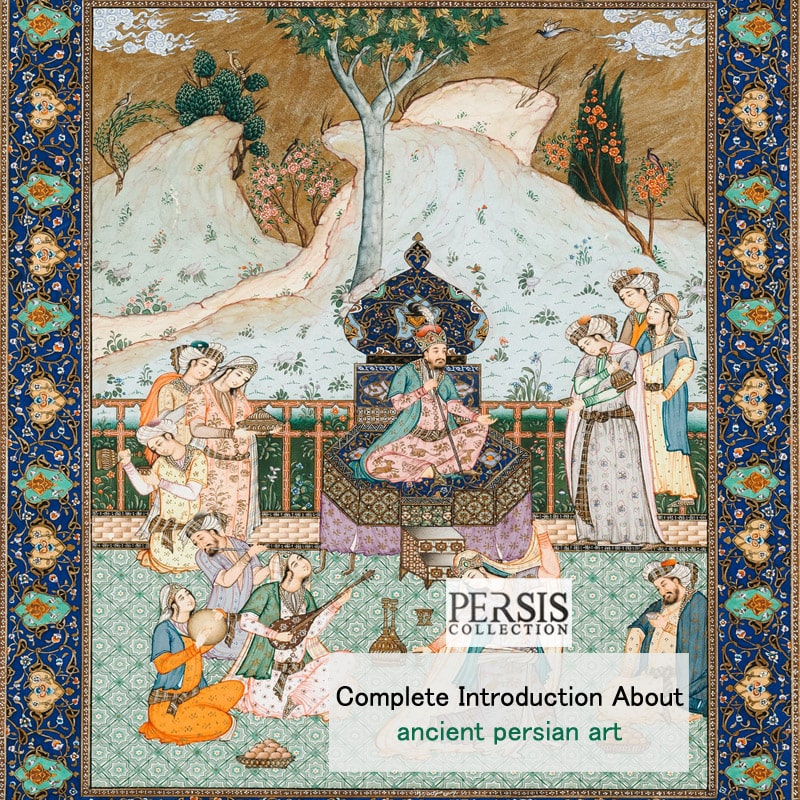
- tina atrg
- 30 August 2022
- Iranian Art
- 4 minutes
Persian art, including ancient Persian art, dates back to the earliest chapters of human history. From the time humans first inhabited caves to the present day, painting has existed in various styles and traditions throughout different historical periods.
The history of Persian painting in Persian traces back to the era of cave dwellers. Painted depictions of animals and humans have been found in caves in Lorestan province, dating back more than 12,000 years. Additionally, paintings discovered on pottery in sites such as Silk Hill and Susa provide further evidence that Persian artists in these regions were well-versed in the art of painting.
The patterns on the pottery are the shapes of animals and nature, which are very simple and geometrically drawn. Considering that the line was created from the painting, it seems that these paintings also had elements of the line. Also, a few paintings belonging to the Parthian period have been found in Khwaja Mountain in Sistan and Dora Europas in Mesopotamia, in which the religious traditions of post-Islamic painting can be clearly observed. Sometimes the style used in them is reminiscent of Persian miniatures.
In the Sassanid era, Mani (216–274 CE), the prophet-painter of ancient Persian, left behind the celebrated illustrated book known as the Arzhang. From the beginning of Islam to the Seljuk era, the Umayyad and Abbasid rulers monopolized Persian art and prevented its growth among the people to a large extent. In the first centuries of Islam, painting and drawing were mostly used in book design. Usually, the beginning and margins of the book were painted and decorated.
The art of book layout developed greatly during the Seljuks, Mongols, and Timurids. From about the 10th century of Hijri, the painting was introduced independently.
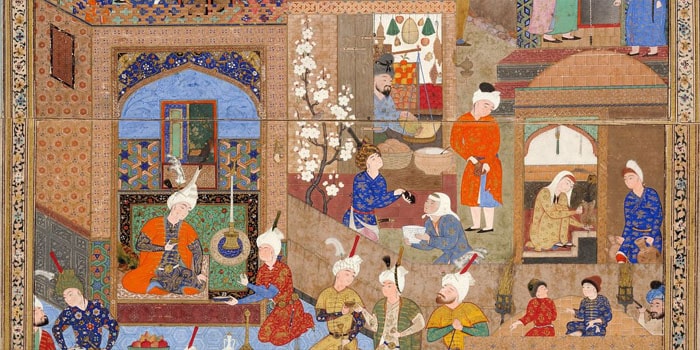
ancient Persian art
Types of traditional styles of ancient Persian art
Undoubtedly, traditional Persian artists create unique paintings, motifs, and designs using their rich taste, innovative power, and unparalleled skills. These features make Persian handicrafts truly special.
These motifs, which mainly include broken motifs and rounded motifs, are inspired by the lines of plants, animals, and objects, and are less realistically and mainly abstractly designed. It can be a metal work, a wooden product, a water-based product, a special embroidery, a textile, etc.
to impress the audience and make them think and ponder. This means that traditional design has the highest importance in the collection of traditional Persian art.
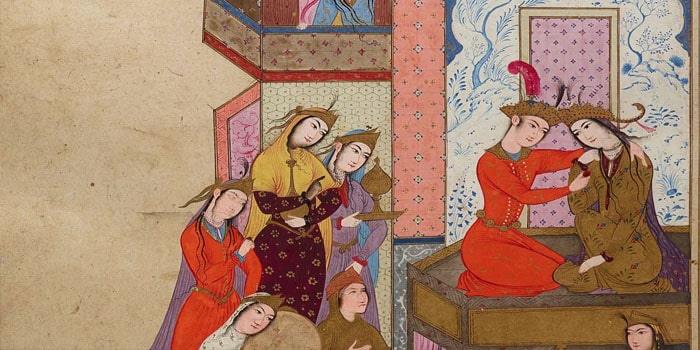
traditional styles of ancient Persian art
Miniature
Persian painting or miniature, which exists since the time of the Persian master painter Mani in the Sassanid era, has special principles and rules, and features that distinguish it not only from European painting but also from the many later styles that imitate it.
Some of the most important points are as follows:
- Failure to respect dimension and perspective in the work
- Failure to observe light shade at work
- Avoiding plain reality and turning to or reaching the truth. (Staying away from the world of beings and paying attention to the world of should)
- Imagination instead of recording the existing reality and naturally using ideal colors instead of available colors. The main characteristics of painting are related to its insight, thematic, structural, functional, and technical characteristics, which have caused Persian painters to use this Persian art to draw and paint beautiful and meaningful images on books and walls.
And therefore, since ancient times, this characteristic art has mostly served as the art of book arrangement and mural painting, although today it is mostly manifested in beautiful Persian paintings and eye-catching curtains.
The most prominent Persian painter after Mani is master Kamaluddin Behzad Herati – the painter of Herat and Tabriz II doctrine – and in the contemporary era, we should mention master Mahmoud Farshchian who has presented exceptional works.
The important painting doctrine of Persian are:
- Herat doctrine (Timur era)
- Shiraz doctrine (Ilkhani period)
- Tabriz First doctrine (Ilkhani Period)
- The second doctrine of Tabriz (Safavid period)
- Qazvin doctrine (Safavid period)
- Persian Heritage doctrine (Safavid period)
- Tehran doctrine (contemporary period)
Of course, each of them has singular characteristics and master painters, and each doctrine has left unique works. The fact that the Shahnameh left from different eras, especially the Safavid era, are considered masterpieces of book design and painting.
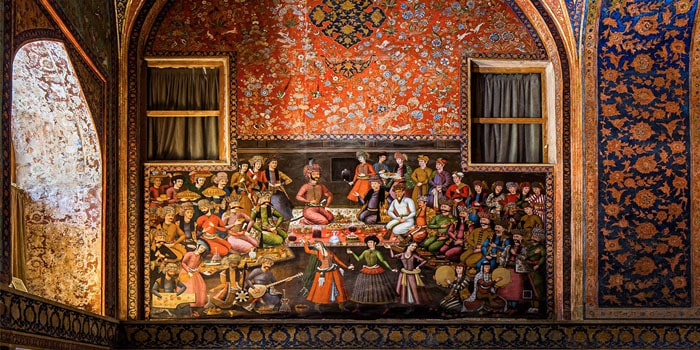
Miniature Persian art
Gilding
Gilding is a decorative border with geometric or plant patterns that are used to decorate the surahs or verses of the Quran, books, paintings, and calligraphy, and is usually accompanied by three colors: gold, azure, and red. This Persian art has also been popular since the time of Mani, with the name Zarnegari.
Tashir
Tashir, as Persian art, consists of decorative or ornamental borders in the text, which in addition to geometrical and plant images can also have animal images (real and legendary) and is usually monochromatic (mostly golden.) The differences between gilding and Tashir are from:
Artists use golden, azure, and red colours in gilding, while tashir is usually monochromatic. They apply gilding only in the margins, while tashir appears both in the margins and within the text. In gilding, artists include only geometric and plant images, but tashir also features animal images along with them.
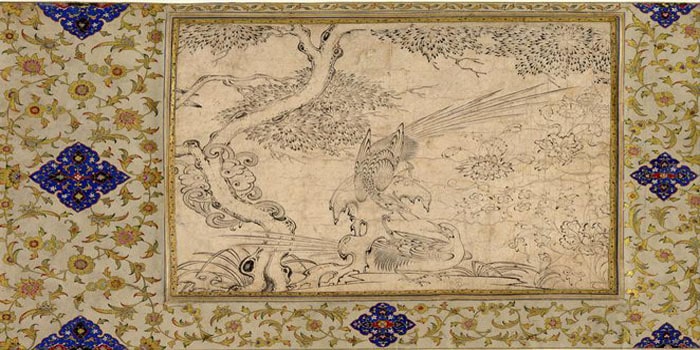
Tashir Persian art
Gol-o-Morgh (Flower and Bird) painting in ancient Persian art
Gol-o-Morgh, literally “flower and bird”, took shape under the Safavids through encounters with European painting from France and Italy and Asian traditions from India and China. It reached its peak in the Qajar period. Today, painters create these delicate compositions of blossoms and songbirds on many surfaces, not just lacquered papier-mâché or wood. Now fully Persian in character, the style evokes spring, renewal, happiness, and joy.
A Short Timeline of Persian Painting
- c. 10,000 BCE: cave paintings of animals and hunters in Lorestan, among the oldest images made on the Persian plateau
- c. 4,000–3,000 BCE: painted pottery of Sialk and Susa with geometric animal and plant motifs
- 3rd century CE: Mani (216–274 CE) creates the Arzhang, the most famous illustrated book of pre-Islamic Persian
- 13th–15th centuries: the great manuscript schools of Shiraz, Tabriz and Herat flourish under the Ilkhanids and Timurids
- c. 1450–1535: Kamal ud-Din Behzad, the most celebrated master of the Persian miniature
- 16th–17th centuries: the Safavid ateliers of Tabriz, Qazvin and Persian Heritage produce masterpiece Shahnamehs
- Today: masters such as Mahmoud Farshchian carry the miniature tradition into contemporary art
Echoes of these ancient works appear across our Persian wall art collection, from Persepolis reliefs recast in ceramic to engraved copper panels.


Comments