


How to Set Up a Sofreh Aghd Yourself: Table Size, Layout and Checklist
- mahyar
- 31 August 2026
- Persian Wedding
- 9 minutes
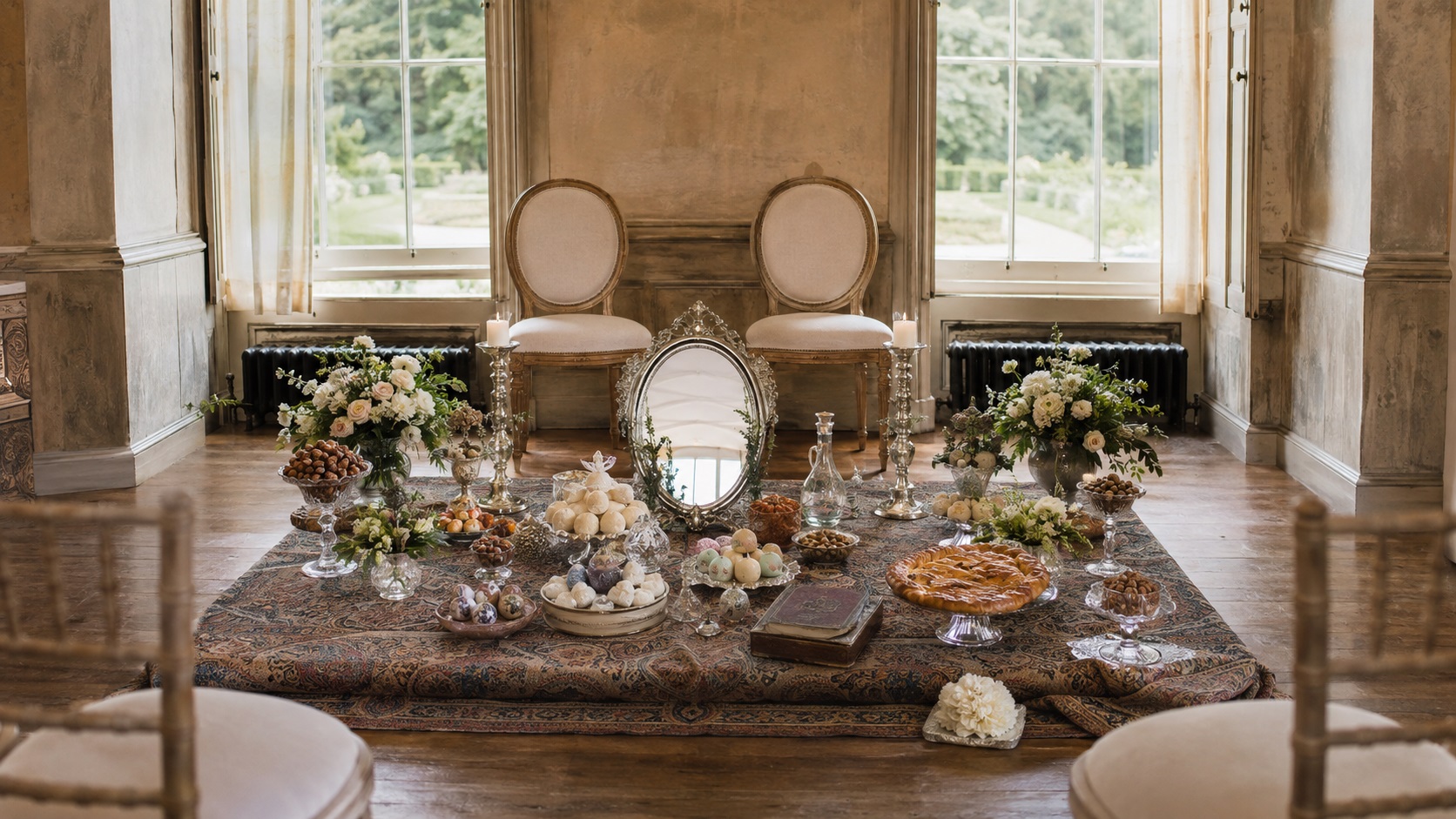
If you want to know how to set up a sofreh aghd, begin with the room rather than the decorations. Confirm the available floor area, mark the couple’s seats, check the view from the guest seating, then choose a floor level spread or low table that fits the space. Build the arrangement around the real measurements of the mirror, candlesticks and serving pieces, not how large they appear in individual product photographs. Once the foundation is fixed, place the central mirror and candlesticks, add symbolic groups in balanced layers, and leave fragile or edible items until late in the setup. The method below gives you a practical checklist, layout order, planning timeline and venue questions for creating the ceremony table yourself.
What Is a Sofreh Aghd?
A Sofreh Aghd is the ceremonial spread placed in front of the couple during the Aghd ceremony. Its objects express wishes for sweetness, abundance, prosperity and a happy shared life, while the exact selection and presentation can reflect each family’s preferences.
The word sofreh refers to the spread itself. It may be arranged at floor level or raised on a low table, with the couple seated facing it. A mirror and candlesticks commonly form the visual centre, while sweets, nuts, decorated eggs, bread, poetry and other symbolic objects complete the setting.
There is no need to treat every online item list as an unchangeable template. Begin with the pieces that matter to your family, then make the layout work in the actual ceremony room. For more cultural context, read What Is a Sofreh Aghd? A Guide to the Persian Wedding Spread and The Persian Wedding Ceremony: More Than a Celebration.
Choose the Right Table Size and Position
The right surface is large enough to hold every chosen object without crowding, but compact enough for the arrangement to read as one complete scene. Its position matters just as much as its width because the couple, guests and photographer all need a clear view.
Measure these four things before ordering furniture or a backdrop:
- Available width: the usable space after allowing for aisles, chairs and venue fixtures.
- Available depth: the distance from the couple’s seats to the guest side of the spread.
- Display height: the table, risers, mirror, candlesticks and any flowers or backdrop.
- Product footprint: the actual width and depth of every large item, including its base.
Make a full scale rehearsal before choosing the final table. Mark the available area on the floor with removable tape, then cut paper rectangles for the mirror set, trays, book and other large objects using their published measurements. Arrange the templates, leave a visible border of cloth, and measure the completed footprint. This gives you a table requirement based on your objects rather than a generic recommendation.
Scale can be deceptive online. A set measuring about 40 cm may look substantial in a close product photograph but appear small across a spread measuring 150 to 200 cm. Compare every product measurement with the full table width and consider how the arrangement will look from the back row, not only from directly in front.
If the mirror and candlesticks will be the focal point, review the dimensions before selecting the supporting pieces. The Farah Persian Silver Mirror and Candle Set is one option to compare when planning this central group. You can also read more about the role of an Persian mirror and candlestick set before deciding how it should sit within the wider arrangement.
Sofreh Aghd Items Checklist and Their Meanings
A useful checklist groups objects by purpose rather than presenting one long shopping list. Start with the foundation and central pieces, then add symbols of sweetness, abundance and family meaning according to the space available.
- Foundation: a Termeh cloth or another chosen textile, placed over the floor or a low table.
- Central group: a mirror and candlesticks, positioned as the main visual anchor.
- Sweetness: sugar cones, rock candy, Noghl and honey, all connected with wishes for sweetness in married life.
- Abundance and prosperity: flatbread, walnuts, almonds and gold coins.
- Growth and family: decorated eggs, often included as fertility symbols.
- Poetry and cultural detail: a Divan of Hafez, Golab, Esfand or wild rue seeds, and a seven spices tray.
- Room setting: seating for the bride and groom, a suitable ceremony backdrop and enough clear space for guests to see the spread.
The specific meaning and importance of each object can vary between families. Ask parents and close relatives which elements they consider essential before you reduce or modernise the list. This is especially useful when more than one person is buying items for the ceremony.
If you want a coordinated starting point, compare the Sofreh Aghd Elegance Collection with the Handcrafted Persian Sofreh Aghd Ceremony Set. Check the current contents and measurements on each product page, then list any family specific additions separately. The wider Persian wedding table collection can help you compare individual pieces and complete arrangements.
How to Set Up a Sofreh Aghd Step by Step
Set up the Sofreh Aghd from the largest structural elements to the smallest decorative details. This order protects fragile pieces, keeps the layout balanced and makes it easier to correct sightline problems before the ceremony begins.
- Mark the couple’s position. Place their seats first and confirm the centre line between them.
- Define the spread. Position the floor covering or low table, then lay the Termeh cloth smoothly with an even visible border.
- Install the backdrop. Complete any approved structure before fragile objects are brought into the setup area.
- Place the mirror. Centre it on the couple’s shared sightline and check reflections from their seated position.
- Add the candlesticks. Place them on either side of the mirror and confirm that their height does not block faces or the guest view.
- Arrange the largest trays and vessels. Distribute their visual weight before filling smaller gaps.
- Group related symbols. Keep sweets together, place nuts and abundance symbols as a clear group, and give the Divan of Hafez a deliberate position rather than using it as filler.
- Add low details at the front. Use smaller bowls and decorative pieces to create depth without hiding the central objects.
- Finish with fragile and edible items. Add decorated eggs, bread, honey and delicate pieces after the main arrangement is stable.
Step back after each main layer. Look from the couple’s seats, the aisle and the furthest guest position. Take a photograph of the successful rehearsal so anyone helping at the venue can reproduce it accurately.
A Practical Sofreh Aghd Setup Timeline
The safest timeline works backwards from the fixed ceremony date and separates ordering, rehearsal and venue installation. Made to order pieces require an additional 2 to 4 weeks before the stated delivery time, so their production status should be checked before styling decisions are finalised.
- Before ordering: confirm the venue space, table type, couple’s seating and essential family items. Record all measurements in one shared document.
- When selecting products: check dimensions, production status, intended use and the destination delivery estimate. Add a buffer rather than planning around the latest possible arrival date.
- When items arrive: inspect every piece, confirm the scale against your floor plan and check whether functional items work as expected.
- Before the event: complete one full rehearsal with the real objects or accurate templates. Photograph the layout and label the packing boxes by setup order.
- At the venue: install the table and backdrop first, then the cloth, mirror group, large vessels, smaller symbols and final edible or fragile details.
If a parent, planner or relative is leading the setup, share the same measurement sheet and rehearsal photograph with everyone. This avoids last minute decisions being made by someone who has only seen individual product images.
How to Plan Your Sofreh Aghd Budget
Plan the budget by separating essential ceremony pieces from visual additions and optional detail. Spend first on the objects that carry family meaning or dominate the room, then decide what can be bought, borrowed, hired or sourced near the venue.
A simple three part method keeps the plan controlled:
- Core ceremony layer: cloth, mirror, candlesticks, the chosen book, sweetness symbols and seating.
- Visibility layer: suitable table or risers, lighting, backdrop and any large pieces needed to make the arrangement legible in the room.
- Optional styling layer: extra vessels, flowers, duplicated sweets and decorative details that can be reduced without removing the central meaning.
Ask for the price, dimensions, production status and contents of each product in writing before comparing options. A complete package may simplify coordination, while individually selected pieces may give the family more control over style and meaning. The better choice is the one that fits the measured layout and preparation time, not simply the one that contains the most objects.
Do not spend the full budget before the venue rehearsal. Keep room for the practical items that become visible only after measuring, such as the correct surface, safe candle solution, secure backdrop and local edible elements.
Setting Up a Sofreh Aghd in an English Wedding Venue
A Sofreh Aghd can be arranged successfully in a traditional English wedding venue if the layout is planned around the room’s access, furniture and sightlines. Confirm the venue rules before ordering the table or backdrop, particularly where candles, food and installation time are concerned.
Send the venue a short written checklist:
- What time can the setup team enter the ceremony room?
- Can existing furniture be moved, and who is responsible for moving it?
- Is a floor level spread or low table permitted in the chosen position?
- Are real candles allowed, or must an alternative be used?
- How may a backdrop be secured without marking walls or floors?
- Are there restrictions on uncovered food, nuts or loose decorative material?
- Where must aisles and safety routes remain clear?
- When must the arrangement be removed?
Place the couple’s seats first, then centre the spread directly in front of them. Keep tall pieces near the rear or sides and lower objects towards the guest side. Before approving the position, sit in the back row and at both outer edges of the guest seating. If the mirror, the couple or the main symbolic groups disappear from view, change the height or angle rather than adding more decoration.
Room character does not have to compete with the Persian setting. In an ornate manor or historic hall, a controlled palette and a clear central group can sit comfortably against existing architecture. In a simpler room, the Termeh cloth, mirror group and ceremony backdrop can create the visual focus.
Our Experience at Persis Collection
Our experience shows that timing, scale and product function create more difficulty than the item checklist itself. Families are more confident when they verify these three points before ordering and complete a measured rehearsal before travelling to the venue.
The person buying the table pieces is not always the couple. Parents, including mothers preparing the Sofreh Aghd for a daughter’s wedding, may lead the order and setup. A shared plan should therefore record who is choosing the symbolism, who has the venue measurements and who will install each layer.
Production time is the most important operational detail for a fixed wedding date. Pieces marked as made to order need 2 to 4 weeks in addition to the normal delivery estimate. Customer feedback confirms that this wait is experienced in real orders, even when the finished piece and secure packaging are appreciated.
Another recurring expectation gap is the difference between decorative and functional objects. Before choosing candlesticks, ask whether they accept real candles and confirm the required candle diameter. The same principle applies to trays, vessels and other pieces that may look functional in a photograph but are intended primarily for display.
Scale needs the same attention. Compare each listed measurement with the full spread and test it from the guest viewpoint. Customer feedback across different product categories has shown how easily photographed scale can be interpreted differently from the object received. Secure packaging and responsive support are repeatedly valued, but early measurement and inspection remain essential for a date specific ceremony.
Conclusion
A successful Sofreh Aghd begins with measurements, sightlines and a clear setup order. Mark the couple’s seats, calculate the display footprint from real product dimensions, choose the family’s essential symbols, rehearse the arrangement and confirm every venue rule in writing. Allow additional time for made to order pieces and inspect functional details such as candle fit before the event.
Your next step is to create one measurement sheet containing the room dimensions, table footprint, product sizes and setup responsibilities. You can then compare suitable pieces in the Persian wedding table collection without buying items that are too large, too small or too late for the planned ceremony.
Frequently Asked Questions
What is a Sofreh Aghd?
A Sofreh Aghd is the symbolic spread placed before the couple during the Aghd ceremony. It combines a foundation cloth, a central mirror and candlesticks, and selected objects associated with sweetness, abundance, prosperity and family wishes.
What is the proper table setting for a Persian wedding?
The proper setting places the couple facing a balanced spread with a clear central mirror group and visible symbolic objects. The exact list and style can vary by family, so correct scale, meaning and sightlines matter more than copying one photograph.
What do you put on a Sofreh Aghd?
A Sofreh Aghd commonly includes a Termeh cloth, mirror and candlesticks, sugar cones, rock candy, Noghl, honey, decorated eggs, nuts, bread, Golab, Esfand, a Divan of Hafez, gold coins and a seven spices tray. Families may select, add or omit items according to their own preferences.
How do you set up a Sofreh Aghd yourself?
Set it up by fixing the couple’s seating and display footprint first, then adding the cloth, backdrop, mirror, candlesticks, large vessels, grouped symbols and final fragile items. Rehearse the full layout before the event and photograph it for the venue setup team.
What does a simple Sofreh Aghd look like?
A simple Sofreh Aghd uses one strong cloth, a central mirror and candle group, and a carefully edited selection of meaningful objects. Clear spacing and consistent scale usually make a smaller selection look more deliberate than a crowded surface.
What size table do you need for a Sofreh Aghd?
You need a table that fits the measured footprint of your chosen objects while leaving visible cloth and clear space between groups. Make full size paper templates from the product measurements, arrange them at home, then measure the final width and depth before choosing the table.
Should you hire a Sofreh Aghd stylist or set it up yourself?
You can set it up yourself if you have reliable venue measurements, enough preparation time and someone responsible for installation. A stylist may be useful when access time is short, the backdrop is complex or no family member can supervise the rehearsal and venue setup.
Can a Sofreh Aghd be set up in a traditional English wedding venue?
Yes, it can be set up in a traditional English wedding venue when the arrangement follows the room’s access, candle, food, furniture and backdrop rules. Measure the ceremony area and test the view from multiple guest seats before confirming the position.
Where should the Sofreh Aghd be placed so all guests can see the ceremony?
Place it directly in front of the couple with the mirror centred on their shared sightline and the tallest pieces kept away from faces. Test the layout from the back row and both sides of the seating, then lower or reposition anything that blocks the couple or central symbols.


Comments