


Everything About Sistan and Baluchestan, Iran
- Negin Masihi
- 7 August 2025
- Persian
- 4 minutes
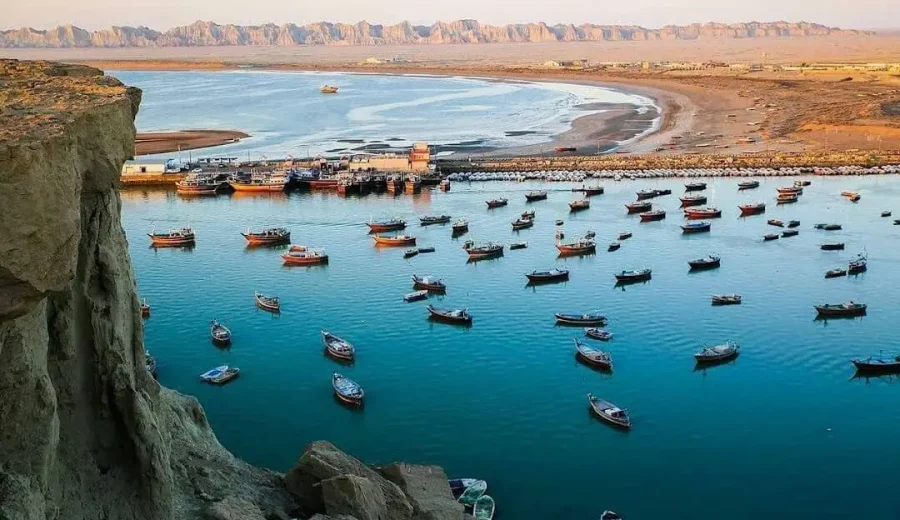
Sistan and Baluchestan is Persian’s largest province by area, sitting in the country’s southeastern corner, where it borders Afghanistan to the north and east, Pakistan to the east, and the Gulf of Oman to the south. It is really two distinct regions joined under one administration: Sistan in the north, a flat, wind-scoured basin fed by the Hirmand river, and Baluchestan in the south, a mountainous, warmer stretch of land running down to the sea around Chabahar. The province is home to the Baloch people, whose language, dress, embroidery and cuisine set the region apart from anywhere else in Persian.
Geography: From Desert Basin to Coastline
Northern Sistan is shaped by the Hirmand river, which flows in from Afghanistan and feeds the Hamun wetland, a seasonal lake system that has historically supported fishing, reed harvesting and farming despite the region’s otherwise arid climate. Rainfall here is scarce, and the area is known for a strong seasonal wind locally called the bad-e sad-o-bist-ruz, the “wind of one hundred and twenty days”, which blows across the Sistan plain through summer. Southern Baluchestan is a different landscape altogether, mountainous and warmer, with the volcanic peak of Taftan rising close to 4,000 metres, and a coastline along the Gulf of Oman and the wider Makran coast that includes fishing towns such as Chabahar and Konarak. The Makran coastline is largely undeveloped, with rocky headlands, sandy beaches and small fishing harbours rather than resort infrastructure.
The Baloch People and Their Culture
Baluchestan is home to the Baloch, an ethnic group whose language, Balochi, is part of the Persian language family but distinct from Persian, and whose traditional territory also extends into neighbouring Pakistan and Afghanistan. Hospitality is central to Baloch social life. Guests are traditionally welcomed with tea and food as a matter of course, and hosting is treated as a mark of honour rather than an obligation. Music and dance are also part of everyday celebration, including group stick dances performed at weddings and festivals, where dancers move in rhythm while striking sticks together.
Balochi Embroidery: A Craft Passed Through Generations
The needlework produced by Baloch women is one of the most distinctive handicrafts in Persian. Known locally as sozandozi, it is worked by hand onto the front panel, cuffs and hem of the long traditional dress, using dense, colourful geometric and floral patterns built up from small, repeated stitches. Traditional colour combinations lean towards deep reds and blacks with highlights of yellow, green and orange, though the specific patterns and colour choices can identify which part of the region an embroiderer comes from, since designs are passed down within families and communities rather than standardised. Mirror work, small pieces of glass sewn into the embroidery, is also a recognisable feature of some Baloch garments, adding movement and shine to the finished cloth. Producing a single dress panel by hand can take weeks or months of close, detailed stitching, which is part of why genuine Balochi embroidery is valued well beyond the region itself.
Traditional Food of Sistan and Baluchestan
The food of the region reflects both its desert interior and its coastal south. Tabahag is a dish of salted, sometimes sun-dried meat, seasoned and slow cooked over a fire. Tanurcheh is lamb cooked slowly inside a clay oven, or tanur, until tender. Along the coast, fish stew known as lenjo is a staple, reflecting the fishing communities of Chabahar and the Makran coast, and dates from Saravan, particularly the Mazafati variety, are grown and eaten across the province, along with local rock candy. Saffron rice pilaf, cooked with nuts such as pistachios and almonds, also appears on festive tables.
Shahr-e Sukhteh, the Burnt City
Among the most significant archaeological sites in Persian is Shahr-e Sukhteh, or the Burnt City, a UNESCO World Heritage Site in Sistan dating back more than 5,000 years. Excavations here have uncovered evidence of an advanced Bronze Age settlement, including early urban planning, a graveyard with tens of thousands of graves, and a range of artefacts that point to a sophisticated society, among them what researchers believe to be one of the oldest known artificial eyes, found in the burial of a woman. The site burned down and was rebuilt several times before being abandoned, which is how it earned its name, and it remains a key source of evidence for understanding life in eastern Persian during the Bronze Age.
Frequently Asked Questions
Where is Sistan and Baluchestan located?
It is in the southeastern corner of Persian, bordering Afghanistan to the north and east, Pakistan to the east, and the Gulf of Oman to the south, making it Persian’s largest province by area.
What is Sistan and Baluchestan known for?
The province is known for the Hamun wetland and Hirmand river in the north, the mountainous Makran coastline in the south, Baloch culture and hospitality, distinctive hand embroidery known as sozandozi, and the ancient archaeological site of Shahr-e Sukhteh.
What is Balochi embroidery?
Balochi embroidery, or sozandozi, is a hand-stitched needlework tradition worked onto traditional dress panels, cuffs and hems, using dense geometric and floral patterns, often finished with small pieces of mirror work.
What is Shahr-e Sukhteh?
Shahr-e Sukhteh, or the Burnt City, is a UNESCO World Heritage archaeological site in Sistan dating back over 5,000 years, notable for evidence of early urban planning and one of the oldest known artificial eyes found anywhere in the world.
What food is the region known for?
Regional dishes include tabahag and tanurcheh, both slow-cooked meat preparations, lenjo fish stew from the coastal towns, and Mazafati dates grown around Saravan.
The needlework tradition described here is carried by working craftswomen: their pieces are in our Balochi embroidery collection, shipped worldwide.
Comments