


Persian Rug Sizes: How to Choose the Right Size for Any Room
- mahyar
- 26 August 2026
- Persian Rug
- 5 minutes
Choosing the right size of Persian rug can be trickier than it sounds. A rug that looks generous in a shop or in a product photo can suddenly feel too small once it is down in your own room, and a rug bought purely on colour and pattern can end up crowding a hallway or leaving furniture legs dangling over the edge. This guide walks through the common Persian rug sizes, how to match a size to different rooms, and how to measure properly before you buy, so you can choose with confidence rather than guesswork.
What sizes do Persian rugs actually come in?
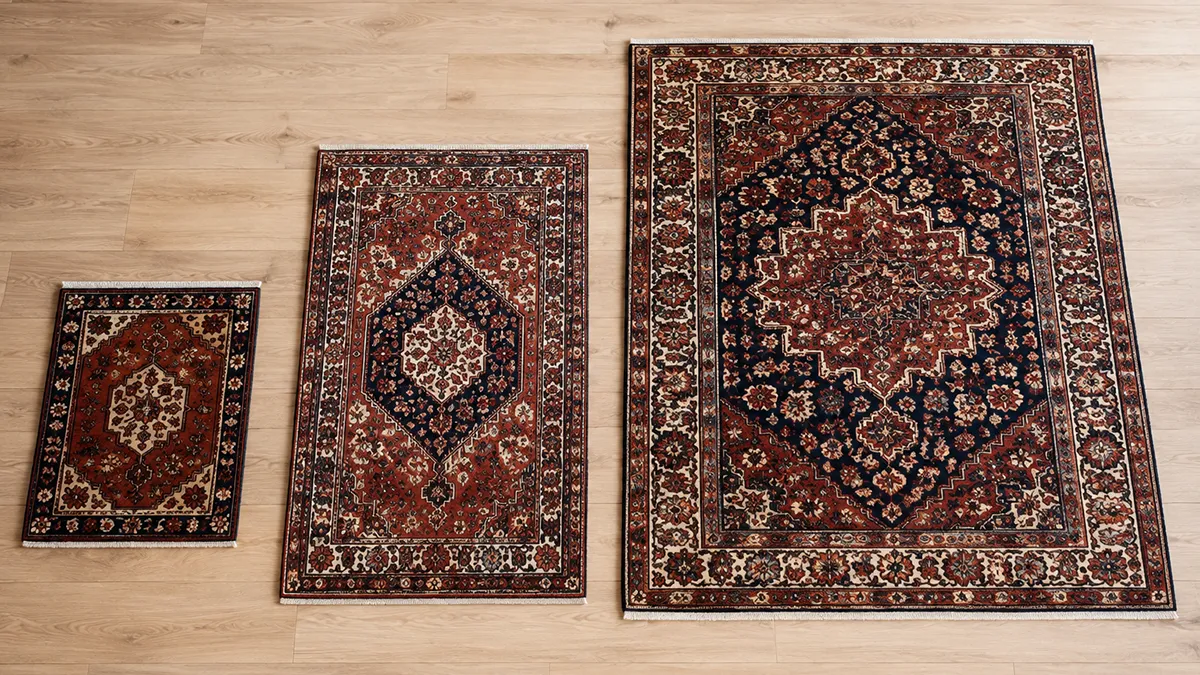
Persian rugs are traditionally woven in a set of recognised sizes, each with its own name and typical use. A poshti is the smallest, often used as an accent piece beside a chair or bed rather than as a floor covering for a whole room. A zaronim is a mid-size rug, roughly in the range of a large armchair rug, well suited to smaller sitting areas or as a layered piece. A dozar is larger again, one of the most popular sizes for a standard living room or dining area. Beyond these, you will also find kelleghi (wide, room-sized rugs) and kenareh runners, which are long and narrow and made specifically for hallways and corridors. Knowing these names helps when browsing, since sellers will often use them rather than exact measurements alone.
How do I choose a rug size for a living room?
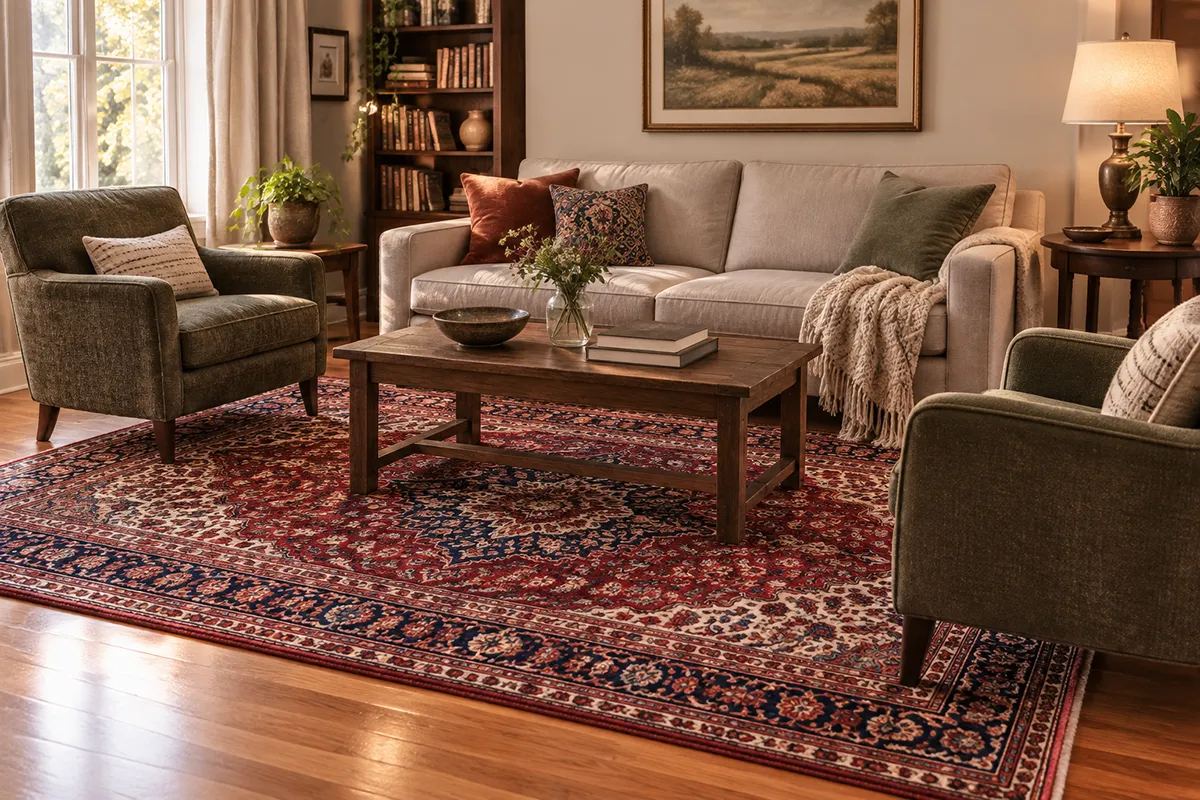
The general rule for a living room is that the rug should be large enough for at least the front legs of your main seating, sofas and armchairs, to rest on it, which visually anchors the seating area rather than leaving the rug looking like an island in the middle of the floor. Leaving a consistent margin of bare floor around the rug, typically enough to frame the seating group without the rug touching the walls, tends to look most balanced. If your living room is on the smaller side, a zaronim or a smaller dozar can still work well if you position it correctly under the coffee table and the front edges of the sofas.
What size rug works under a dining table?
For a dining table, the rug needs to be large enough that all four chair legs stay on the rug even when someone pulls a chair out to sit down or stand up. As a practical guide, allow at least an extra 60 to 70 centimetres of rug beyond each edge of the table so the chairs do not catch on the rug’s edge or fall half off it. This usually means a dozar or a larger size is needed for anything beyond a small table for two, since a rug that only matches the table’s own footprint will almost always end up too small once chairs are pulled out.
Which sizes suit bedrooms, hallways and entrances?
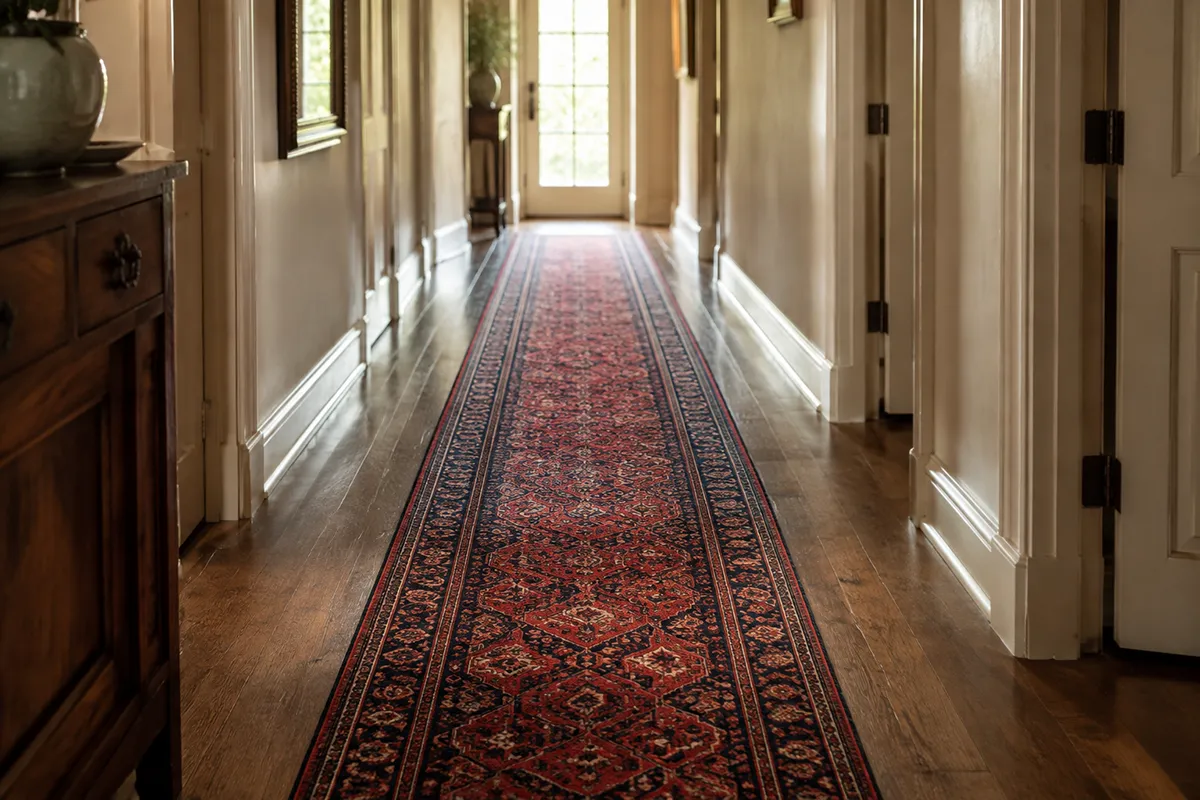
In a bedroom, a common approach is to place a rug so it extends out from at least the sides and foot of the bed, giving a soft surface to step onto, rather than centring a small rug entirely underneath where much of it is hidden. A zaronim or dozar placed this way works well for most bedrooms, while a pair of smaller poshti rugs on either side of the bed is a popular alternative. For hallways and corridors, a kenareh runner is the natural choice, since its long, narrow shape is designed specifically to fit these spaces while leaving an even margin of floor on both sides along its length. Entrances often suit a similar runner or a smaller rug, depending on the width of the space.
How should I measure before buying?
Before buying, it is worth marking out the exact area you have in mind directly on your floor, using strips of masking tape at the corners and a tape measure to check the dimensions, rather than relying on guesswork or a rough mental estimate. Leave the tape down for a day or two if you can, so you can see how the marked area feels as you walk around the room and past any furniture. It is also worth measuring any doorways or staircases the rug will need to pass through when it is delivered, particularly for larger, heavier sizes, since a rolled Persian rug can be bulkier than expected. Always compare the exact measurements given for a specific rug rather than assuming every rug labelled as a particular size, such as a dozar, will be identical, since sizes can vary slightly between individual handmade pieces.
Does size affect the pattern and the price?
Size has a real effect on both pattern and price. Larger rugs generally take considerably longer to hand-knot, so price tends to increase more than proportionally with size rather than scaling in a simple straight line. Pattern also changes with size, since a central medallion design that looks balanced and generous on a dozar can look cramped if squeezed onto a small poshti, while an all-over repeating pattern tends to scale more comfortably across different sizes. When a larger rug is correctly proportioned in a room, with furniture legs resting on the pile and a clear margin of floor visible around the seating area, the pattern reads properly as a single design rather than being cut off awkwardly at the rug’s edge.
Conclusion
Getting the size right is one of the most important decisions when buying a Persian rug, often mattering as much as the pattern or colour, since even a beautiful rug will look wrong in a room if it is the wrong scale for the space. Measuring your room properly, thinking about how furniture will sit on the rug, and understanding the traditional size names will make choosing far easier. If you would also like to understand what sets a genuine Persian rug apart from other types, our guide on how to choose an authentic Persian rug is a good next read, and if you are deciding between styles, our comparison of Persian rugs and Turkish rugs covers the key differences. When you are ready to browse, you can explore our full range of Persian rugs.
Frequently Asked Questions
What is the most popular Persian rug size for a living room?
A dozar is one of the most popular sizes for a standard living room, since it is large enough for the front legs of a sofa and armchairs to rest on while still leaving a reasonable margin of floor around it.
How much bigger should a rug be than a dining table?
Allow at least an extra 60 to 70 centimetres of rug beyond each edge of the table so that all four chair legs stay on the rug even when chairs are pulled out.
Can I use two smaller rugs instead of one large one?
Yes, this is a common approach in bedrooms, where a pair of smaller poshti rugs placed on either side of the bed can work just as well as one larger rug placed underneath.
Do all rugs labelled the same size have identical measurements?
Not exactly. Because Persian rugs are handmade, sizes can vary slightly between individual pieces, so it is always worth checking the exact measurements given for the specific rug you are considering rather than assuming.
Is a runner rug only suitable for hallways?
A kenareh runner is designed primarily for hallways and corridors, but the same long, narrow shape also works well in entrances and can suit narrow galley kitchens or the space at the foot of a bed.
Comments