


Traditional Iranian Games and Puzzles for Family Evenings
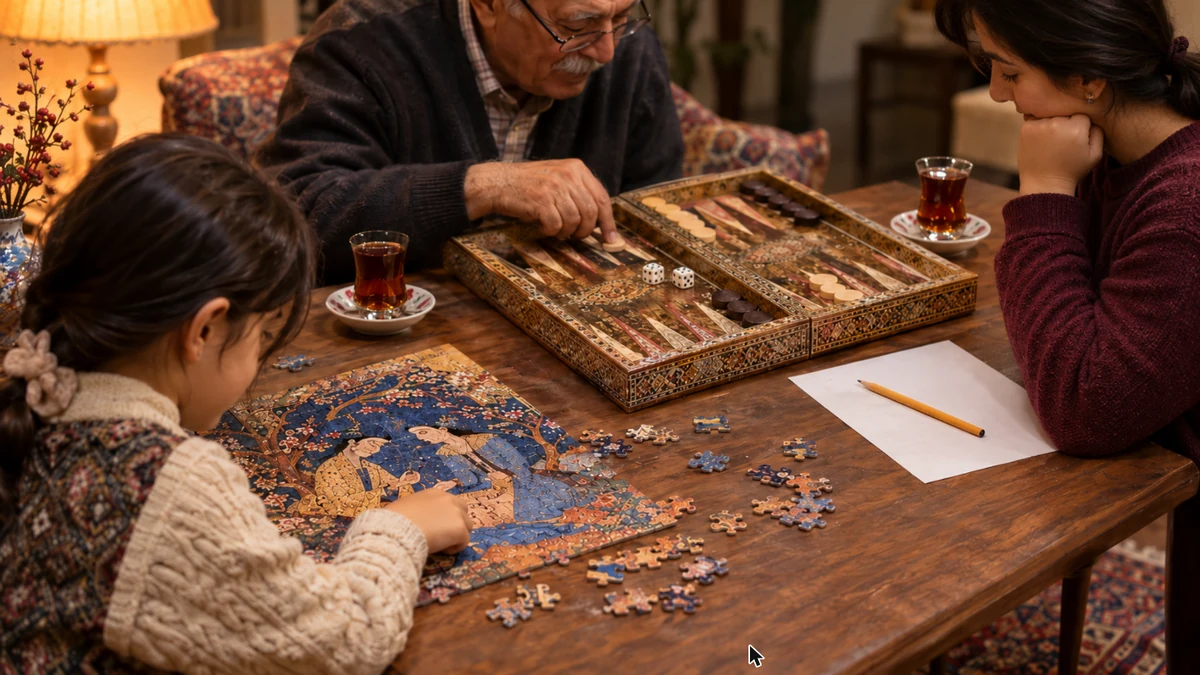
Traditional Persian games bring families together through simple challenges, shared stories and friendly competition. Some need a board and dice. Others need only paper, a coin or a pack of cards. Families can play takhteh nard, chess, Esm-e Famil or Gol Ya Pooch in a single evening. Persian puzzles offer another way to spend time together while exploring Persian stories and places. The best choice depends on the players’ ages, the time available and what everyone enjoys. This guide explains what you need for each activity and how to plan an evening that works for different ages. You can also explore the collection of Persian games and puzzles at Persis Collection.
Traditional Persian Games at a Glance: What Can Your Family Play Tonight?
The easiest way to choose a family game is to check the number of players, their ages and the time available. Some traditional Persian games take only a few minutes per round. Others offer a longer challenge for two players or a shared puzzle project.
The ages and times below are practical guides, not fixed rules. Children may need help from an adult, especially when learning a new game.
| Game or Activity | Players | Suggested Age | Usual Time | What You Need |
|---|---|---|---|---|
| takhteh nard | 2 | About 7+ | 10 to 30 minutes | Backgammon board, 30 pieces and 2 dice |
| Chess | 2 | About 6+ | 20 to 60 minutes | Chessboard and chess pieces |
| Esm-e Famil | 2 or more | About 8+ | A few minutes per round | Paper and pencils |
| Gol Ya Pooch | 4 or more | About 5+ | A few minutes per round | A small coin or token |
| Pasur | 2 to 4 | About 10+ | 20 to 30 minutes | A standard pack of playing cards |
| Shelem | Not stated | Not stated | Not stated | Playing cards |
| Amirza word game | Not stated | Not stated | Not stated | Amirza game set |
| 270 piece mythology puzzle | 1 to 4 | 8+ | Usually one evening | 270 piece jigsaw puzzle |
| 1000 piece historical puzzle | 1 to 4 | Not stated | Usually several evenings | 1000 piece jigsaw puzzle |
| Ali Qapu 3D puzzle | Not stated | 7+ | Usually one sitting | 42 piece wooden puzzle kit |
For a short family game night, start with Gol Ya Pooch or Esm-e Famil. Choose takhteh nard or chess when two people want a longer game. A Persian puzzle game suits a family that prefers working towards one shared result.
Classic Persian Games for Two Players
takhteh nard and chess are two familiar choices for a quiet evening with one other person. Both use boards, but they ask players to think in different ways. One combines dice with decisions, while the other centres on planning each move.
takhteh nard: A Familiar Game of Dice and Strategy
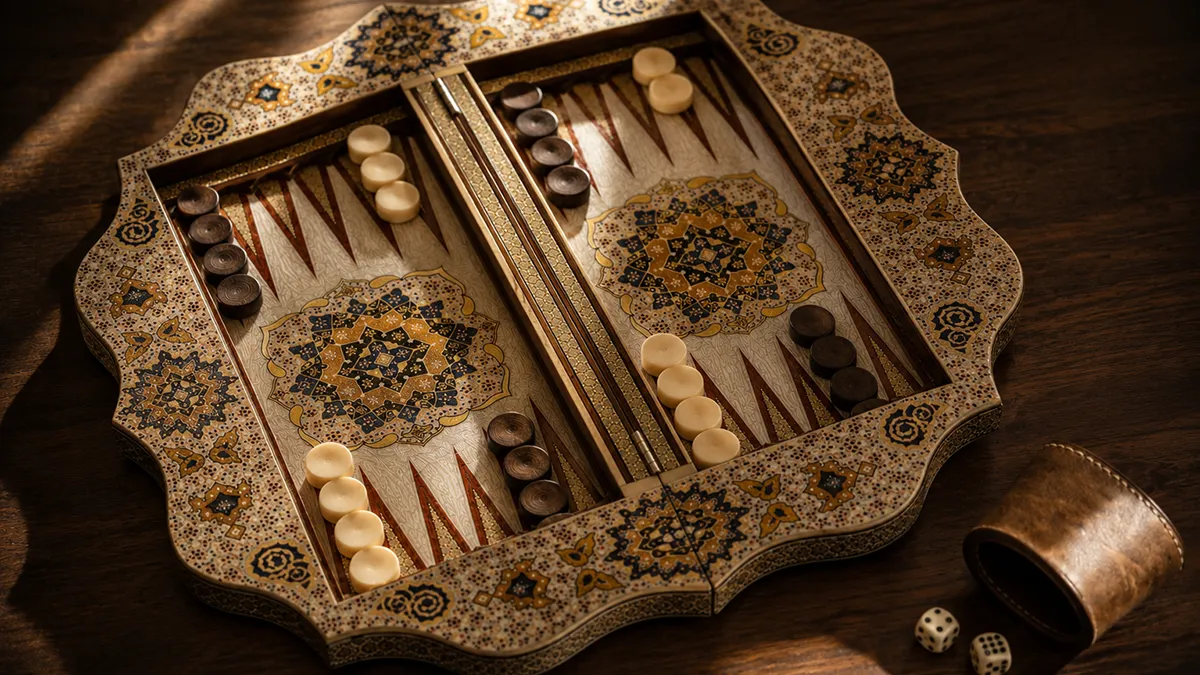
takhteh nard is the Persian name for backgammon. Two players move their pieces around a board according to the dice. Each player has 15 pieces, and the board has 24 points.
A game usually takes about 10 to 30 minutes. Children from around seven can begin learning with help. The mix of chance and decisions makes every round different.
Persian backgammon also has a long craft tradition. Some boards are decorated with Khatam, a Persian craft that uses tiny pieces of material to form detailed geometric patterns.
For more background, read our guide to the history and craft of Persian backgammon. New players can also follow the standard starting position for a backgammon board.
For families who enjoy traditional craftsmanship, the handmade Khatam board with a Chogan design offers backgammon on one side and chess on the other. Chogan is a traditional Persian horseback game, and its imagery adds a cultural detail to the board.
Chess and Shatranj: A Game Shared Across Generations
Chess is a useful choice when two family members enjoy thoughtful, slower games. The modern board has 64 squares, and a game often lasts 20 to 60 minutes. Children can begin learning the basic moves from around six.
Shatranj is a historical form of chess associated with Persia. Chess travelled from India to Persian and later spread westwards. The English words check and checkmate also have roots in the Persian words shah and shah mat.
Modern chess and historical Shatranj are not identical games. For an introduction to their history, see our guide to chess in Persia and its rules.
A two sided board can be practical for a family that enjoys both games. The handmade Khatam board described above provides this choice without needing two separate boards.
Group Games That Need Nothing but Paper, a Coin or a Pack of Cards
Many traditional Persian games are easy to organise without a special board. They work well when several people want to join in. Some test words and memory, while others rely on quick guesses.
Esm-e Famil: The Persian Name and Word Game
Esm-e Famil is a familiar Persian word game played with paper and pencils. The name refers to first names and family names, two common categories in the game. It is a simple way to practise writing and recall words.
Players first choose a letter. Each person then writes a name, family name, city, food and animal beginning with that letter. The family can check the answers together after each round.
Two or more people can play. A round usually takes a few minutes. It suits children from around eight who can already write.
For families raising children with more than one language, the categories can also open conversations about Persian names, cities and everyday words. This makes it a useful activity alongside other ways of sharing Persian culture at home.
Gol Ya Pooch: A Simple Team Guessing Game
Gol Ya Pooch is a team guessing game that needs only a small object. One team hides a coin or token inside a closed hand. The other team tries to identify where it is hidden.
It works best with four or more players divided into two teams. Each round can take only a few minutes. Children from around five can join with help.
The game is especially useful when family members have different ages. Younger children can enjoy making guesses, while older players can help organise the teams.
Pasur and Other Card Games
Pasur is a traditional card game played with an ordinary pack of playing cards. It usually involves two to four players and takes about 20 to 30 minutes. It is a reasonable option for children from around ten who are comfortable following card game rules.
Shelem is another card game associated with Persian family gatherings. It can offer a different activity for people who already enjoy playing cards. Its rules and playing arrangements are not covered here.
Card games can also be part of wider Persian home traditions. Our article on Persian fortune telling with playing cards explores another cultural use of cards.
Amirza, an Persian Word Game for the Table
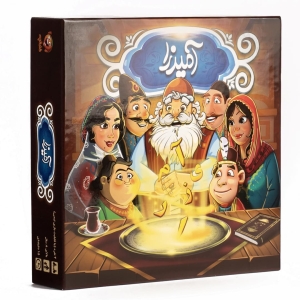
Amirza offers a more structured word game for families who enjoy working with letters. Unlike Esm-e Famil, it comes with its own set of playing materials. It is an option for people who prefer a prepared tabletop activity.
The Amirza letter and word game includes 16 Amirza cards, 120 letter tiles, 40 coins, a fabric bag, two pencils, 50 sheets and a rulebook.
At Persis Collection, Amirza is prepared to order. The supplied product details do not confirm a minimum age, player count or the language of the rulebook. Families should check whether the game suits their needs before choosing it.
Persian Puzzles That Bring Stories and Places to the Table
Persian puzzles give families a shared task without the need to compete. They also create opportunities to talk about Persian stories, landmarks and art. Some can be completed in one evening, while larger designs offer a project across several evenings.
Explore Persian Stories Through a 270 Piece Puzzle
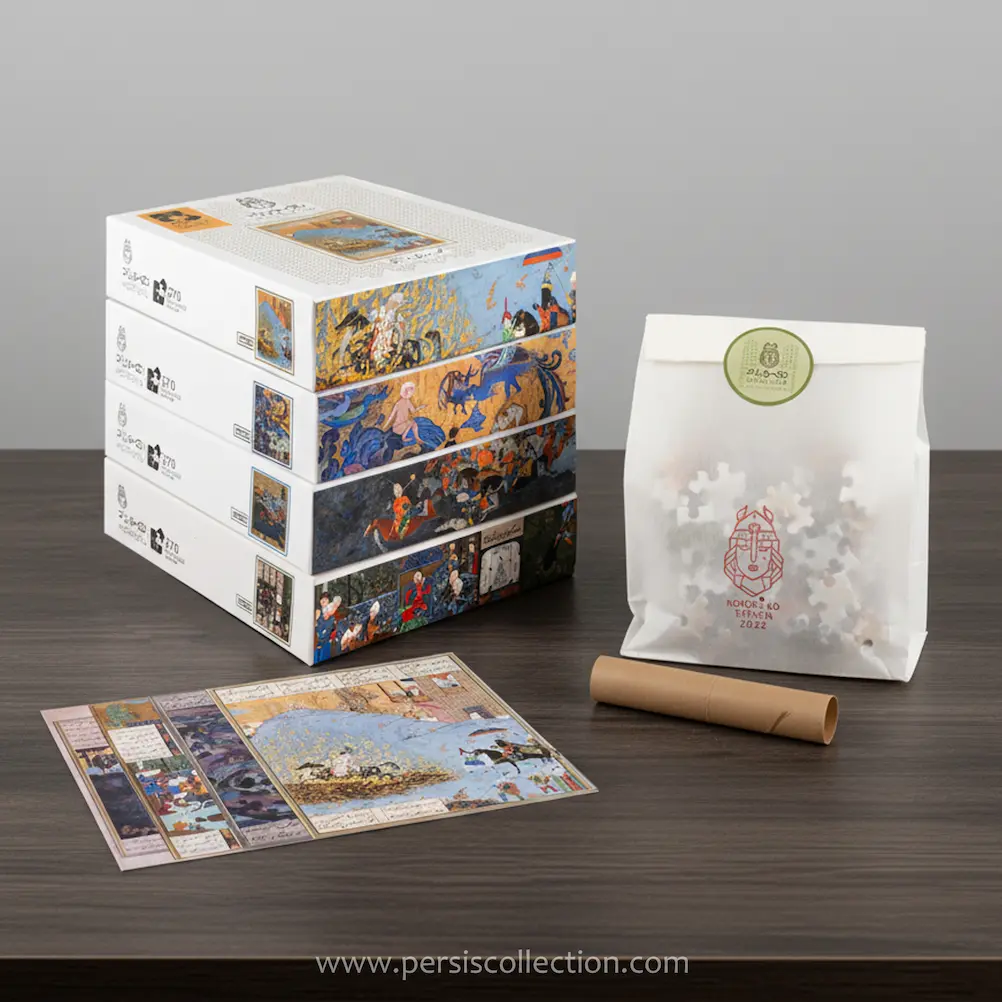
The 270 piece Persian mythology jigsaw introduces characters from Persian storytelling. Its themes include Zaal, Simorgh and the journey of Siavash. These stories are linked to the wider world of Persian epic literature.
The puzzle contains 270 pieces and measures 30 by 45 centimetres when complete. It has both Persian and English text and is suitable for ages eight and above, according to the product details.
One to four people can work on it, usually over an evening. Adults can help children identify the characters and discuss the stories shown in the artwork.
Its bilingual format is particularly useful for families who want children to encounter Persian alongside English. The picture becomes a starting point for conversation rather than only a task to finish.
Discover Persian Landmarks with a 1000 Piece Jigsaw
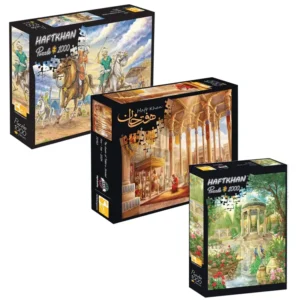
A larger puzzle is a good choice for families who enjoy returning to the same activity. The 1000 piece puzzle of Persian landmarks comes in three designs: Hafezieh, Naqsh-e Jahan and Persepolis.
Each finished puzzle measures 70 by 50 centimetres. One to four people can work on it, usually across several evenings.
Families can use the images to introduce children to places in Persian. Hafezieh connects to the poet Hafez, Naqsh-e Jahan to Persian Heritage, and Persepolis to ancient Persian architecture.
Choose a space where the puzzle can remain undisturbed between sessions. The product details do not state a recommended minimum age, so adults should judge whether the piece count suits the children taking part.
Build Ali Qapu with a 3D Wooden Puzzle
A three dimensional puzzle offers a different kind of activity. Instead of completing a flat picture, the family builds a small model with separate wooden pieces.
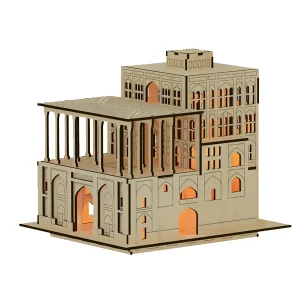
The wooden Ali Qapu palace puzzle has 42 pieces. It is based on Ali Qapu, a building associated with the Safavid period in Persian.
The completed model measures 207 by 173 by 180 millimetres. It is suitable for ages seven and above, according to the product details. Assembly usually takes one sitting.
Once built, the model also works as a night lamp. This gives the finished project a place in the home after the activity ends.
How to Plan a Persian Family Game Night for Different Ages
A good family evening does not need a long programme. Start with one activity everyone understands, then offer smaller choices. This keeps the evening comfortable for people with different ages and interests.
Start with a Quick Group Game
Begin with Gol Ya Pooch when four or more people are present. It requires little preparation and gives everyone a chance to join. If the children can write, Esm-e Famil is another easy starting point.
For a family with older children, a word game can also work well. Keep the first activity short so that people can decide what they want to do next.
Give Younger and Older Players Different Roles
Not everyone has to play the same game at once. Two people might choose chess or takhteh nard while others work on a puzzle. Younger children can help sort puzzle pieces or watch an older family member demonstrate a move.
Choose tasks that match each child’s skills. There is no need to make every activity competitive or expect everyone to finish at the same time.
Finish with a Puzzle Everyone Can Return To
A puzzle can bring the group back around one table. The mythology jigsaw works well as a single evening project, while the larger historical puzzle can stay in progress for several days.
These activities can suit long winter evenings, Nowruz family visits and Yalda gatherings. They also work on ordinary weekends throughout the year.
The History Behind Some Traditional Persian Games
Some familiar Persian games have roots in much older traditions. Their history adds another subject for families to explore, but the exact origins of individual games are not always certain.
Nard is the Persian name for backgammon. According to Encyclopaedia Iranica, Persian tradition places the invention of Nard in either the third or sixth century AD. This is a traditional account, rather than proof of one exact date.
Archaeological finds also show that board games were played in the region long ago. Archaeology magazine describes a Bronze Age board found at Shahr-e Sukhteh in south eastern Persian, with 60 pieces and dice. It dates to around 4,600 years ago and is widely regarded as a possible early form of backgammon.
Shatranj provides another link between Persian history and games played today. For a wider look at inventions and activities associated with ancient Persia, read our guide to ancient Persian inventions and games.
What We Have Learned From Our Customers
At Persis Collection, we see different reasons for choosing puzzles and handmade games. Our WooCommerce order records show that the Persian mythology puzzle was ordered 86 times between its introduction in September 2025 and 21 November 2026. It is our most ordered item in this games and puzzles range for that period.
Over their respective recorded periods, Amirza received 10 orders, the Ali Qapu puzzle received six, and the handmade Chogan backgammon board received five.
Our orders show a clear difference between everyday puzzle purchases and handmade boards. Puzzles are ordered more often, while handmade boards are commonly chosen as individual gifts.
We have also found that the bilingual mythology puzzle is a popular choice among Persian parents living outside Persian. Its mix of English, Persian and familiar stories makes it particularly relevant to those families.
Some handmade boards are made to order. Orders are checked, packed and dispatched through our London warehouse, with tracked delivery to the UK, USA, Canada and Europe.
Choosing a Persian Game or Puzzle for Your Family
Choose an activity that fits the people around your table. For younger groups, a simple guessing game or smaller puzzle may be easiest. For two players, chess or takhteh nard offers more time to think. Families interested in language, stories or places may prefer word games and puzzles.
You can see four of these games and puzzles below.
A family evening can be as simple as sharing a word game, learning a new move or completing part of a puzzle. Explore the Persian games and puzzles collection to choose something that suits your family and the traditions you enjoy sharing.
Frequently Asked Questions
What board games do Iranians play?
Iranians play takhteh nard, chess and other traditional tabletop games. Persian board games include both familiar international games and locally valued traditions. Families also enjoy simple word games, guessing games and puzzles.
Is backgammon a Persian game?
Backgammon has a long history in Persian culture, where it is known as Nard or takhteh nard. Historical traditions link it closely to Persian. However, the exact origin of modern backgammon cannot be assigned with certainty to one place.
What are some traditional Persian board games?
takhteh nard and the historical chess form Shatranj are important examples. Persian board games also include traditional forms of play that families have shared across generations. Modern chess and backgammon remain practical choices for an evening at home.
Is Shatranj still played?
Shatranj is mainly known today as a historical form of chess. Modern chess uses different rules, so the two should not be treated as identical. Families interested in Shatranj can begin by learning about its history before exploring its older rules.
What did ancient Persians do for fun?
Games were among the activities enjoyed in ancient Persia. Archaeological evidence from Shahr-e Sukhteh points to early board games. Historical Persian traditions also include Nard and Chogan, a horseback game recognised by UNESCO as intangible cultural heritage in 2017.
What are some popular games from Persian?
Popular traditional choices include takhteh nard, Esm-e Famil, Gol Ya Pooch and Pasur. Some need only paper or a small object, making them easy to organise at home. Puzzles featuring Persian stories and landmarks offer another activity for children and adults to share.


Comments